


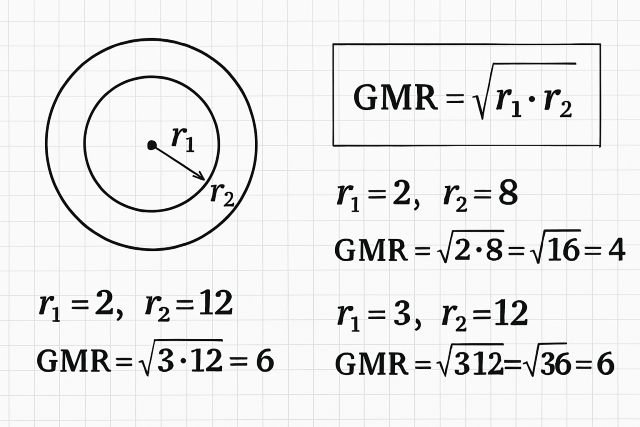
The Geometric Mean Radius (GMR) is a fundamental concept in electrical engineering, mathematics, and physics — especially in the study of transmission lines, conductors, and electromagnetic fields. Understanding GMR helps simplify complex calculations related to inductance, capacitance, and flux linkage.
This guide provides a clear definition, easy-to-follow formulas, worked examples, tables, and common FAQs, all optimized to help you fully understand the topic.
What Is the Geometric Mean Radius?
The Geometric Mean Radius (GMR) is a special type of average radius that accounts for how the magnetic field distributes around a conductor. Unlike a regular radius, which is a single physical measurement, GMR is a mathematical value that represents the effective radius for calculating inductance and electromagnetic effects.
In simple terms:
GMR is the effective radius of a conductor used in electrical engineering to calculate inductance and transmission line properties.
It is especially important for bundled conductors and multiphase power systems.
Why Geometric Mean Radius Matters
Engineers use GMR because:
- It simplifies inductance calculations
- It accounts for the internal flux linkage of a conductor
- It provides accurate values for bundled conductor configurations
- It is essential for designing efficient high-voltage transmission systems
GMR is commonly paired with the Geometric Mean Distance (GMD) to compute line inductance using the well-known formula.
Geometric Mean Radius Formula
The general formula for GMR of a conductor is: GMR=r′=r⋅e−1/4GMR = r’ = r \cdot e^{-1/4}GMR=r′=r⋅e−1/4
Where:
- r = physical radius of conductor
- e−1/4≈0.7788e^{-1/4} \approx 0.7788e−1/4≈0.7788
- r′ = reduced radius or effective GMR
This formula applies to single solid conductors.
GMR Formula for Bundled Conductors
For a bundle of n conductors: GMR=(Ds⋅Dm)1/nGMR = (D_s \cdot D_{m})^{1/n}GMR=(Ds⋅Dm)1/n
Where:
- Ds = self-GMD (self-geometric mean distance)
- Dm = mutual distances between conductors
- n = number of subconductors
In symmetric bundles: GMR=Ds⋅(dn−1)nGMR = \sqrt[n]{D_s \cdot (d^{n-1})}GMR=nDs⋅(dn−1)
Where d is the spacing between subconductors.
Geometric Mean Radius vs. Geometric Mean Distance
| Concept | Meaning | Used For |
|---|---|---|
| GMR | Effective radius of one conductor or a bundle | Inductance of a single phase or bundle |
| GMD | Distance between phases | Total line inductance |
Both are essential for efficient transmission line design.
How to Calculate GMR (Step-by-Step)
Here is a simple 3-step method:
Step 1: Identify the physical radius
Look up the radius of the conductor (usually in cm or mm).
Step 2: Apply the reduction factor
Multiply the radius by 0.7788, which is the value of e−1/4e^{-1/4}e−1/4: GMR=r×0.7788GMR = r \times 0.7788GMR=r×0.7788
Step 3: Convert to consistent units
Convert all final values to meters (m) for inductance formulas.
Easy Examples of Geometric Mean Radius
Example 1: GMR of a Solid Conductor
A conductor has a radius of 1 cm. GMR=1×0.7788=0.7788 cmGMR = 1 \times 0.7788 = 0.7788\ \text{cm}GMR=1×0.7788=0.7788 cm
Answer:
GMR = 0.7788 cm (or 0.007788 m)
Example 2: GMR of a 2-Conductor Bundle
Given:
- Conductor radius r = 1 cm
- Spacing between conductors d = 30 cm
Step 1: Find Ds Ds=r⋅e−1/4=1×0.7788=0.7788 cmD_s = r \cdot e^{-1/4} = 1 \times 0.7788 = 0.7788\ \text{cm}Ds=r⋅e−1/4=1×0.7788=0.7788 cm
Step 2: Find GMR GMR=Ds⋅dGMR = \sqrt{D_s \cdot d}GMR=Ds⋅d GMR=0.7788×30=23.364=4.833 cmGMR = \sqrt{0.7788 \times 30} = \sqrt{23.364} = 4.833\ \text{cm}GMR=0.7788×30=23.364=4.833 cm
Answer:
GMR = 4.83 cm
Example 3: GMR for 3-Conductor Bundle (Symmetrical)
Given:
- r = 0.8 cm
- d = 40 cm
- n = 3
GMR=Ds⋅d23GMR = \sqrt[3]{D_s \cdot d^2}GMR=3Ds⋅d2 GMR=(0.8×0.7788)⋅4023GMR = \sqrt[3]{(0.8 \times 0.7788) \cdot 40^2}GMR=3(0.8×0.7788)⋅402 GMR=0.623⋅16003=996.83=9.98 cmGMR = \sqrt[3]{0.623 \cdot 1600} = \sqrt[3]{996.8} = 9.98\ \text{cm}GMR=30.623⋅1600=3996.8=9.98 cm
Answer:
GMR = 9.98 cm
Applications of Geometric Mean Radius
The GMR is used in:
1. Transmission Line Inductance Calculation
The famous formula: L=2×10⁻⁷ln(GMDGMR) H/mL = 2 \times 10^{-7} \ln\left(\frac{GMD}{GMR}\right)\ \text{H/m}L=2×10−7ln(GMRGMD) H/m
2. Power System Design
- Reducing reactance
- Increasing power transfer capability
- Lowering voltage drop
- Improving stability
3. Electromagnetic Field Analysis
Used in modeling magnetic flux and field interactions.
4. High-Voltage Line Optimization
Bundled conductors reduce corona loss and noise.
Advantages of Using GMR in Engineering
- Provides accurate inductance values
- Accounts for flux linkage inside the conductor
- Prevents underestimation of line reactance
- Simplifies complex system calculations
- Supports efficient power system design
Frequently Asked Questions (FAQ)
1. What is the Geometric Mean Radius in simple terms?
It is the effective radius of a conductor used for inductance calculations.
2. Is GMR the same as geometric mean distance (GMD)?
No. GMR applies to a conductor or bundle; GMD applies to spacing between phases.
3. Why is GMR smaller than the physical radius?
Because it accounts for internal flux linkage, which reduces the effective magnetic radius.
4. What is the value of the reduction factor?
The reduction factor is 0.7788, derived from e−1/4e^{-1/4}e−1/4.
5. Where is GMR used most?
Common in transmission line design, inductance calculations, and EM field modeling.
Conclusion
The Geometric Mean Radius (GMR) is a crucial concept in electrical engineering for calculating inductance and understanding conductor behavior. By using the GMR formula — either for solid conductors or bundled configurations — engineers can design efficient, stable, and high-performing power systems.
Understanding GMR not only helps in solving textbook problems but also enhances real-world engineering decision-making.