


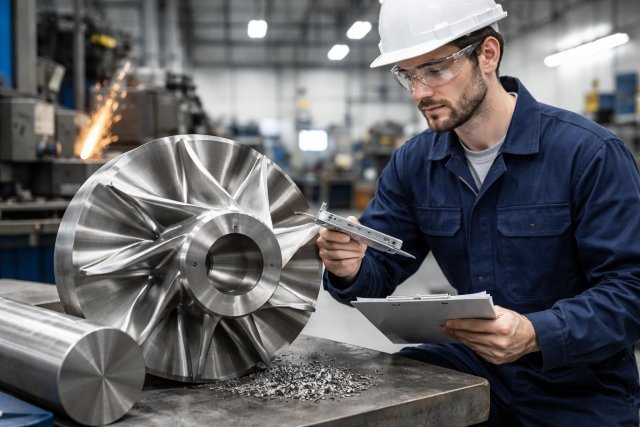
If you work with pumps, valves, hydro turbines, or other pressure-containing cast components, CA6NM is one of those alloys you keep seeing on drawings — and for good reason. CA6NM is a cast, martensitic stainless steel (often discussed alongside F6NM / 13-4 stainless) known for a practical balance of strength, toughness, and corrosion resistance in wet service.
- What is CA6NM stainless steel?
- CA6NM chemical composition
- Mechanical properties of CA6NM
- Microstructure and why CA6NM behaves the way it does
- Heat treatment of CA6NM
- Where CA6NM is used (and why)
- CA6NM vs other stainless steels (quick decision guidance)
- Common engineering questions about CA6NM
- Choosing CA6NM for a high-pressure pump casing
- Conclusion
You’ll get a clear breakdown of CA6NM chemical composition, key mechanical properties, how heat treatment changes performance, and where it’s commonly used — plus selection tips and FAQs for real-world engineering decisions.
What is CA6NM stainless steel?
CA6NM is an ASTM cast stainless steel grade (UNS J91540) typically described as a 12–14% chromium, ~4% nickel, and ~0.4–1.0% molybdenum martensitic stainless steel casting alloy. It’s widely specified for cast parts that need higher strength than austenitic cast stainless grades (like CF8M/316 cast) while still maintaining respectable corrosion resistance for water and mild chloride environments.
You’ll also see CA6NM referenced as “13-4” or “F6NM” in the industry because it’s closely aligned with 13Cr-4Ni martensitic stainless families and is often compared with wrought equivalents such as UNS S41500 (F6NM / 1.4313-type discussions).
CA6NM chemical composition
The composition window is the foundation of why CA6NM performs the way it does: chromium provides corrosion resistance, nickel improves toughness and helps stabilize structure, and molybdenum enhances pitting resistance and strengthens the alloy at the same time.
Here’s a commonly published CA6NM composition range (typical spec ranges shown by foundry/alloy references):
| Element | Typical CA6NM range (wt%) | Why it matters |
|---|---|---|
| Carbon (C) | ≤ 0.06 | Keeps hardness/strength achievable while supporting toughness/weldability |
| Chromium (Cr) | 11.5–14.0 | Corrosion resistance + supports martensitic structure |
| Nickel (Ni) | 3.5–4.5 | Improves toughness and low-temp behavior vs straight 12Cr martensitics |
| Molybdenum (Mo) | 0.4–1.0 | Better pitting resistance + strength |
| Manganese (Mn) | ≤ 1.0 | Deoxidation, helps castability |
| Silicon (Si) | ≤ 1.0 | Deoxidation, casting support |
| Phosphorus (P) | ≤ 0.04 | Controlled to reduce brittleness |
| Sulfur (S) | ≤ 0.03 | Controlled to avoid hot cracking/embrittlement |
A quick “rule of thumb” on corrosion resistance (PREN context)
You’ll sometimes see CA6NM discussed using “PREN” (Pitting Resistance Equivalent Number). Because CA6NM has moderate Cr and modest Mo, it’s typically not in the same pitting-resistance class as duplex or high-alloy austenitics — but it often outperforms basic 12Cr martensitic stainless grades in wet service due to its Ni + Mo balance. Some material datasheets even report an indicative PREN value for CA6NM-type castings.
Mechanical properties of CA6NM
Mechanical properties for CA6NM depend heavily on heat treatment (more on that soon), section thickness, and foundry practice. That said, published minimums and typical ranges are consistent enough to guide early selection and to sanity-check MTRs.
Typical room-temperature strength and ductility
A practical way to think about CA6NM is: “high strength casting stainless that still behaves decently in impact/toughness compared with many martensitic options.”
Commonly published values include:
- Yield strength: around 550 MPa minimum in some datasheet presentations
- Tensile strength: around 750+ MPa minimum in the same context
- Elongation: roughly 15% minimum in typical listings
- Hardness: often in the ~230–300 HB band depending on heat treatment and condition
Foundry alloy selectors commonly show CA6NM tensile strength in the 110–135 ksi band with yield around 80 ksi (typical listing style), again depending on grade variant and heat treatment condition.
Toughness and impact performance
One of the reasons CA6NM is popular for hydro, pumps, and pressure parts is that it can deliver usable impact toughness when properly heat treated. Some datasheets list impact energy figures (for example, values like ~70 J in certain presentations), but always treat this as condition-specific and verify against the governing spec and project requirements.
Academic and technical literature also discusses how CA6NM’s microstructure and processing influence toughness and mechanical performance, especially in welded/repair situations common in service components.
Microstructure and why CA6NM behaves the way it does
CA6NM is generally described as martensitic, sometimes with a small amount of delta ferrite depending on solidification and composition balance. That martensitic base is what provides the higher strength compared with austenitic cast stainless steels.
In plain language: CA6NM is engineered so that after proper heat treatment it lands in a “sweet spot” where it’s strong and reasonably tough, without being so hard and brittle that it becomes risky for pressure parts.
Heat treatment of CA6NM
Heat treatment is not optional “nice-to-have” for CA6NM — it’s the main lever that turns the alloy from “cast structure” into reliable service performance.
Most production routes use a quench and temper approach (exact parameters vary by spec and foundry practice). The objectives are typically:
- Transform and refine the martensitic structure
- Reduce residual stresses
- Improve toughness and ductility
- Tune hardness to a target band for wear + machinability trade-offs
Many practical heat-treatment discussions emphasize that correct tempering is a key step for balancing corrosion resistance and mechanical properties in CA6NM service.
Actionable selection tip: don’t compare “as-cast” numbers to “heat-treated” numbers
If you’re comparing quotes or reviewing MTRs, always confirm the material condition. A CA6NM casting that’s not heat-treated to the project spec can look “off” on hardness, impact, or ductility — without the alloy itself being wrong.
Where CA6NM is used (and why)
Pumps and pump casings/impellers
CA6NM is frequently used for pump casings and other pump components where higher system pressure is a driver and where the medium is water or mildly corrosive fluids. This is one of the most common “day-to-day” uses you’ll see in industry.
Valves and pressure-containing parts
CA6NM appears in specifications for valve bodies and other pressure-containing cast parts — especially when designers want higher strength than many austenitic cast stainless options while still maintaining corrosion resistance for wet environments.
Hydro turbines and power generation components
In hydro and power applications, CA6NM shows up in turbine-related components because it can combine strength, toughness, and corrosion resistance in water service — particularly when cavitation and erosion resistance are part of the material conversation (final suitability still depends on velocity, silt, and design). Many stainless casting grade discussions place CA6NM in the turbine component family.
CA6NM vs other stainless steels (quick decision guidance)
Designers often end up deciding between CA6NM and a handful of “usual suspects”:
CA6NM vs CF8M (cast 316):
CF8M typically wins for broad corrosion resistance, especially in chlorides, but CA6NM can win on strength and pressure capability at similar section sizes. CA6NM is also often chosen when the design needs martensitic-type strength characteristics.
CA6NM vs CA15 (cast 410-type):
CA6NM is usually considered the more balanced option when you need better toughness and weld/repair friendliness than straight 12Cr martensitic cast grades.
CA6NM vs duplex stainless (CD4MCu / similar):
Duplex grades are typically chosen for more aggressive chloride corrosion and higher PREN-driven resistance, while CA6NM often sits in the “strong, cost-effective, good in water service” category. (Always validate against your actual chemistry, temperature, and chloride levels.)
Common engineering questions about CA6NM
What is CA6NM material equivalent to?
CA6NM is a cast stainless designation (UNS J91540) that’s commonly discussed alongside F6NM / 13-4 martensitic stainless families and is often mapped in equivalency lists to EN 1.4313 / GX5CrNi13-4 style naming in some cross-reference charts. Always confirm exact equivalency against the governing standard and chemistry ranges for your project.
Is CA6NM stainless steel magnetic?
Yes — CA6NM is martensitic, and martensitic stainless steels are generally magnetic due to their microstructure.
Is CA6NM good for seawater?
CA6NM can be used in some marine-adjacent environments, but it is not typically the “best-in-class” choice for seawater exposure compared with higher-alloy austenitic (e.g., 316 in many cases) or duplex stainless steels, especially where pitting risk is high. If your service involves high chlorides, elevated temperature, crevices, or stagnant zones, evaluate more corrosion-resistant alloys or protective strategies.
Can CA6NM be welded?
CA6NM is often repaired and joined in industry, but weld procedure control and post-weld heat treatment strategy matter because martensitic structures can be sensitive to cracking and toughness changes. Technical literature discusses welding and its relationship to microstructure and mechanical performance for CA6NM components.
Choosing CA6NM for a high-pressure pump casing
Imagine you’re designing a high-pressure pump casing for a water-handling system. CF8M (cast 316) might be your first instinct for corrosion resistance, but your stress calculations point toward either thicker walls or a stronger alloy to control deflection and meet safety factors.
In this situation, CA6NM can be attractive because it’s widely used for pump casings when high system pressure is a key requirement, and because its heat-treated martensitic structure supports higher strength than many austenitic cast stainless alternatives. If corrosion exposure is moderate (clean water, controlled chemistry), CA6NM is often a practical, proven selection.
Conclusion
CA6NM is a workhorse cast martensitic stainless steel for water and pressure-containing service — especially in pumps, valves, and turbine-related components — because it delivers a well-balanced package of strength, toughness (when properly heat treated), and practical corrosion resistance. When specifying CA6NM, pay close attention to composition limits, required heat treatment condition, and the actual environment (especially chloride severity). Done right, CA6NM can be a reliable, cost-effective material choice for demanding cast components in real industrial systems.