


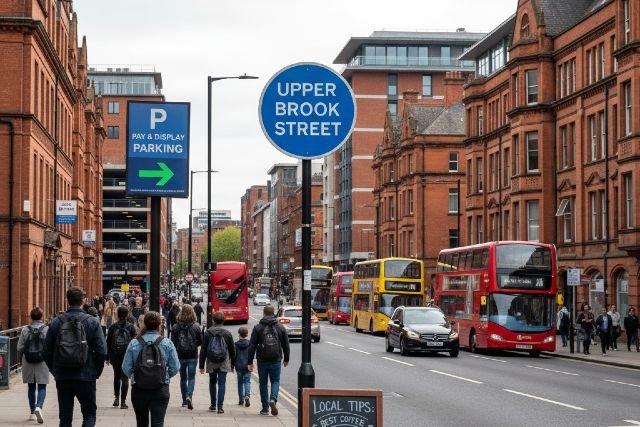
If you’re heading to upper brook street in Manchester for the universities, the Oxford Road hospitals, a flat viewing, or simply passing through, knowing the “local rules” makes the whole trip easier. This area sits next to the Oxford Road Corridor, one of the city’s busiest movement zones, with heavy bus flows, constant pedestrian crossings, and lots of appointment and campus traffic. That mix makes Upper Brook Street convenient, but it also means parking is tight and driving restrictions nearby are enforced.
- Where is Upper Brook Street in Manchester?
- What Upper Brook Street feels like day to day
- Upper Brook Street safety: what to know
- Parking on Upper Brook Street: what trips people up
- Visiting Manchester Royal Infirmary: the easiest parking approach
- Driving near Upper Brook Street: Oxford Road bus gates and enforcement
- Getting around without driving: buses that make sense here
- Local tips people learn after a few trips
- FAQs
- Conclusion
This guide focuses on what people actually want to know: how safe it feels day to day, where parking tends to work (and where it doesn’t), how the Oxford Road bus gates can affect your route, and the practical tips locals use to avoid tickets and avoid hassle.
Where is Upper Brook Street in Manchester?
Upper Brook Street runs close to the Oxford Road Corridor and sits near major destinations including parts of The University of Manchester and the Manchester University NHS Foundation Trust’s Oxford Road hospital campus, which includes Manchester Royal Infirmary among other facilities.
Because of that location, it’s commonly used by students walking between buildings, hospital visitors travelling to appointments, and motorists trying to navigate in and out of the central area without slipping into restricted sections of Oxford Road.
What Upper Brook Street feels like day to day
Upper Brook Street changes character depending on the stretch, but overall it’s best described as a busy, functional city route rather than a quiet residential street. You’ll notice strong footfall around university and hospital edges in the morning and late afternoon, and you’ll also see frequent buses and plenty of rideshare pick-ups.
If you like being close to services and transport, this can be ideal. If you prefer calm streets, it can feel intense at peak times, especially when appointments and campus schedules overlap.
Upper Brook Street safety: what to know
Safety on Upper Brook Street is mostly about normal big-city awareness rather than anything uniquely alarming about the road itself. It’s a high-activity area, and that usually means the most common issues are opportunistic, such as phone snatches and unattended-bag theft, rather than anything that resembles “danger zones” people sometimes imagine.
If you want a data-led view instead of hearsay, Police.uk lets you check recorded crime by area and month, which is helpful because crime patterns vary around Manchester from one neighbourhood pocket to another.
Greater Manchester Police also shares practical prevention advice for mobile phone theft, which is especially relevant in places with crowds, bus stops, and students moving between buildings. The theme is consistent: keep devices out of sight when not in use, stay alert at roadside edges, and avoid leaving valuables on café tables where a quick grab is easy.
If you’re moving around campus-adjacent areas, The University of Manchester highlights its Campus Support and Security provision, including a 24/7 control room and options like the SafeZone app for quick support access. This matters because Upper Brook Street often functions as a “connector” route for students and staff.
At night, the most useful mindset is not fear but friction reduction. Choose brighter, busier routes when possible, keep your phone away until you actually need it, and wait for rides near entrances with lighting and activity rather than on a quiet side stretch.
Parking on Upper Brook Street: what trips people up
Parking is the number one source of frustration for first-time visitors to this area. The reason isn’t that parking never exists, but that rules change quickly by bay, time, and nearby zones, and enforcement tends to be consistent.
Manchester City Council explains that city-centre on-street parking uses pay-and-display bays and typically operates from 8am to 8pm every day, though you should always treat the sign at the exact bay as the final authority.
The council also publishes tariff details by zone, including examples like Zone 1 having a two-hour maximum stay and specific charges by time parked. Even if you don’t think you’re in the centre, you can still drift into controlled areas without realising it, so reading the sign before you walk away is the simplest money-saving habit.
If you’re tempted to park on nearby residential streets, be cautious. Manchester has resident parking schemes in neighbourhoods close to this corridor, including Rusholme and Moss Side, and the council confirms that restrictions for that scheme came into force in January 2024. That kind of scheme is designed to stop commuter parking spillover, so it’s exactly the places “just park on a side street” tends to fail.
Visiting Manchester Royal Infirmary: the easiest parking approach
If your destination is Manchester Royal Infirmary or the wider Oxford Road hospital campus, the simplest plan is to use the official multi-storey car parks rather than searching for street bays. The NHS trust advises that patient and visitor parking is largely concentrated in two multi-storey locations: Grafton Street on the north-east side of the hospital site and Hathersage Road on the south-west side.
A realistic scenario here is arriving for a weekday appointment, thinking you’ll be early, then losing time circling. Even when you do find parking, the site is big and entrances vary, so building in extra walking time helps you arrive calmer.
Driving near Upper Brook Street: Oxford Road bus gates and enforcement
Upper Brook Street often shows up in local route advice because Oxford Road has bus gate restrictions that limit general traffic at certain times. Manchester City Council explains that the Oxford Road bus gate operates between 6am and 9pm, and that a Penalty Charge Notice can be issued for driving through restricted sections, with a £70 charge reduced to £35 if paid within 21 days.
The University of Manchester has also highlighted the bus gate changes and explicitly notes that motorists heading into or out of the city centre should use Upper Brook Street rather than attempting to drive through the restricted corridor. This is a key detail because satnav directions can sometimes conflict with local restrictions, and relying on navigation alone can lead to avoidable penalties.
Getting around without driving: buses that make sense here
If you don’t want to deal with parking, public transport is usually the smoother option around this corridor. Transport for Greater Manchester’s Bee Network provides route and timetable information that helps you plan realistically.
For example, the Bee Network route page for the 142 includes a stop at Upper Brook Street and Hathersage Road, which is useful for hospital-area access.
The 43 is another widely used option because it links Manchester Airport with the city centre via major stops on and around Oxford Road, including the Manchester Royal Infirmary area.
In practice, a simple approach is to arrive into central Manchester by train or tram, then take a bus down the corridor and walk the last few minutes. It’s often faster than driving, and it removes the “where do I leave my car?” anxiety entirely.
Local tips people learn after a few trips
On Upper Brook Street, choosing the right side of the road can genuinely save time. Bus stops and crossing points are not always where you expect, and hospital and campus entrances can be closer than they look on a map. If you’re meeting someone, the most reliable plan is to name a precise entrance or a specific stop rather than saying “meet on Upper Brook Street.”
It’s also worth treating this as a “walk and transit” area rather than a “drive up and pop in” area. The rules are designed to keep the corridor flowing, and that means restrictions, controlled parking, and enforcement are part of everyday life here. Using the official hospital car parks, reading bay signs carefully, and avoiding permit-only residential streets unless you’re covered is the difference between a smooth visit and a ticket.
If you’re a student nearby, don’t ignore the safety infrastructure that already exists. Having campus security contact options and using tools like SafeZone can be a practical layer of reassurance, particularly during late-night study or shift patterns.
FAQs
Is Upper Brook Street in Manchester safe?
Upper Brook Street is a busy urban route next to the universities and hospitals, and it generally feels like a typical city corridor where the main risk is opportunistic theft in high-footfall areas. For a factual view, check Police.uk for area crime data and follow prevention guidance from Greater Manchester Police on phone theft.
Can I park on Upper Brook Street?
You may find pay-and-display bays depending on the exact location, but restrictions can be strict and nearby zones can limit stay length. For hospital visits, the official multi-storey car parks are usually the most reliable option.
What are Oxford Road bus gates and why do they matter?
Oxford Road has bus gate restrictions that operate 6am to 9pm, and driving through restricted sections can result in a Penalty Charge Notice. Many drivers use Upper Brook Street as a practical alternative route.
What’s the easiest way to reach the hospitals from Upper Brook Street?
The Oxford Road hospital campus sits between Oxford Road and Upper Brook Street, and the NHS trust directs visitors to the Grafton Street and Hathersage Road multi-storey car parks for patient and visitor parking.
Which buses should I use near Upper Brook Street?
The Bee Network provides route information for services that stop nearby. The 142 includes a stop at Upper Brook Street and Hathersage Road, and the 43 connects Manchester Airport and the city centre via the Oxford Road area, serving the hospital zone.
Conclusion
Upper Brook Street is one of Manchester’s most practical connector roads if you understand what surrounds it: a major university presence, one of the city’s key hospital campuses, and the Oxford Road Corridor with its traffic restrictions. The area is generally manageable and convenient, but it rewards planning. Use official hospital car parks when visiting, read parking signage carefully, and keep an eye on Oxford Road bus gate rules so your route doesn’t accidentally turn into a penalty.
With those habits in place, upper brook street stops being a confusing first-time experience and becomes a straightforward base for getting around this part of Manchester.