


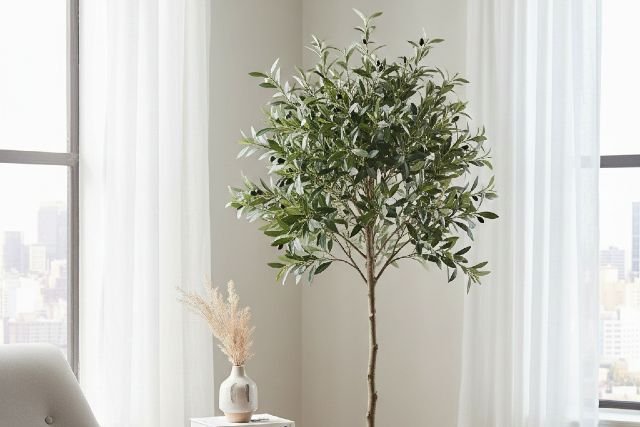
A fake olive tree is one of the easiest ways to make a small home look thoughtfully designed. It adds height, softness, and that relaxed Mediterranean feel without demanding sunlight, watering, or a strict routine. If you live in a studio, apartment, or compact home, you already know how quickly a space can feel cluttered or unfinished. A fake olive tree solves both problems by filling vertical space while keeping the floor mostly open.
- Why a fake olive tree is perfect for small spaces
- Fake olive tree vs. real olive tree indoors
- How to choose the best fake olive tree for a compact home
- Where to place a fake olive tree in a small space
- How to make a fake olive tree look real and expensive
- Does faux greenery still give the “well-being” effect?
- Common mistakes to avoid with a fake olive tree
- Buying guide: what quality looks like in a fake olive tree
- FAQ: fake olive tree for small spaces
- Conclusion
People are also spending a large share of their day indoors, and creating a calming environment at home matters more than ever. Many discussions of indoor time in modern life often cite that people spend the majority of their time inside, commonly around 80% or more in some urban settings, which is one reason nature-inspired interiors stay popular. Bringing in greenery, even artificial greenery, can make a room feel softer and more welcoming.
Why a fake olive tree is perfect for small spaces
Small spaces benefit from decor that makes a strong visual impact without taking up much room. A fake olive tree is slim at the base but tall through the trunk and canopy, so you get a “designed” look with minimal footprint. Unlike dense faux plants that can feel bulky, olive branches are naturally airy, which helps a room feel open rather than crowded.
There’s also a style advantage. Olive trees work across many aesthetics, including minimalist, modern, Scandinavian, farmhouse, and boho. They blend into neutral palettes, pair well with wood tones, and soften sharp furniture lines. In a small space, that versatility is valuable because you usually can’t afford to decorate with lots of extra objects.
Fake olive tree vs. real olive tree indoors
Real olive trees can be grown indoors, but they are not a low-effort plant. They typically need very bright light and consistent care, and indoor conditions don’t always match what they prefer. Many general houseplant care guidelines emphasize regular watering patterns and adjusting based on season, light, and airflow, which is exactly what small-space renters and busy homeowners may not want to manage.
A fake olive tree gives you a predictable result. It looks good in any light, it does not drop leaves when stressed, and it stays the same season after season. If your goal is to make your home look elevated without adding another responsibility, faux is often the smarter choice.
How to choose the best fake olive tree for a compact home
Picking the right fake olive tree is mostly about scale and realism. In small spaces, the wrong proportions stand out quickly. The right one feels intentional, like it was chosen for the room instead of squeezed in.
Start with height. Most small homes with standard ceilings look best with a tree in the 5 to 6 foot range because it creates vertical lift without overwhelming the room. If you have higher ceilings, a 6 to 7 foot tree can look dramatic and designer-like, especially in an empty corner that needs presence.
Next, look at branch structure. A realistic fake olive tree should feel airy, not packed. The canopy should have space between branch clusters, and the silhouette should avoid perfect symmetry. Real olive trees have irregular growth, and that slight unevenness is what makes faux versions look believable.
Then check leaf color and finish. Ultra-glossy leaves tend to look plastic, especially under artificial lighting. A higher-quality tree usually has subtle variation in green tones and a more matte finish that reads natural from a distance.
Finally, pay attention to the trunk. The trunk is a common giveaway. A more realistic faux trunk has texture, tonal variation, and a slightly imperfect shape. If the trunk looks like smooth painted plastic, it will look artificial no matter how good the leaves are.
Where to place a fake olive tree in a small space
Placement is everything. The same tree can look high-end or awkward depending on where you put it.
One of the best spots is the corner that never looks right. Many small homes have a dead corner near the sofa, beside a TV stand, or next to a window that doesn’t get used. A fake olive tree fills that negative space cleanly and creates a finished look without adding clutter.
Another great placement is beside the sofa. In small living rooms, the sofa often dominates the space, and the wall behind it can feel empty. A fake olive tree adds height and softness, balancing the horizontal line of the couch and making the seating area feel styled.
Bedrooms also benefit from faux trees because bedrooms often have lots of straight, boxy furniture. A tree placed near a dresser or in a corner near a mirror breaks up rigid lines and adds a calm, organic shape.
If your entryway is small, placing a faux olive tree near a mirror can make the space feel bigger. The reflection doubles the greenery and adds brightness, especially if the mirror bounces natural light around.
How to make a fake olive tree look real and expensive
Most faux plants look fake for one simple reason: they’re left exactly the way they arrive. A few small adjustments make a huge difference.
Start with the planter. Many faux trees come in a lightweight black plastic pot that looks temporary. Swapping it into a heavier planter instantly upgrades the look. Matte ceramic, textured stone-look planters, woven baskets, and minimal black cylinders all work well, depending on your style. The planter is also what anchors the tree visually, and in a small room, that grounding detail matters.
Next, make the base look natural. If you can see the foam or the artificial “soil,” it breaks the illusion. Cover the top with preserved moss, decorative stones, or a realistic topper. This also helps stabilize the trunk so the tree does not wobble.
Then shape the branches. Pull the branches apart, bend them gently into slightly different directions, and avoid symmetry. Aim for a natural silhouette with variation, where some branches angle forward and others extend sideways. This step alone can turn a basic faux tree into something that looks surprisingly real.
Cleaning is the last step that many people overlook. Dust dulls the leaves and makes them look more artificial. A quick wipe or gentle dusting keeps the finish looking fresh and believable.
Does faux greenery still give the “well-being” effect?
Real plants can provide psychological benefits in some environments, but results vary. A commonly referenced set of findings reported productivity improvements when plants were added to office spaces, including a frequently cited figure around 15% in certain workplace contexts. Other research notes that results can be mixed depending on the real-world setting and how studies are designed.
A fake olive tree will not purify air or behave like a living plant, but it can still improve how a space feels visually. In small homes, that visual calm is valuable. A room that feels softer, warmer, and more balanced can support better rest and comfort, even if the greenery is decorative rather than biological.
Common mistakes to avoid with a fake olive tree
A fake olive tree can look dated if the materials are too shiny or the color is unnaturally bright. The quickest way to avoid that is to choose a tree with subtle tonal variation and a matte finish.
Another mistake is keeping the original pot exposed. Even a high-quality tree can look budget if the base looks flimsy. Upgrading the planter almost always makes it look more realistic.
Placement mistakes matter too. If you put it where it blocks movement, it becomes an annoyance. Small spaces rely on good flow, so choose a spot that adds style without interfering with daily life.
Finally, avoid over-decorating around it. A fake olive tree is already a statement piece. If you crowd the area with extra objects, the corner can start to feel visually messy instead of curated.
Designers often point out that cheap-looking faux greenery is what makes a space feel off, not faux greenery itself. The difference is quality and styling.
Buying guide: what quality looks like in a fake olive tree
A good fake olive tree has realistic leaves with tonal variation, flexible branches that hold shape when you style them, and a trunk that looks textured rather than smooth. It should feel stable once placed in a proper planter, and the canopy should look airy rather than stuffed.
If you are shopping online, zoom in on product photos of the trunk and leaf finish. Those are the two details that most clearly separate high-end faux trees from cheaper options.
FAQ: fake olive tree for small spaces
What size fake olive tree is best for a small apartment?
A 5 to 6 foot fake olive tree is usually the most flattering for small apartments because it adds vertical style without overwhelming the room. If your ceilings are higher, a 6 to 7 foot option can look dramatic in a corner, especially with a clean planter.
How do you make a fake olive tree look more realistic?
Swap the pot for a heavier planter, cover the base with moss or stones, and shape the branches so the canopy looks slightly asymmetrical. Keep it dust-free so the leaves do not turn dull and artificial-looking.
Where should I place a fake olive tree in a small room?
Corners that feel empty, the space beside a sofa, an entryway near a mirror, or a bedroom corner near a dresser are all great placements. The key is choosing a spot that adds height and softness without blocking walking paths.
Do fake plants look tacky?
They can if the leaves are shiny, the color is unnatural, or the tree is left in its original pot. Higher-quality faux plants can look polished when styled correctly, and designers often emphasize that the issue is cheap-looking faux greenery rather than faux greenery itself.
Are faux plants good for people who travel often?
Yes. Faux greenery gives you the visual benefit of plants without returning home to dried soil, leaf drop, or stressed plants that need time to recover.
Conclusion
A fake olive tree is one of the smartest design choices for small spaces because it delivers big style without creating more work. It adds height without taking up much floor space, softens hard furniture lines, and instantly makes a room feel more curated. When you choose a realistic trunk and leaf finish, style the branches, and upgrade the planter, your fake olive tree can look high-end and stay beautiful year-round with zero maintenance.