


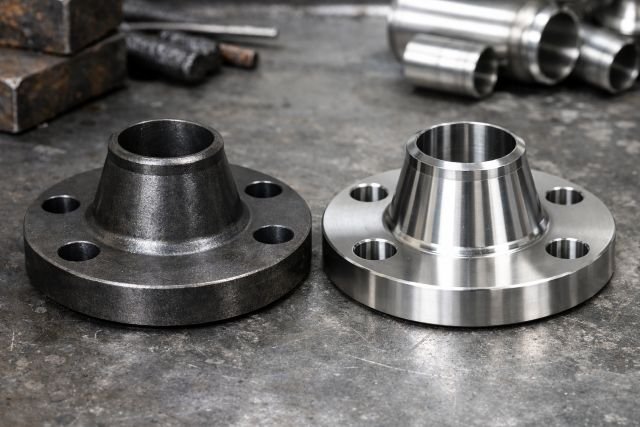
A weld neck flange is often chosen because it’s one of the most reliable flange designs for demanding service. But the flange geometry is only part of the performance story. The material you choose — most commonly carbon steel or stainless steel — decides how that weld neck flange will handle corrosion, heat cycles, pressure fluctuations, and long-term maintenance. If you’re selecting between carbon steel (often ASTM A105) and stainless steel (often ASTM A182 grades like 304/316), this guide will help you make a decision that fits real operating conditions, not just procurement preferences.
- What is a weld neck flange and why material choice matters
- The most common weld neck flange materials in the field
- Carbon steel weld neck flange performance in real service
- Stainless steel weld neck flange performance in real service
- Weld neck flange material selection: what actually drives the right decision
- Real-world scenarios: how engineers typically choose
- Common questions about weld neck flange materials
- Conclusion: making the right weld neck flange material choice
What is a weld neck flange and why material choice matters
A weld neck flange has a long tapered hub that transitions gradually to the pipe, and it is butt-welded to the pipe end. That taper is more than a shape; it’s a stress-management feature. It reduces stress concentration at the flange-to-pipe junction and improves fatigue resistance, which is why weld neck flanges show up in high-pressure lines, high-temperature services, vibration-prone systems, and applications where leak prevention is critical.
Material determines what happens after installation. Corrosion can erode sealing faces and bolts, temperature can weaken yield strength, and thermal cycling can encourage cracking in susceptible alloys. Two weld neck flanges built to the same dimensional standard can behave completely differently if one is carbon steel and the other is stainless steel.
The most common weld neck flange materials in the field
In many industrial piping systems, carbon steel weld neck flanges are typically made from forged carbon steel such as ASTM A105 (often referenced as ASME SA-105 when used under ASME code frameworks). This is a common baseline material because it’s widely available, weldable, and cost-effective for many pressure services.
Stainless steel weld neck flanges are commonly produced from forged stainless steels such as ASTM A182 grades, especially 304/304L and 316/316L (often written as F304/F304L and F316/F316L). These are selected when corrosion resistance, cleanliness, or harsh exposure conditions become central to reliability.
Carbon steel weld neck flange performance in real service
Carbon steel remains a practical default in large parts of oil and gas, power, utilities, and general process piping because it delivers strong mechanical performance at a competitive cost. In many non-aggressive services — such as dry hydrocarbons, steam, compressed air, and certain utilities — a carbon steel weld neck flange can run for decades when corrosion is managed well.
The key phrase is “managed well.” Carbon steel corrodes readily in the presence of oxygen and moisture, and its corrosion behavior is often more uniform than stainless steel. That uniformity can be an advantage because it’s easier to predict and accommodate through corrosion allowance and inspection plans. At the same time, uniform corrosion still degrades flange faces, stud threads, and sealing surfaces if left unchecked, and external corrosion can be accelerated in humid or coastal atmospheres.
In day-to-day plant reality, carbon steel weld neck flange success depends on the broader corrosion control plan. Coatings and paint systems matter, insulation practices matter, and drainage and water-trapping details matter. If the line is insulated and exposed to weather, corrosion under insulation becomes a serious risk. In those environments, carbon steel can still be used, but it typically requires a disciplined CUI strategy with the right coating spec and inspection program.
From a lifecycle standpoint, carbon steel is often the best choice when internal corrosion is minimal or controlled and external exposure is not severe. It’s also the go-to choice when the system is large, the budget is constrained, and a structured maintenance program already exists to keep corrosion in check.
Stainless steel weld neck flange performance in real service
Stainless steel weld neck flanges are chosen primarily for corrosion resistance and cleanliness, not because stainless is “stronger” in every case. Stainless steels rely on a passive oxide film that forms due to chromium content, which helps resist rusting in many environments where carbon steel would corrode quickly.
This doesn’t mean stainless is immune to corrosion. It means stainless shifts corrosion risks toward localized forms such as pitting and crevice corrosion, especially in chloride environments. In other words, carbon steel often loses thickness more steadily, while stainless can look perfect for a long time and then develop a small pit or crevice attack that becomes a leak path faster than expected.
That’s why gasket choice, crevice control, washdown chemistry, and chloride exposure matter more with stainless steel than many buyers assume. A stainless weld neck flange installed in a design that traps moisture under a gasket, under insulation, or within a stagnant pocket can still corrode if the environment supports localized attack.
Stainless steel weld neck flange grades: 304 vs 316
Most stainless steel weld neck flange decisions eventually become a 304 versus 316 conversation. 304/304L is often sufficient for general industrial environments without high chlorides, and it’s common in food and beverage, many chemical services, and clean utility systems. 316/316L is often preferred when chlorides are present, when the plant is coastal, or when cleaning and washdowns introduce chloride-bearing solutions. The molybdenum in 316 typically improves resistance to pitting and crevice corrosion compared to 304.
A practical way to think about it is that 304 is a strong general-purpose stainless for mild to moderate corrosive environments, and 316 is the more conservative stainless when chlorides or salt exposure increase localized corrosion risk. Even then, 316 is not “seawater-proof” in every configuration. Design details, temperature, oxygen content, and crevices can still cause issues.
Weld neck flange material selection: what actually drives the right decision
The most reliable selection process starts with the service, not the budget. If the internal fluid is corrosive to carbon steel at operating temperature and velocity, stainless becomes a candidate quickly. If the external environment is harsh — coastal air, chemical splash, frequent washdowns, high humidity, or CUI-prone insulation — stainless is often considered for reliability and maintenance reduction even when the process fluid itself is benign.
Temperature and pressure also matter, but usually as a confirmation step. A weld neck flange is typically specified to a dimensional standard such as ASME B16.5 for size and class, and then the material grade is selected to meet the code allowables for the operating conditions. The important reality is that allowable pressure ratings change with temperature, and those allowable values depend on the selected material group.
Weldability and fabrication practice is another deciding factor. Carbon steel welding is widely familiar and forgiving in most shops and field crews. Stainless requires cleaner handling, better contamination control, and more attention to heat input and post-weld cleanup. If stainless is selected but handled like carbon steel on the jobsite — shared grinding wheels, dirty wire brushes, poor cleaning — its corrosion performance can be compromised early.
Cost should be evaluated as lifecycle cost, not unit price. Carbon steel usually wins on purchase cost, but stainless can win when downtime costs are high, maintenance labor is scarce, washdowns are constant, or external corrosion is a repeat failure mode.
Real-world scenarios: how engineers typically choose
In a refinery hydrocarbon line where water is well controlled and corrosion is managed through process control and inspection, carbon steel weld neck flanges are common and sensible. The internal corrosion risk is low and external corrosion can be handled by coatings, paint maintenance, and periodic checks.
In a coastal utility header that sees frequent washdowns, stainless weld neck flanges often become attractive even if the internal fluid is non-corrosive. The external environment becomes the dominant reliability factor, and the cost of repeated coating repairs or flange replacements can exceed the stainless premium over time.
In a chemical dosing line carrying chloride-bearing fluids, stainless is often evaluated early. 316/316L is frequently considered as a baseline, but depending on concentration and temperature, engineers may need to consider higher alloys or alternative materials. This is where “316 is always fine” becomes a risky assumption, because localized corrosion can be highly sensitive to the exact chemistry and temperature.
Common questions about weld neck flange materials
What is a weld neck flange used for?
A weld neck flange is used in services where high integrity matters, such as higher pressure, higher temperature, vibration, and cyclic loading. Its tapered hub helps distribute stress and improves fatigue performance compared to many other flange types.
Is carbon steel or stainless steel better for a weld neck flange?
Carbon steel is often better when the environment is non-aggressive and the goal is cost-effective mechanical performance with manageable corrosion controls. Stainless steel is often better when corrosion resistance, hygiene, washdowns, or harsh external exposure drive reliability and lifecycle cost.
Should I choose 304 or 316 for a stainless steel weld neck flange?
304/304L is typically chosen for general corrosion resistance in environments without significant chlorides. 316/316L is typically chosen when chlorides, coastal exposure, or salt-bearing washdowns raise the risk of pitting and crevice corrosion.
Do weld neck flange dimensions change by material?
The geometry is governed by the flange standard and pressure class, not by whether it’s carbon steel or stainless steel. Material affects allowable pressure-temperature limits and corrosion performance rather than the flange’s basic dimensions.
Conclusion: making the right weld neck flange material choice
Choosing the right weld neck flange material is about matching failure modes to reality. Carbon steel weld neck flanges are a strong, economical default when internal corrosion is low or controlled and external exposure is manageable through coatings and inspection. Stainless steel weld neck flanges are often worth the premium when corrosion resistance, washdowns, cleanliness, coastal exposure, or product purity drive lifecycle cost and uptime.