

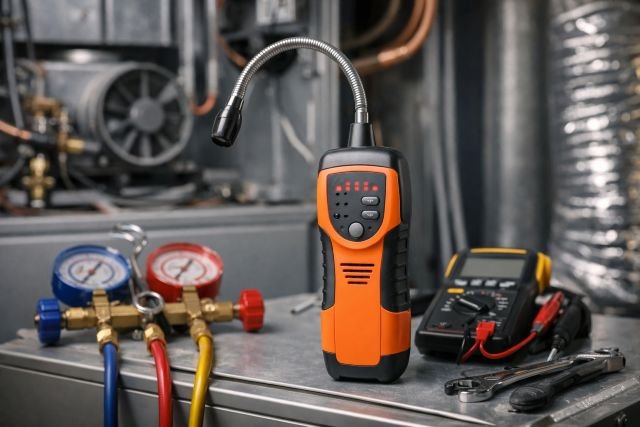
A combustible gas detector is one of those HVAC tools that doesn’t just make you faster; it can keep you, your customer, and the building safe. If you service gas-fired furnaces, RTUs, makeup air units, boilers, unit heaters, or commercial kitchens, you already know leaks aren’t always obvious. They can be intermittent, diluted by airflow, or trapped in pockets that your nose simply won’t catch consistently. A good detector turns “I think I smell gas” into a measurable, repeatable process: screen the area, find the source, fix it, and verify the space is clear before you leave.
- What a combustible gas detector measures and why %LEL matters
- Why this tool belongs on every truck, not just “gas days”
- Sensor types you’ll see in the field and what they mean for HVAC work
- How to choose the right combustible gas detector for HVAC calls
- Field technique that makes your readings trustworthy
- How to interpret %LEL readings without guessing
- Maintenance that keeps your detector from lying to you
- A realistic rooftop scenario where the detector saves time and risk
- A2L refrigerants are expanding “combustible gas” awareness in HVAC
- FAQs about combustible gas detectors for HVAC techs
- Conclusion: make the combustible gas detector part of your standard workflow
This article walks through how combustible gas detection works, what specs matter in the field, how to interpret %LEL readings, and the habits that separate confident leak verification from guesswork.
What a combustible gas detector measures and why %LEL matters
Most portable instruments that HVAC techs call a combustible gas detector display results in %LEL, which stands for percent of the Lower Explosive Limit. LEL is defined as the lowest concentration of a gas or vapor in air that can ignite in the presence of an ignition source. Concentrations below the LEL are “too lean” to burn, and instruments often express what they detect as a percentage of that LEL reference point.
That matters because, in real service conditions, you’re not only trying to find a leak at a fitting. You’re also assessing whether the area is trending toward a hazardous atmosphere. %LEL gives you a safety-oriented frame of reference that a simple “beep” or “trace detected” indicator doesn’t.
It also helps you communicate clearly. When you can document that readings increased as you approached the gas train, or that the mechanical room returned to baseline after repair and ventilation, you’re providing a defensible service outcome rather than a vague reassurance.
Why this tool belongs on every truck, not just “gas days”
Flammable gas incidents are not rare enough to treat casually. NFPA’s report on structure fires involving flammable gases estimated an annual average of 15,941 structure fires (2018–2022) where the material first ignited was a flammable gas, leading to an estimated 191 civilian deaths, 747 civilian injuries, and $402 million in property damage each year.
You don’t need to be working in a refinery for gas risk to be real. A loose union in a rooftop unit, a compromised flex connector, or an aging valve packing nut can create the conditions for a serious incident, especially when ignition sources are nearby.
Sensor types you’ll see in the field and what they mean for HVAC work
When HVAC techs talk about a combustible gas detector, they’re usually referring to a portable instrument designed to detect flammable gases like methane (natural gas) or propane and present a reading that helps with safety screening and leak hunting.
Many %LEL meters use catalytic bead sensors (often called pellistors). They’re widely used and can respond well to many hydrocarbons, but they can be affected by certain contaminants and by oxygen availability because the sensing principle is tied to oxidation at the sensor.
Other instruments use infrared (NDIR) sensing. In many applications, NDIR can be stable for hydrocarbon detection because it doesn’t rely on combustion at the sensor, which can be an advantage in harsh environments or where sensor poisoning is a concern. The “best” choice depends on your work mix, the environments you enter, and how disciplined you are about maintenance and testing.
A separate category is the high-sensitivity “sniffer” style leak detector that is designed primarily to pinpoint tiny leaks at joints. Those tools can be excellent for finding the exact fitting, but they don’t automatically replace a %LEL meter when you need to understand whether the area is approaching a flammability hazard. In practice, many experienced techs treat these as complementary rather than interchangeable.
How to choose the right combustible gas detector for HVAC calls
Gas coverage and real-world fuels
Start with the gases you actually encounter. If your service territory is predominantly natural gas, you want strong methane performance. If you touch propane systems, confirm the instrument’s performance for propane as well. Some devices are calibrated on one gas and provide “relative” response on others, which can still be useful, but you should understand what that means for accuracy and how you’ll document your results.
Readability and alarms that work in mechanical rooms
HVAC work rarely happens in ideal lab conditions. Fans are running. There’s background noise. You’re wearing gloves. You might be working in a dim basement room or in bright rooftop sunlight. Clear displays, strong audible alarms, vibration alerts, and fast response time are not “nice-to-haves” when you need to make quick safety decisions.
Sampling approach that matches the jobsite
Diffusion instruments are common and often adequate for close-range scanning around fittings and appliances. Pumped instruments can be useful when you need to sample a specific location, such as a ceiling void, a cabinet before opening it fully, or a potentially confined space where you want information before committing your body to the area. Even with pumped units, you still need to use good judgement about entry procedures, ventilation, and local regulations.
Standards awareness for commercial and institutional customers
If you work with larger facilities, customers may ask about compliance with standards relevant to gas detection products and systems. UL 2075 is a key standard for gas and vapor detectors and sensors, and it has been updated and revised over time (including revisions noted as recently as 2025).
For industrial and commercial applications where explosive atmospheres are a formal consideration, the IEC 60079 series includes gas detection equipment requirements and test methods. IEC 60079-29-0:2025 describes general requirements, test methods, and acceptance criteria for gas detection equipment intended for personnel or property protection in industrial and commercial applications.
You don’t need to turn every service visit into a standards seminar, but understanding the language helps you answer questions confidently when a safety manager or inspector asks why you chose a particular detector or how it’s maintained.
Field technique that makes your readings trustworthy
A combustible gas detector is only as reliable as the way you use it. Most “misses” aren’t because the tool failed; they happen because the tech moved too fast, sampled the wrong areas, or assumed air behaves the same way in every jobsite.
Airflow is the first complication. A strong supply fan, return pull, open doors, or rooftop wind can dilute or redirect gas plumes. That’s why a quick scan at one height, in one spot, is not a meaningful safety check.
A more reliable approach is to begin by screening the broader area, then work inward. Scan likely migration paths, such as around doorways to mechanical rooms, near louvers or combustion air openings, and around equipment seams before you open panels. As you see elevated readings, repeat the pass and confirm the trend. A single blip can be turbulence; a repeatable rise is information you can act on.
Sweep speed matters, too. Many sensors need a moment to respond and stabilize. If you wave the probe like a wand, you can sail right past a concentrated pocket without giving the sensor time to register it.
Finally, treat “location” as three-dimensional. Natural gas tends to rise and propane tends to settle, but airflow can override those tendencies. The practical solution is not to memorize gas behaviors and call it done; it’s to sample multiple heights when the airflow is unknown or changing, especially in rooms with duct leakage, open combustion chambers, or high/low ventilation paths.
How to interpret %LEL readings without guessing
Because LEL is the threshold where ignition becomes possible, a %LEL display is fundamentally a hazard indicator. Honeywell’s definition frames LEL as the lowest concentration that can produce a flash of fire with an ignition source, and instruments often display gas present as a percentage of LEL.
In practical HVAC terms, you’re watching for stability and trends. A low reading that appears once and disappears may be residual gas from prior work or a transient plume. A low reading that repeats in the same area suggests a small leak or a persistent source. A reading that increases as you approach a valve train, burner compartment, or union is exactly the “gradient” you want when you’re trying to locate a leak efficiently.
When readings become elevated, shift your mindset from diagnostic to safety-first. Your priority becomes controlling ignition sources, ventilating when appropriate, isolating fuel supply when safe and allowed, and following your company or site procedure. The goal is to avoid normalizing a dangerous atmosphere because the last job “turned out fine.”
Maintenance that keeps your detector from lying to you
If there’s one place HVAC techs get burned by gas detection tools, it’s maintenance discipline. A detector that isn’t tested and maintained is not a safety tool; it’s a false sense of security.
OSHA’s Safety and Health Information Bulletin on calibrating and testing direct-reading monitors provides guidance on calibration and testing practices for direct-reading instruments. NIOSH guidance also emphasizes performing bump testing at the beginning of each shift following manufacturer guidance, reinforcing that routine functional checks are part of safe use.
A bump test is typically a quick functional check that verifies the sensor responds to gas and that alarms activate. Calibration is the adjustment process that aligns the instrument’s readings with known test gas concentrations. Many organizations treat bump testing as a daily or per-shift habit, and calibration as a scheduled procedure, but the exact cadence should follow manufacturer recommendations and your working conditions.
A realistic rooftop scenario where the detector saves time and risk
Imagine a service call on a gas rooftop unit where occupants report intermittent gas odor, especially early in the morning. You arrive and start with a perimeter scan using your combustible gas detector before opening panels fully. You notice small but repeatable spikes near the lower edge of the burner compartment. Because rooftop wind can dilute and redirect gas, you reposition upwind, repeat the scan, and see a clearer increase as you approach the gas train.
At that point, you haven’t “proven” the exact fitting, but you’ve done two crucial things. You’ve confirmed there is a detectable flammable gas presence in a repeatable pattern, and you’ve limited how much you expose yourself to a potentially unsafe pocket while opening equipment.
Once you’ve confirmed conditions are stable enough for close work, you move into pinpoint verification and discover a slow leak at a union downstream of the manual shutoff that worsens on startup. You repair it, then verify again with the detector by scanning the same zones that previously showed spikes. That final scan is what reduces callbacks and reduces risk, because you’re confirming the area is actually clear, not just that the fitting stopped bubbling.
A2L refrigerants are expanding “combustible gas” awareness in HVAC
HVAC isn’t only about fuel gas anymore. The transition to lower-GWP refrigerants includes more systems using A2L refrigerants, which are classified as lower flammability. Industry and code updates are increasingly focused on safe application, including leak detection and mitigation strategies. A Trane engineering newsletter discussing A2L refrigerants and ASHRAE Standard 15 notes that codes and standards have been updated to include safety considerations as the industry transitions.
Some guidance documents used for training and implementation describe detector-triggered responses based on a fraction of the Lower Flammable Limit (LFL). For example, a refrigerant monitoring guidance document references detection that triggers actions when concentrations exceed 25% of the LFL, including shutdown of ignition sources and equipment. ASHRAE addenda for refrigeration safety standards also discuss when leak detection systems are required for A2L systems based on charge and mitigation methods.
For HVAC techs, the practical point is not that your fuel-gas detector automatically covers every refrigerant scenario. The point is that customers, inspectors, and manufacturers are increasingly “detection-minded.” Being comfortable with concepts like LEL/LFL, alarm setpoints, and ventilation response makes you more credible when modern systems come up in conversations, commissioning, or troubleshooting.
FAQs about combustible gas detectors for HVAC techs
What is a combustible gas detector?
A combustible gas detector is an instrument designed to sense flammable gases and indicate concentration, commonly in %LEL. LEL is the lowest concentration of gas in air that can ignite in the presence of an ignition source, and many detectors express readings as a percentage of that limit.
Do I need a %LEL meter or just a gas leak sniffer?
If you regularly service gas equipment, a %LEL combustible gas detector is valuable for screening and safety decisions, while a high-sensitivity leak finder can be helpful for pinpointing tiny leaks at fittings once you’ve confirmed the area is safe. Many techs treat these as complementary tools because they answer different questions: “Is this atmosphere trending hazardous?” versus “Which exact joint is leaking?”
How often should I bump test and calibrate my detector?
Follow the manufacturer’s instructions, but routine testing is strongly supported by safety guidance. OSHA provides guidance on calibrating and testing direct-reading monitors, and NIOSH recommends bump testing at the beginning of each shift following manufacturer guidance.
What should I do if I get elevated %LEL readings?
When readings rise, treat it as a safety-first situation. Reduce ignition risks, ventilate when appropriate, isolate fuel when safe and permitted, and follow your company or site procedures. Once the area is stabilized and safe, you can move into pinpoint troubleshooting and then re-scan to verify the space returns to baseline.
Conclusion: make the combustible gas detector part of your standard workflow
A combustible gas detector earns its keep when you use it the same way every time: screen the area before you open equipment, move deliberately to follow trends, repair with verification, and rescan to confirm the space is clear. The tool is powerful, but the real advantage comes from disciplined technique and disciplined maintenance. OSHA’s guidance on calibrating and testing direct-reading instruments, along with NIOSH’s emphasis on routine bump testing, reinforces that reliability is built, not assumed. And when you zoom out to the bigger picture, NFPA’s flammable gas fire statistics are a reminder that this isn’t paranoia; it’s professional risk management.