

If you work around fuels, solvents, or combustible gases, you’ve probably heard someone say, “We’re safe — we’re below the lower flammable limit.” It sounds reassuring, but that phrase is also where a lot of real-world safety mistakes begin. The lower flammable limit is a vital boundary in fire and explosion prevention, yet it’s constantly misread, misapplied, or treated like a guarantee rather than a threshold.
This article clears up the confusion in practical terms: what the lower flammable limit is, how monitors report it, why “below LFL” can still be risky, and how to use LFL/LEL data to make better decisions in plants, labs, confined spaces, and emergency response.
What is the lower flammable limit?
The lower flammable limit (LFL) is the lowest concentration of a flammable gas or vapor in air that can ignite and sustain flame propagation when an ignition source is present. Below this concentration, the mixture is considered too “lean” to burn under the stated test conditions.
You’ll often see LEL (lower explosive limit) used in the same way in industrial safety. Many safety references treat LFL and LEL as equivalent terms in practice, especially because a mixture that can burn can also explode under confinement and turbulence.
Why the lower flammable limit is misunderstood so often
“Below LFL” does not automatically mean “safe”
It’s true that mixtures below the lower flammable limit are typically not ignitable under standard definitions. The misunderstanding is assuming that this instantly removes the hazard in real workplaces.
Concentrations can rise fast if a valve opens, a spill spreads, a pump seal fails, or ventilation changes. Vapor clouds can also be uneven. A reading in one spot can be “below LFL” while a pocket in a low area, sump, or dead zone is already within the flammable range.
Another common blind spot is treating published limits as fixed, universal numbers. In practice, flammability behavior depends on conditions such as how well the atmosphere is mixed and the environment around the release. That’s why “below LFL” should be read as “below ignitable range under defined conditions,” not “problem solved.”
Confusing %LEL on a monitor with % gas in air
Gas detectors commonly display combustible concentration as %LEL, which is a percentage of the lower limit, not the gas’s percent-by-volume in air. Safety references explicitly warn that monitor readings should not be confused with the actual LFL concentration values.
A simple way to think about it is this: 100% LEL means you’re at the lower flammable limit for that gas. If the LFL for a gas is 5% by volume, then 10% LEL corresponds to roughly 0.5% by volume for that gas. The exact conversion depends on the gas and the instrument’s calibration.
This is why procedures should state measurement units clearly. “10% LEL” and “10% by volume” are completely different realities.
Assuming one calibration gas equals accurate readings for every gas
Many combustible sensors are calibrated with a standard gas, but real incidents may involve a different vapor or gas mix. NIOSH warns that LEL readings may not be completely accurate when the calibration gas differs from the gas/vapor encountered, because different gases respond differently on the instrument.
Manufacturers also publish correction-factor guidance because LEL sensors can have different sensitivity depending on molecule size and diffusion characteristics. Honeywell’s technical note, for example, explains that these sensors can be more sensitive to small molecules like hydrogen and methane than to heavier compounds like kerosene.
The practical takeaway is straightforward: %LEL is extremely useful, but you should treat it as a measurement that depends on calibration assumptions. If you need high confidence for entry, hot work, or shutdown decisions, verify what the target gas actually is and whether correction factors or different sensing technology are appropriate.
LFL vs other safety terms people mix up
Lower flammable limit vs upper flammable limit
The LFL is the lean boundary. The upper flammable limit (UFL) is the rich boundary, where there’s too much fuel and not enough oxygen to sustain combustion. The flammable range is between these two limits.
A subtle but important real-world point is that “too rich to burn” is not a clearance condition. A rich mixture can become ignitable as it dilutes with air, passing through the flammable range during ventilation or dispersion.
LFL vs “ventilation makes it safe”
Ventilation is often used to keep concentrations well below LFL, but “ventilated” is not the same as “uniformly mixed,” and it doesn’t guarantee every pocket stays lean. Ventilation effectiveness depends on airflow path, obstructions, vapor density, and where the release occurs.
If your work involves pits, trenches, sumps, or enclosed equipment, you’ll typically need both ventilation and strategic monitoring at representative locations rather than a single convenient sampling point.
How gas monitors relate to the lower flammable limit
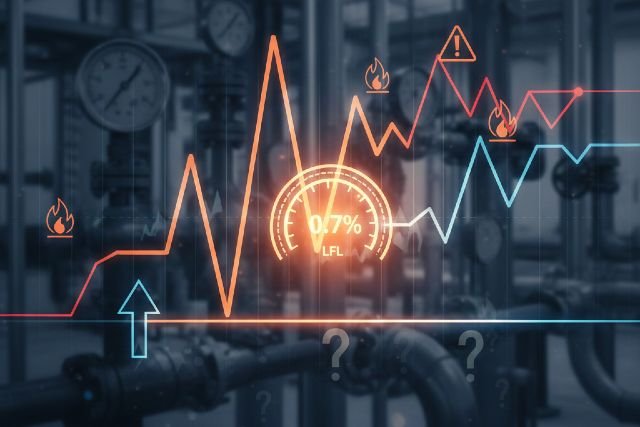
Most combustible gas monitors express readings in %LEL. That display is designed to help you react before conditions become flammable, not to tell you “you’re fine until you hit 100.”
Why alarm setpoints are usually far below 100% LEL
If a device waited until 100% LEL to alarm, it would be warning you at the moment the atmosphere becomes capable of ignition, leaving minimal time for response. In many practical systems and safety programs, low alarms are set in the 20–25% LEL range with higher alarms above that, depending on the risk and process design.
You can see this “early warning” philosophy reflected in residential propane alarm documentation that states activation occurs at concentrations below 25% LEL, giving occupants time to ventilate and respond.
In broader standards discussions for residential fuel gas detection, industry presentations and NFPA public comment material show active debate around lowering thresholds from 25% LEL toward 10% LEL to improve early detection.
The point is not that one number fits every site. The point is that alarms are intentionally conservative because real environments are messy, instruments have uncertainty, and time matters.
A scenario that shows the “below LFL” trap
Imagine a team opens a sump cover in a process area. A monitor at waist height reads 8% LEL. Someone says, “We’re below the lower flammable limit, so we can proceed.”
Now picture what’s happening physically. Heavier-than-air vapors can concentrate deeper in the sump, and the monitor at one height might not sample the richest layer. Lifting the cover changes airflow, potentially pushing vapor outward and creating a local zone in the flammable range. If an ignition source appears, even briefly, you’ve created the exact conditions LFL was meant to warn you about.
In this kind of job, the better question isn’t “Are we below LFL right now?” It’s “Are we controlling the atmosphere with enough margin, representative sampling, and continuous monitoring to stay below flammable conditions even if the situation changes?”
How to use the lower flammable limit correctly in real safety decisions
A good way to think about the lower flammable limit is as a boundary line on a map. Being on the “safe side” of the line is not the same as being safe if you’re walking toward the boundary quickly, if the map is imprecise, or if you’re only checking one point while the terrain changes elsewhere.
Start by using LFL/LEL data as an engineering reference, then build margin into how you work. That usually means setting triggers well below 100% LEL, choosing monitoring locations that reflect where vapors actually travel, and writing procedures that treat rising trends as more urgent than stable low readings.
It also means respecting calibration realities. If your sensor is calibrated on methane but you’re dealing with another vapor, treat the reading as a potentially biased estimate unless you’ve accounted for response differences. NIOSH highlights this exact issue for multi-gas monitors in the field.
Finally, if the hazard is complex, consider whether a different sensing approach is needed. LEL sensors are excellent tools, but they are not magic. The “right” setup depends on your site, fuels, and task.
Featured snippet-friendly FAQ
What does lower flammable limit mean?
The lower flammable limit is the minimum concentration of a flammable gas or vapor in air that can ignite and sustain flame propagation when an ignition source is present.
Is LFL the same as LEL?
In many safety contexts, LFL and LEL are used as equivalent terms, describing the lower boundary of ignitability for a gas/vapor in air under test conditions.
What does 10% LEL mean on a gas detector?
10% LEL means the measured combustible concentration is one-tenth of the lower limit for the calibration basis. It is not the same as 10% gas by volume in air, and safety references warn against confusing monitor readings with actual LFL concentrations.
Why do detectors alarm below the lower flammable limit?
Detectors alarm below 100% LEL to provide an early warning and time to respond before conditions become flammable. Many products and standards discussions reflect thresholds such as below 25% LEL and, in some debates, even lower for earlier detection.
Conclusion
The lower flammable limit is one of the most important safety metrics in fire and explosion prevention, but it’s also one of the easiest to misuse. It is a threshold for ignitability under defined conditions, not a promise that everything below it is safe. If you treat %LEL as a trend, build conservative margins into alarms and work practices, and account for calibration and gas-type differences, you’ll use LFL the way it was intended: as a decision tool that prevents incidents, not a slogan that creates false comfort.