

If you’re comparing types of tint, you’re probably trying to fix a very real daily annoyance: stepping into a hot cabin, squinting through glare, or feeling like your car’s interior is on display. The confusing part is that “darker” doesn’t automatically mean “cooler,” and two films that look similar from the outside can perform very differently in heat rejection, clarity, and long-term durability.
- What window tint actually does in a car
- The three tint goals most drivers care about
- The performance numbers that matter more than “percent tint”
- Types of tint for cars: what each one is best at
- Which tint is best for heat?
- Which tint is best for privacy?
- Which tint is best for looks?
- The biggest myth: darker tint always blocks more heat
- UV protection and why it matters on the road
- Real-world buying scenarios
- FAQ: quick answers people search for
- Conclusion: choosing the right types of tint without regret
What window tint actually does in a car
Automotive window tint is a thin film applied to the inside of your glass. Depending on the film type, it can reduce visible light (how dark the glass looks), reduce glare, block ultraviolet (UV) radiation, and cut the “feel” of heat from the sun by targeting infrared energy.
It helps to know that heat in a car is not just one thing. Some of the heat you feel is direct solar energy coming through the glass, and some is heat that builds up as your seats, dashboard, and interior materials absorb sunlight and then radiate it back into the cabin. That’s why the best tint choice is less about picking the darkest shade and more about picking the right film technology for your goal.
The three tint goals most drivers care about
Most tint buyers fall into one of three camps, even if they don’t say it out loud.
Heat-focused drivers want the cabin to feel noticeably cooler during daytime driving, especially in strong sun. They usually care about comfort, air-conditioning workload, and protecting interior materials from sun damage.
Privacy-focused drivers want the inside of the car harder to see. They often care about street parking, valuables, kids in car seats, or simply personal comfort.
Style-focused drivers want the windows to look cleaner and more premium. They often care about a neutral, factory-like finish rather than a mirror-like reflective effect.
The good news is you can usually get all three. The catch is that you’ll need to choose the right combination of film type and shade level rather than guessing based on darkness alone.
The performance numbers that matter more than “percent tint”
People commonly shop by “20% tint” or “5% tint,” but that number is only part of the story. It describes visible darkness, not overall heat control.
VLT: how dark it looks and how private it feels
VLT stands for Visible Light Transmission. It’s the percentage of visible light that passes through the glass and film together. A lower VLT looks darker and usually increases privacy, but it can also reduce night visibility if you go too dark on front windows.
If you want privacy, VLT is your primary lever. If you want heat control, you still care about VLT, but it’s not the most important number.
TSER: the heat-control stat worth paying attention to
TSER stands for Total Solar Energy Rejected. Think of it as a “big picture” heat number that reflects how much solar energy is being blocked overall. Educational explanations of TSER describe it as a key performance spec that indicates how much solar energy is rejected by the film.
This is where many buyers have their “aha” moment: two films with the same VLT can have very different TSER, which means one can feel significantly cooler even if both look equally dark.
IR metrics: why some films feel cooler even when they’re not very dark
Many premium films advertise infrared performance. You’ll see terms like IRR and IRER. The important point is that different brands may measure IR differently and over different wavelength ranges.
For example, 3M technical data sheets describe IRER as a measure over a broader infrared range, and note that it accounts for transmitted and absorbed IR energy that can be reradiated into the vehicle. This matters because the “felt heat” in a car isn’t only about what passes straight through; absorbed energy can re-radiate inward depending on the glass-film system.
If you’re comparing two films, try to compare IR numbers from spec sheets using the same kind of measurement, rather than relying on marketing claims alone.
UV protection: it’s not just an “extra”
UV protection is often discussed as interior protection, but it’s also about you and your passengers. The Skin Cancer Foundation notes that UVA rays can pass through window glass and reach you, including while you’re on the road.
That’s one reason many drivers choose higher-quality films even if they don’t want a very dark look: strong UV blocking can be valuable even in a lighter shade.
Types of tint for cars: what each one is best at
Now we’ll get into the practical part. These are the main types of tint you’ll see at reputable tint shops.
Dyed window tint
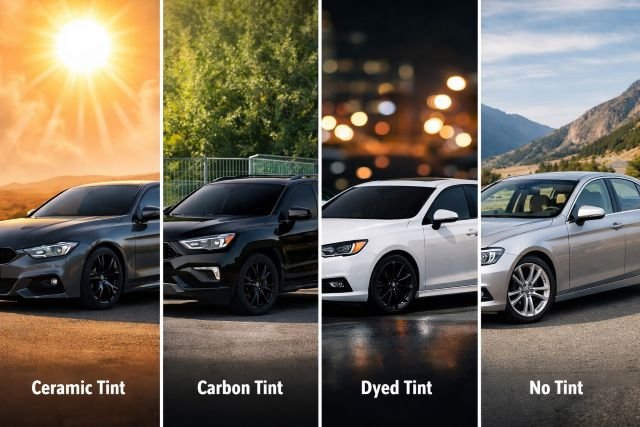
Dyed film is one of the most common entry-level options. It uses dye to darken the glass appearance and reduce some glare. It can improve the look of a car quickly and affordably, and it can offer a modest privacy boost depending on the VLT you choose.
The limitation is that dyed film generally isn’t the best choice for serious heat reduction. It can absorb heat, but it often won’t deliver the same TSER and infrared performance that advanced films can. If your biggest complaint is that the cabin feels like a furnace in summer, dyed tint can end up feeling like a cosmetic upgrade rather than a comfort upgrade.
Dyed tint can be a reasonable choice for a commuter who drives mostly early morning and evenings, parks in shaded areas, or simply wants a cleaner look on a budget. If that’s your situation, consider pairing dyed side-window tint with a higher-performing clear heat-rejecting film on the windshield, assuming it’s legal where you live. For deeper guidance.
Metalized window tint
Metalized tint uses metallic particles to reflect solar energy. Drivers often pick it when they want better heat performance than dyed film without jumping to the highest-priced premium options.
The potential downside is that metal can interact with electronics. Depending on the vehicle and film, metalized tint may contribute to weaker reception for GPS, mobile data, or radio signals. This isn’t guaranteed in every car, but it’s common enough that many people with newer vehicles, in-car navigation, or heavy phone use choose non-metallic films.
Metalized tint can also look slightly more reflective from the outside. Some people love that crisp, shiny appearance. Others prefer a more neutral “factory” look.
Carbon window tint
Carbon tint is often considered the “balanced” option. It tends to have a richer, darker aesthetic than basic dyed films and typically provides stronger heat performance than entry-level tint.
Carbon is popular among drivers who want a premium look without a reflective finish. It’s also a nice fit for people who want heat relief but aren’t ready to pay for top-tier ceramic film on every window.
A realistic scenario where carbon shines is the daily commuter who drives during the hottest hours and wants to feel the difference without aiming for maximum specs. It can also be a smart choice for drivers who dislike the look of metallic reflectivity but still want more comfort than dyed film provides. For a direct comparison.
Ceramic window tint
Ceramic tint is widely considered the best all-around choice for drivers who care about heat reduction, clarity, and long-term stability. It uses nano-ceramic technology to reject heat, often with strong infrared performance, while remaining non-metallic.
One reason ceramic gets recommended so often is that you can sometimes choose a lighter shade and still get meaningful comfort improvement. That matters if you want to stay closer to legal limits or you drive frequently at night and don’t want very dark front windows.
To ground this in real specs, 3M’s Automotive Window Film Ceramic IR Series states it can reject up to 66% of total solar energy and provide up to 95% infrared rejection, and it also notes the metal-free design is intended not to interfere with electronics. Those numbers vary by shade and test conditions, but they illustrate why film technology can outperform darkness alone.
Ceramic tint is especially worth considering if you live in a hot climate, park outside, drive long distances, or simply want to reduce the “sun sting” you feel on your skin through side glass. If you’re pricing it out, see /ceramic-window-tint-cost.
Hybrid window tint
Hybrid tint is a broad category and can vary a lot by manufacturer. In many cases it blends dyed and metalized layers, aiming to capture some of the benefits of both: better heat rejection than dyed, and less reflectivity or lower cost than some premium films.
Because “hybrid” can mean different constructions, it’s the category where you should most strongly insist on a spec sheet that includes VLT and TSER. If a shop can’t explain the film’s performance numbers, you’re essentially buying blind.
Hybrids can be a strong “middle ground” choice when the film line is reputable, the specs are clear, and the finish matches your taste.
Which tint is best for heat?
If heat is your top priority, focus on TSER and clearly defined infrared performance metrics. TSER is commonly explained as a key measure of how much solar energy is being blocked. Infrared metrics can further indicate how much “sun feel” is reduced, but make sure you’re comparing the same type of measurement when you compare brands.
In practice, premium ceramic films tend to lead for heat control because they can deliver high solar energy rejection without relying on metal layers, and they can do it even at lighter VLT levels. That combination is why ceramic is often the best answer for drivers in very hot regions or anyone who spends a lot of time in daytime traffic.
Which tint is best for privacy?
Privacy is mainly governed by VLT. Lower VLT makes it harder to see into the car, especially in daylight. If you primarily want privacy, you’ll typically choose a darker VLT for the rear doors and back glass where laws often allow darker tint than on the front windows.
Film type still matters for privacy comfort. A darker dyed film can provide privacy, but a darker premium film can provide privacy plus stronger heat relief and better clarity. This becomes important if you want the rear windows quite dark but still want the cabin to feel comfortable and reduce glare.
If you’re aiming for privacy without sacrificing night driving confidence, it’s usually smarter to go moderate on the front windows and reserve the darkest tint for rear windows, then use a higher-performing film type to make the moderate front tint still feel cool and comfortable. You can read a practical walkthrough at /best-tint-percent-for-privacy.
Which tint is best for looks?
“Best looking” depends on whether you prefer a neutral finish or a reflective sheen.
If you want the most factory-like look, many drivers gravitate toward carbon and ceramic films because they can look deep and neutral rather than shiny. If you like a brighter, slightly reflective appearance, metalized films can give that effect.
A good way to decide is to ask the shop to show the same vehicle model with different film lines installed. The difference between “nice” and “premium” often comes down to how neutral the tint appears and how consistent it looks across curved glass.
The biggest myth: darker tint always blocks more heat
This myth causes a lot of buyer’s remorse. Darkness mainly reduces visible light. Heat control is better predicted by TSER and the film’s infrared performance.
That’s why a high-performing ceramic film at a lighter shade can sometimes feel cooler than a very dark budget dyed film. When you’re shopping specifically for heat relief, the spec sheet matters more than the shade card.
UV protection and why it matters on the road
A lot of people assume the windshield and side glass fully protect them from UV. The Skin Cancer Foundation points out that UVA can pass through window glass and contribute to skin damage.
This is one of the most practical reasons to consider quality film even if you don’t want very dark windows. A lighter tint or even a nearly clear UV-protective film can help reduce UV exposure during long commutes and road trips.
If you’re trying to balance legality, night visibility, and sun protection, many drivers choose a lighter film on front side windows and a clear or very light protective film on the windshield, while keeping darker privacy tint for the rear glass where permitted. For install guidance, see /how-to-choose-a-window-tint-shop.
Real-world buying scenarios
If you live in a very hot climate and your car sits outside at work, ceramic is usually the most satisfying long-term upgrade. The reason is simple: you feel the benefit every time you get back in the car, and you can often keep the front windows at a moderate VLT while still getting noticeable comfort.
If you’re mostly after privacy because you street-park or carry valuables, start with VLT and legality, then choose the best film type you can afford at that darkness. A darker film gives privacy, but a higher-quality film gives privacy plus better heat control and often better clarity.
If your main goal is appearance, carbon and ceramic tend to deliver the cleanest neutral aesthetic. Dyed film can still look good, but the best “OEM style” finish often comes from premium lines that maintain a consistent, neutral tone.
FAQ: quick answers people search for
What are the main types of tint for cars?
The main types of tint are dyed, metalized, carbon, hybrid, and ceramic. The difference is not just how dark they look, but how they manage solar energy, infrared heat, and UV exposure, which is why two films with similar darkness can feel very different in real driving.
Which window tint is best for heat reduction?
For most drivers, ceramic tint is the best for heat because it can deliver high total solar energy rejection and strong infrared performance while remaining non-metallic. Look at TSER and clearly defined IR metrics to compare films accurately.
Does darker tint always block more heat?
No. Darkness is controlled by VLT, but heat control is better predicted by TSER and the film’s infrared performance. A lighter premium film can sometimes outperform a darker budget film in comfort.
Does window tint help block UV rays?
Yes, quality films can significantly reduce UV exposure through windows. The Skin Cancer Foundation notes that UVA can pass through window glass, which is one reason UV-protective window film is discussed for sun protection.
Conclusion: choosing the right types of tint without regret
When you’re comparing types of tint, the smartest move is to match the film technology to your goal. If you want real heat relief, shop TSER and infrared performance first, because those numbers explain why one film can feel cooler than another even if both look the same darkness. If privacy is your priority, choose the VLT you can comfortably drive with, then pick the best film type you can afford at that shade. If looks are your priority, carbon and ceramic are often the easiest path to a neutral, premium finish.