

When people search intake manifold intake manifold leak symptoms, it usually starts with a feeling: the engine doesn’t sound like it used to, the idle isn’t steady, or the check engine light suddenly shows up with a “too lean” code. The reason this problem creates so much confusion is simple. An intake manifold leak can imitate ignition issues, fuel delivery problems, and even exhaust or sensor faults. But the leak has its own “fingerprint,” and once you know what to watch for, you can spot it fast.
- What an Intake Manifold Leak Really Means
- Intake Manifold Intake Manifold Leak Symptoms That Usually Appear First
- Symptoms That Suggest a Coolant-Related Intake Manifold Leak
- The Fastest Way to Confirm an Intake Air Leak: Fuel Trim Behavior
- How to Spot the Leak Quickly Without Guessing
- Common Mistakes That Waste Time and Money
- Repair Reality: What Usually Gets Replaced
- FAQs
- Conclusion
This guide focuses on the symptoms that show up first, the patterns that separate an intake air leak from a coolant-related leak, and the quickest real-world checks that help you confirm your suspicion before you start replacing parts.
What an Intake Manifold Leak Really Means
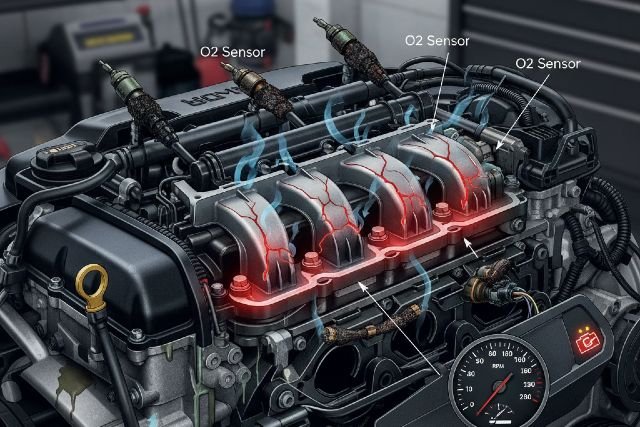
Your intake manifold is the engine’s air distribution hub. It routes incoming air to each cylinder, and it seals to the engine with gaskets that must keep outside air out and, on many engines, keep coolant flowing only where it’s supposed to go.
That’s why the symptoms depend on the type of leak. A leak that pulls in unmetered air tends to push the engine lean and triggers fuel-trim corrections. A leak involving coolant can create overheating, white exhaust smoke, or coolant loss that seems to have no obvious source.
The important takeaway is that “intake manifold leak” isn’t one single symptom. It’s a cluster of symptoms that appear together in predictable combinations.
Intake Manifold Intake Manifold Leak Symptoms That Usually Appear First
Rough idle that feels worse at stoplights than on the highway
One of the earliest and most common signs is a rough or unstable idle. At idle, engines operate under higher intake vacuum. If there’s a leak, a relatively small amount of unmetered air makes a big difference, and the idle can surge, hunt, or even stall.
A useful real-world clue is how the engine behaves when you gently raise RPM. Many vacuum-type leaks become less noticeable when you hold the engine slightly above idle, because the leak becomes a smaller fraction of total airflow.
A hissing sound near the top of the engine
Owners often describe a hiss or “air sucking” sound coming from the engine bay. That’s not always the manifold itself, but vacuum leaks around the intake area are a common cause of lean conditions and often produce audible hissing. One diagnostic write-up specifically notes that vacuum leak sounds often accompany lean codes, and that the hissing can be heard around intake manifold areas, throttle body connections, and vacuum hose routing.
If you hear a hiss and the engine feels rough at idle, that pairing is worth taking seriously.
Check engine light with lean codes like P0171 and P0174
A big “tell” for an intake air leak is a lean diagnostic trouble code. P0171 and P0174 are two of the most common ones drivers see. Multiple references describing these codes point to vacuum leaks and intake-related air leaks as common causes, along with other possibilities like MAF sensor contamination or fuel delivery issues.
If you see one lean code on one bank, it can still be an intake manifold gasket issue, but it can also be more localized. If you see lean behavior across banks on a V engine, the likelihood of a shared air leak (intake tract, PCV plumbing, manifold gasket, or brake booster hose) tends to rise.
Hesitation and “lazy” acceleration
When the mixture runs lean, the engine may hesitate when you tip into the throttle. Some drivers describe it as a brief stumble, then it catches up. A repair guide describing P0174 lists common driver-visible signs such as rough idle, hesitation on acceleration, and reduced fuel economy.
This symptom alone doesn’t prove a manifold leak, but it becomes meaningful when it appears together with rough idle and lean codes.
Misfires that appear randomly or mostly at idle
A vacuum-style intake leak can push one or more cylinders into a lean misfire, especially at idle and low load. That can trigger misfire codes, create shaking you can feel through the steering wheel, and sometimes produce a blinking check engine light if the misfire is severe enough.
Symptoms That Suggest a Coolant-Related Intake Manifold Leak
Some intake manifold gasket failures involve coolant passages. These can be higher urgency because overheating can escalate quickly.
Coolant level dropping without an obvious puddle
If you keep topping off coolant and can’t find a steady drip on the ground, it’s possible the leak is internal or it’s evaporating off hot parts. Many intake manifold coolant leak symptom guides list low coolant level as a recurring sign, often paired with other indicators like overheating or rough running.
Sweet smell from the engine bay or the exhaust
Coolant has a distinct sweet odor. If you smell it after driving, especially near the top of the engine, it can point to a small external leak that’s hitting hot components and burning off.
White smoke that lingers after warm-up
Light vapor on a cold morning can be normal. What isn’t normal is thick white smoke that continues after the engine is warm. Intake manifold coolant leak guides commonly describe lingering white smoke as a telltale sign of a serious leak.
White smoke can also come from other problems, including head gasket issues, so treat it as a sign that you need a proper diagnosis rather than a final verdict.
Overheating or temperature spikes in traffic
Overheating is one of those symptoms you never want to “test your luck” with. If coolant is escaping or the system is pulling in air, your temperature gauge may climb when you idle in traffic and drop again once you get moving.
The Fastest Way to Confirm an Intake Air Leak: Fuel Trim Behavior
If you have access to a basic scan tool that shows fuel trims, you can often confirm the “shape” of the problem in minutes.
Fuel trims are the ECU’s way of correcting mixture. When unmetered air enters the engine through a vacuum leak, the computer adds fuel to compensate. A fuel trim explainer describes that short-term fuel trim increases to match the higher amount of air going in due to a vacuum leak.
The pattern that many technicians rely on is this: a vacuum leak often produces more positive fuel trim numbers at idle than at cruising RPM. A professional trade article on using fuel trim data notes that fuel trims can be positive at idle with a vacuum leak, then return closer to normal during cruise and higher airflow conditions because the leak becomes “masked” when airflow increases.
In plain English, that means this. If your trims are noticeably high at idle but calm down when you hold 2,000 RPM, a vacuum-style intake leak becomes a very strong suspect.
How to Spot the Leak Quickly Without Guessing
Start with a cold idle check, then listen carefully
A cold start often makes the symptoms more obvious before the ECU settles into its normal correction strategy. Let it idle and listen near the intake area. If the idle is unstable and you hear a hiss that seems to come from the top of the engine, that combination fits the vacuum leak profile.
Look for the “usual suspects” around the intake system
Many “intake manifold” problems turn out to be something connected to it. Cracked PCV hoses, hardened vacuum elbows, and loose intake duct clamps can all create unmetered air that produces the same lean symptoms.
This matters because P0171 and P0174 explanations repeatedly list vacuum leaks as common causes, alongside MAF sensor issues and fuel system problems.
Don’t skip the smoke test if you want the fastest certainty
A smoke test is one of the most efficient ways to find intake leaks because it makes the leak visible. If you’re deciding between hours of DIY guessing and one definitive diagnostic, smoke testing is usually the better value.
Common Mistakes That Waste Time and Money
One common mistake is replacing the oxygen sensor first because the code says “too lean.” Lean codes do not automatically mean the oxygen sensor is bad. Most code guides emphasize that lean codes can be caused by vacuum leaks, MAF issues, and fuel delivery faults.
Another mistake is ignoring the issue because the car still drives “okay.” A P0171 overview warns that if ignored, the problem may lead to misfires or catalytic converter damage.
Repair Reality: What Usually Gets Replaced
Most repairs fall into two categories. The first is replacing the intake manifold gasket because the seal has failed. The second is replacing the manifold itself if it’s cracked or warped, which can happen with some plastic designs.
A practical note from P0171 repair guidance is that once the cause is identified, the repair might involve replacing a cracked vacuum hose, a failed intake manifold gasket, or cleaning a contaminated MAF sensor, and it emphasizes cleaning mating surfaces carefully for a proper seal when replacing gaskets.
That’s a useful reminder because intake gasket jobs can fail early when the surfaces aren’t prepared properly or bolts aren’t torqued in the right sequence.
FAQs
What are the most common intake manifold intake manifold leak symptoms?
The most common symptoms are a rough idle that often improves when RPM is raised slightly, a hissing sound near the intake area, hesitation on acceleration, and a check engine light that may include lean codes like P0171 or P0174. Lean-code resources commonly list vacuum leaks among the frequent causes.
Can an intake manifold leak cause P0171 or P0174?
Yes. P0171 and P0174 indicate the ECU is detecting a lean condition, and many code explanations identify vacuum leaks and intake-related unmetered air as common causes, alongside other possibilities such as MAF sensor issues or fuel delivery faults.
What’s the quickest way to tell if it’s a vacuum leak versus a fuel problem?
Fuel trims often tell the story. With a vacuum leak, the ECU tends to add fuel, and professional diagnostic guidance notes that positive fuel trims can be strongest at idle and move closer to normal at cruise as airflow increases and the leak becomes less influential.
Can a bad intake manifold gasket cause white smoke?
It can, if coolant is entering the intake path and then the combustion chambers. Intake coolant leak symptom guides commonly mention thick white smoke that lingers after warm-up as a warning sign.
Is it safe to drive with an intake manifold leak?
A small air leak might allow you to drive short distances, but it can cause misfires and prolonged lean operation, which some code guides warn can contribute to catalytic converter damage if ignored.
If the symptoms point to coolant loss or overheating, the risk is much higher and continuing to drive can lead to severe engine damage.
Conclusion
Catching intake manifold intake manifold leak symptoms early saves you from the expensive chain reaction that can follow a long-term lean condition or coolant loss. If the engine idles rough, you hear hissing, and you see lean codes like P0171 or P0174, focus your diagnosis on unmetered air and intake sealing first, then confirm with fuel trim behavior and a smoke test when possible. If coolant is disappearing, white smoke lingers after warm-up, or overheating shows up, treat it as urgent and diagnose before driving further.