


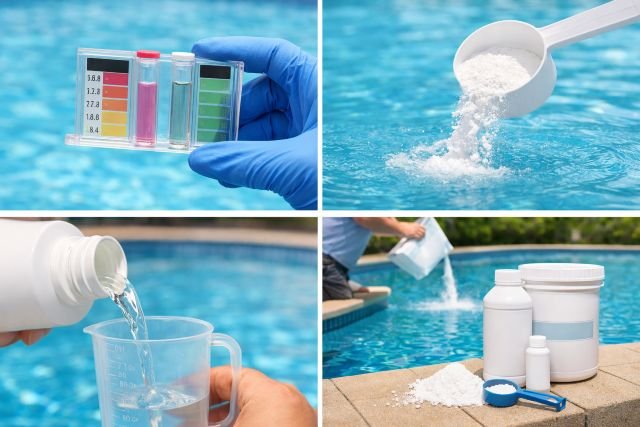
If you’re searching for how to raise ph in pool fast, you’re probably noticing at least one of these issues: the water feels harsh, eyes sting, metal parts look dull, or your readings are drifting below the comfortable zone. The good news is that pH is one of the quickest chemistry levels to correct, as long as you use the right product, add it in measured steps, and avoid pushing other levels out of balance.
- What Pool pH Means and Why Low pH Is a Problem
- Confirm Your Test Is Accurate Before You Add Anything
- How to Raise pH in Pool Quickly Using Soda Ash
- Exact Dosage Tips: A Practical Calculation You Can Use
- Fast Alternative: Raise pH Without Raising Alkalinity Using Aeration
- How Long It Takes for pH Increaser to Work
- Common Reasons pH Keeps Dropping
- FAQs
- Conclusion
Most pool owners aim for a pH range that keeps swimmers comfortable and helps chlorine work efficiently. The CDC’s healthy swimming guidance commonly recommends keeping pool pH between 7.0 and 7.8.
What Pool pH Means and Why Low pH Is a Problem
pH measures how acidic or basic your pool water is. A pH of 7.0 is neutral, values below 7.0 are acidic, and values above 7.0 are basic. When pH drops too low, the water becomes more acidic and can feel irritating to swimmers. Low pH can also accelerate corrosion on ladders, rails, heaters, and other metal components and may shorten the life of some pool surfaces and equipment.
A practical target for many residential pools is roughly 7.2 to 7.8, with the CDC commonly citing 7.0 to 7.8 as an acceptable operating range.
Confirm Your Test Is Accurate Before You Add Anything
Before adjusting chemistry, confirm the reading is real. Testing errors are common, especially when strips are old, stored in humidity, or read late. Run the pump for at least 30 minutes so the water is mixed, then retest pH. If you used strips, confirm with a drop-based kit for a more reliable reading. If pH is truly below about 7.2, you can usually raise it quickly, often within the same day.
How to Raise pH in Pool Quickly Using Soda Ash
The fastest common method is using soda ash, also called sodium carbonate, often sold as pH increaser or pH up. Soda ash raises pH quickly and typically increases total alkalinity a bit as well. Because it can move two targets at once, the best results come from dosing in increments and retesting rather than adding one large amount.
A widely used dosing rule of thumb is that about 6 ounces of soda ash per 10,000 gallons raises pH by about 0.2, though the exact change depends on your starting pH and total alkalinity.
Step 1: Know Your Pool Volume
Every dosage depends on gallons. If you’re not sure, use your pool’s dimensions and average depth to estimate volume. A 10 to 20 percent error in volume can turn a “quick fix” into an overcorrection, so this step matters.
Step 2: Check Total Alkalinity Before You Dose
Total alkalinity is your pH buffer. When TA is low, pH can swing and “bounce,” and when TA is high, pH can become stubborn or rise on its own. Even if your main goal is how to raise ph in pool, TA tells you how aggressive to be and whether you should consider a different method like aeration.
Step 3: Pre-Dissolve and Add With Circulation Running
For the fastest, safest results, pre-dissolve soda ash in a clean bucket of pool water. With the pump running, slowly pour the solution in front of a return jet so it disperses quickly. Avoid dumping granules in one spot, especially in shallow areas, because concentrated chemicals can cloud water and may stress some finishes.
Let the pump run continuously while it mixes. Retesting after 30 to 60 minutes can show early movement, but retesting after two to four hours often gives a more stable picture.
Step 4: Re-Test and Repeat in Smaller Increments
The fastest results in real life come from two or three smaller doses rather than one big dose. Overshooting pH creates new problems, like reduced chlorine effectiveness, scale risk in hard water, and the need to add acid to pull pH back down.
Some product directions simplify dosing for low pH. For example, one soda ash product guideline suggests adding 1 pound per 10,000 gallons when pH is below 7.2, while still emphasizing proper circulation and measured treatment.
Exact Dosage Tips: A Practical Calculation You Can Use
Because pool water buffers differently based on alkalinity, temperature, and starting pH, no dosage is perfectly universal. The most accurate approach is to calculate a starting dose, apply it, circulate, retest, and then adjust.
Using the common rule of thumb that 6 ounces per 10,000 gallons raises pH by about 0.2, you can estimate ounces needed with this approach: multiply your pool gallons divided by 10,000 by your desired pH increase divided by 0.2, then multiply by 6.
Here’s a realistic scenario. Imagine a 20,000-gallon pool with a current pH of 7.0 and a target of 7.4. That’s an increase of 0.4. The scaling factor for volume is 2 because 20,000 is twice 10,000. The scaling factor for pH change is also 2 because 0.4 is twice 0.2. The estimate becomes 2 times 2 times 6 ounces, which equals 24 ounces, or 1.5 pounds.
A reliable “exact dosage” habit is splitting that estimate into two steps. You add about half first, circulate for a couple of hours, retest, and then add only the remainder needed to reach the target.
Fast Alternative: Raise pH Without Raising Alkalinity Using Aeration
If your alkalinity is already high, soda ash can push it higher, which may increase the chance of cloudiness or scaling over time. In that situation, aeration can be a better solution. Aeration raises pH by driving carbon dioxide out of the water without increasing TA.
You can aerate quickly by aiming return jets upward to break the surface, running a fountain or water feature, using spillover from an attached spa, or turning on air features if your system has them. Aeration may not “spike” pH instantly like soda ash, but with strong surface agitation it can move pH meaningfully over several hours, especially in pools that are already close to the target range.
How Long It Takes for pH Increaser to Work
You can often see a change within a few hours, especially if circulation is strong and the chemical is pre-dissolved. For decision-making, testing two to four hours after dosing is usually more useful than testing immediately, because it gives time for mixing and stabilization.
Swimming timing depends on the product and how fully it has dispersed. Some retail guidance suggests waiting several hours with circulation before swimming. The safest approach is to circulate thoroughly, retest, and ensure pH is within the recommended range before anyone gets in. CDC guidance emphasizes maintaining pH in the recommended range for healthy swimming and proper sanitizer performance.
Common Reasons pH Keeps Dropping
If you raise pH and it falls again soon after, you’re likely dealing with an ongoing cause rather than a one-time imbalance. Frequent use of acidic chlorine products such as trichlor tablets can slowly lower pH. Heavy rain and frequent top-offs can dilute alkalinity and destabilize pH. Low total alkalinity can cause pH to swing and drift. High bather load with poor circulation can also contribute to unstable readings.
In these cases, fixing pH quickly today is still helpful, but the longer-term win comes from stabilizing TA and reviewing sanitizer choices and dosing practices.
FAQs
How can I raise my pool pH fast?
The quickest method is usually adding soda ash, also sold as pH increaser, in small measured doses with the pump running. A common starting estimate is about 6 ounces per 10,000 gallons to raise pH by roughly 0.2, then retest and adjust.
What pH should my pool be?
Many residential pools aim for roughly 7.2 to 7.8, and the CDC commonly recommends keeping pH between 7.0 and 7.8.
Can I raise pH without raising alkalinity?
Yes. Aeration raises pH by releasing carbon dioxide from the water and does not increase total alkalinity. It’s a strong option when alkalinity is already high and you want pH to rise without adding buffering chemicals.
Why does my pool pH keep going down?
Common causes include ongoing use of acidic chlorine products, low total alkalinity, dilution from rain or frequent refilling, and circulation issues. Stabilizing alkalinity and reviewing sanitizer type and dosing habits usually reduces repeated pH drops.
Conclusion
If you want how to raise ph in pool quickly without creating a chemistry roller coaster, start with accurate testing, use soda ash for the fastest pH lift, and dose in increments with strong circulation and retesting between additions. A practical estimate is about 6 ounces per 10,000 gallons to raise pH by roughly 0.2, adjusted based on your pool’s total alkalinity and how far you need to move. The CDC’s recommended operating range of roughly 7.0 to 7.8 provides a dependable target zone for swimmer comfort and sanitizer performance.