


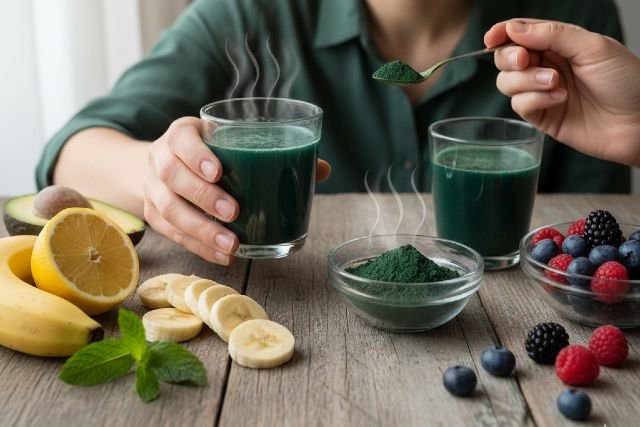
If you’re here because you’re wondering what does spirulina taste like, you’re not alone. Spirulina is one of those wellness staples people buy for the nutrition, then hesitate to use because they’ve heard it tastes like pond water. The truth is more balanced and more useful: spirulina usually tastes earthy and green, sometimes mildly bitter, and often carries a noticeable seaweed-like “marine” note. How strong it feels depends heavily on the brand, freshness, and how you take it.
- Quick answer: what does spirulina taste like?
- Why spirulina tastes and smells the way it does
- A realistic spirulina taste profile in plain language
- How strong is spirulina taste on a scale that makes sense?
- Does spirulina taste different in powder, tablets, and gummies?
- What does spirulina smell like, and why does it matter?
- Why some spirulina tastes worse than others
- How to make spirulina taste better in real life
- How spirulina tastes in common drinks and foods
- Common questions people ask about spirulina taste
- Conclusion: what does spirulina taste like, really?
This article breaks down spirulina’s taste and smell in a realistic way, explains why it tastes like algae in the first place, and shows you how to make spirulina taste better without ruining the nutrition or your drink.
Quick answer: what does spirulina taste like?
Spirulina tastes earthy, grassy, and seaweed-like, with a mild bitterness and a mineral “green” finish. Many people compare it to seaweed, wheatgrass, or a concentrated spinach flavor. In lower-quality or poorly stored products, some people notice a stronger “fishy” or pond-like note, which is often more about aroma than taste.
Because smell strongly influences flavor, spirulina’s odor can shape your experience even before you take a sip. Dried spirulina commonly smells like dried seaweed, algae, or a musty green powder. That first sniff often determines whether you’ll find it tolerable or intense.
Why spirulina tastes and smells the way it does
Spirulina is made from cyanobacteria (often listed as Arthrospira or Limnospira), and its “algae taste” is part identity and part chemistry. It contains natural pigments, lipids, and aromatic compounds that translate into a green, marine sensory profile. Spirulina is also used as a food ingredient at small gram-level amounts and appears in GRAS notices for use in foods, which is one reason it’s so common in smoothies and functional beverages.
Food science research analyzing spirulina aroma has identified odor-active compounds that are known to produce grassy, plant-like, fatty, and sometimes “marine-adjacent” notes. One study using detailed aroma techniques reports potent spirulina odorants such as hexanal, oct-1-en-3-ol, β-cyclocitral, and β-ionone, which are compounds widely associated with green or oxidized-fat aromas and plant-like notes in other foods.
It also helps to know why some spirulina smells “earthy” or “pondy.” In aquatic systems, earthy and musty smells are often linked to compounds like geosmin and 2-methylisoborneol (2-MIB), which humans can detect at extremely low concentrations. Even tiny amounts can feel overwhelming to your nose.
A 2024 review focused on improving spirulina flavor notes that acceptability is strongly influenced by processing and application, and that different approaches can reduce unpleasant odors, though outcomes still depend on how spirulina is used in real foods. In everyday terms, the way spirulina is produced and handled can change your experience a lot.
A realistic spirulina taste profile in plain language
Most people experience spirulina as a “green” flavor first. It feels earthy and grassy, similar to a greens powder. If you’ve tasted wheatgrass or chlorella, you’ll recognize that style of intensity, although spirulina is often a bit smoother than wheatgrass and less sharp than some chlorella products.
The marine note shows up next, especially in water, light juices, or anything that doesn’t have much sweetness or acidity. People often call it seaweed-like. This is where some describe a subtle umami quality, like the savory edge you get in nori or kombu, but less pleasant if you weren’t expecting it.
Then comes the finish. Spirulina can leave a mild bitterness and a mineral aftertaste. If you use too much, that bitterness becomes the dominant sensation and can linger. If you use a small amount and pair it with fruit, the bitterness usually fades into the background.
If spirulina tastes strongly fishy, rancid, or like stagnant pond water, that’s not the “normal” baseline most people aim for. It can happen with certain batches, storage conditions, or simply a very pungent product. In those cases, reducing your dose or switching brands often makes a bigger difference than trying to mask it with stronger flavors.
How strong is spirulina taste on a scale that makes sense?
In practical kitchen terms, spirulina’s flavor intensity is dose-sensitive. A tiny amount can add a subtle green note, but doubling it can make your smoothie taste like algae. That’s why many people do better starting small and building up, rather than trying to jump straight to a “full serving” on day one.
If you want a realistic expectation, spirulina is much easier to hide in something thick, sweet, and acidic than in plain water. It’s also easier to tolerate cold than room temperature, because cold dulls aroma.
Does spirulina taste different in powder, tablets, and gummies?
Powder tends to taste the strongest because it’s fully exposed to your tongue and your nose the moment it hits liquid. That instant bloom of aroma is what makes powder feel intense, even at modest doses.
Tablets and capsules are usually easier for people who dislike the flavor because you can swallow them quickly with minimal contact time in your mouth. The tradeoff is that if a tablet begins dissolving before you swallow, you may still get a sudden algae aftertaste, which some people find even more unpleasant because it’s unexpected.
Gummies and flavored products can be easier, but they vary widely. Some use enough sweetener and acid to balance the algae notes, while others still let the green flavor come through. Also, flavored formats sometimes contain smaller amounts of spirulina, so the taste is lighter simply because the dose is lower.
What does spirulina smell like, and why does it matter?
Spirulina often smells more intense than it tastes. The most common descriptions are dried seaweed, algae, or a musty “green” powder. That smell is a major reason people say spirulina “tastes like pond,” because your brain merges aroma with flavor.
If you open a container and the smell is aggressively musty, fishy, or rancid, treat that as a quality signal. Spirulina is sensitive to heat, light, and oxygen over time. Even if it’s still safe, the sensory profile can degrade.
A simple real-world scenario explains this well. Two people can try the same recipe and disagree about the taste. One uses a fresh bag stored airtight in a cool cupboard. The other uses an older container kept near a warm stove and opened daily. The second person will often experience a stronger smell and harsher aftertaste because aroma compounds and oxidation notes are more noticeable.
Why some spirulina tastes worse than others
Source and processing matter. Spirulina cultivated and dried carefully, then stored well, can taste mild and clean for what it is. Spirulina that’s older, exposed to heat, or processed in a way that emphasizes oxidation can taste sharper, more bitter, and more pond-like.
Research on spirulina aroma shows that its sensory profile includes multiple odor-active compounds, and a 2024 review discusses approaches to mitigate undesirable notes. That aligns with what consumers notice: the same “ingredient” can taste very different depending on how it’s produced and used.
How to make spirulina taste better in real life
The easiest way to make spirulina taste better is to stop treating it like a standalone flavor. Spirulina is a supporting ingredient. It behaves best when you pair it with sweetness, acidity, and a thicker texture.
Sweetness is helpful because it reduces perceived bitterness and distracts from seaweed notes. Fruit-based sweetness usually works better than neutral sweeteners because fruit also brings aroma that competes with spirulina’s smell.
Acidity is the most underrated trick. Citrus, pineapple, berries, or yogurt can brighten the overall flavor and reduce the “marine” heaviness. This is why spirulina often tastes more tolerable in tropical smoothies than in green juices.
Thickness helps because it slows down aroma release and makes the flavor feel less sharp. A thin spirulina drink lets the smell rise quickly and dominate your senses. A thicker smoothie keeps things more balanced.
Cold temperature also helps. Cold dulls aroma, and spirulina’s smell is a big part of why people struggle with it. Blending with ice or using chilled ingredients can noticeably improve your experience.
How spirulina tastes in common drinks and foods
In a banana smoothie, spirulina usually reads as “green” more than “seaweed.” Banana’s sweetness and thick texture do a lot of work. If you add a small amount of citrus or pineapple, it often becomes even easier to hide.
In pineapple or mango smoothies, spirulina is often the most “maskable.” Tropical fruit is aromatic, sweet, and naturally acidic, so it crowds spirulina out.
In plain water, spirulina is at its most honest. You’ll get the marine smell, the grassy taste, and the bitter finish more clearly. If you want to take it in water anyway, cold water and a squeeze of lemon tend to make a difference.
In yogurt, spirulina can be surprisingly manageable because the tang and thickness reduce the sharp edges. The taste becomes more like “earthy green” than “pond.”
In baked goods, spirulina’s taste is usually muted, but it can still leave a green, slightly earthy aftertaste depending on how much you use. Many people use it more for color than for nutrition in baking, because heat and recipe ratios can limit how much you can add before flavor shows up.
Common questions people ask about spirulina taste
Does spirulina taste like seaweed?
Often, yes. Many people describe spirulina as seaweed-like, especially in water or lightly flavored drinks. In thicker, fruit-based smoothies, the seaweed note is typically less obvious and can fade into a general “greens” taste.
Is spirulina supposed to taste fishy?
A slight marine note can be normal, but strong fishy, rancid, or stagnant flavors are not what most people consider “good spirulina.” If the taste is aggressively fishy, try a fresher product, store it airtight away from heat, and reduce the dose.
Why does spirulina taste bitter?
Bitterness tends to appear when the dose is high, the drink is thin, or there’s not enough sweetness or acidity to balance it. It can also be more noticeable in some products because of natural variation and processing differences.
Can you get spirulina that doesn’t taste bad?
You can get spirulina that tastes milder and cleaner, but it almost never tastes like nothing. The goal is usually “easy to blend and hide,” not “tasteless.” Using it in the right recipes often matters more than chasing the perfect brand.
Conclusion: what does spirulina taste like, really?
So, what does spirulina taste like in real life? Most of the time, it tastes earthy, grassy, and seaweed-like, with a mild bitterness and a mineral green finish. The smell can be stronger than the taste, and that aroma is a big reason spirulina gets a “pond water” reputation. Quality, freshness, and storage can noticeably change the experience, and dose matters more than people expect.
If you want spirulina without the struggle, treat it like a background ingredient. Keep the dose modest, use cold and thick recipes, and pair it with fruit sweetness and acidity. Done right, spirulina becomes “a faint green note” instead of the main character in your glass.