

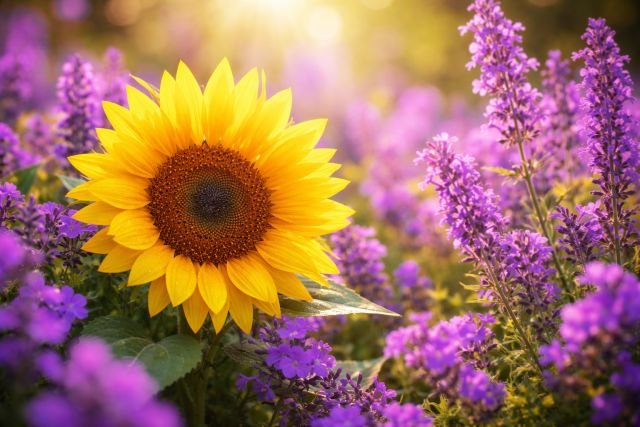
The sunflower and purple combination has a way of stopping people mid-scroll. It feels bright, emotional, and strangely “intentional,” like it’s saying something beyond aesthetics. That reaction isn’t random. Sunflower yellow and purple sit opposite each other on the color wheel, which makes them complementary and naturally high-contrast. Designers use complementary pairs to create visual energy and direct attention, and yellow–purple is one of the clearest examples.
- What Does Sunflower and Purple Mean Together?
- Sunflower Symbolism: Why This Flower Feels Like Pure Light
- Purple Symbolism: Royal, Spiritual, Creative, and Unforgettable
- Why Sunflower and Purple Feels So Visually Powerful
- Sunflower and Purple Symbolism in Love, Relationships, and Personality
- Sunflower and Purple in Spiritual and Mindset Symbolism
- How to Use Sunflower and Purple in Design Without It Looking Too Loud
- Branding Psychology: What Sunflower and Purple Signals to Customers
- Sunflower and Purple for Weddings and Events
- Fashion and Personal Style: Wearing Sunflower and Purple
- Common Questions About Sunflower and Purple
- Actionable Ways to Use Sunflower and Purple Intentionally
- Conclusion: Why Sunflower and Purple Keeps Winning Hearts
But the power of sunflower and purple goes deeper than color theory. Each element carries its own symbolism: sunflowers often signal optimism, loyalty, and warmth, while purple has long been tied to royalty, spirituality, and creativity. When you blend them, you get a message that feels like hopeful confidence with depth — joy that doesn’t feel shallow.
What Does Sunflower and Purple Mean Together?
At its simplest, sunflower and purple tends to communicate “bright hope meets meaningful depth.” Sunflower yellow reads as open and uplifting. Purple reads as thoughtful and distinctive. Put them together and people often perceive a blend of cheerfulness and sophistication.
This is also why the combo can feel “powerful” rather than merely pretty. Complementary colors create strong contrast, and strong contrast creates emphasis. Yellow and purple sit opposite each other on the color wheel, so they intensify one another visually.
If you want a more emotional definition, this pairing often signals a personality or message that is both optimistic and self-possessed. It can suggest confidence without harshness, creativity without chaos, and warmth without naivety.
Sunflower Symbolism: Why This Flower Feels Like Pure Light
Sunflowers are one of the most instantly legible symbols in nature. Even people who don’t care about flowers tend to recognize what a sunflower is “trying to say.”
A big part of that is shape and color. Sunflowers resemble the sun, and our brains associate sun-like visuals with daytime, safety, warmth, and energy. It’s also why sunflowers show up constantly in imagery around encouragement, milestones, and fresh starts.
Another reason sunflowers gained symbolic weight is their famous sun-tracking behavior. In the juvenile stage, many sunflowers exhibit heliotropism, moving to face the sun as it crosses the sky. That behavior has helped anchor sunflower meaning in ideas like orientation toward light, devotion, and perseverance.
In everyday gifting and decorative use, sunflower symbolism most commonly clusters around joy, positivity, loyalty, and resilience.
Purple Symbolism: Royal, Spiritual, Creative, and Unforgettable
Purple is one of the most meaning-heavy colors. Part of that comes from history. Purple dye in antiquity was notoriously expensive and labor-intensive to make, so purple became a visible marker of wealth and status. Accounts of Tyrian purple often emphasize the immense resources required, which contributed to purple’s association with royalty and power.
Modern color psychology sources continue to describe purple with words like royal, spiritual, and creative. Even if someone doesn’t know the history, purple can still feel elevated because it’s less common in nature than greens and blues, and it carries a strong “chosen” quality in design.
This is why purple often works as a signal for originality, imagination, and identity. It also explains why purple can feel mysterious. It implies there’s more beneath the surface.
Why Sunflower and Purple Feels So Visually Powerful
The “wow” factor comes from a mix of biology, perception, and design logic.
First, complementary contrast. Yellow and purple amplify each other because they sit opposite on the color wheel, which is why the pairing can look vivid even without heavy saturation. Designers frequently rely on complementary contrast to pull attention toward focal elements.
Second, emotional contrast. Yellow tends to read as friendly and energizing, while purple reads as reflective and unique. When a palette contains both, viewers often feel a balanced tension: approachable but intriguing.
Third, it’s a nature-coded combo that still feels “styled.” Gardens often use purple and yellow flowers together because the contrast pops and looks lively, which reinforces our sense that this combination is both natural and visually striking.
One caution: because the contrast is strong, it can also feel jarring if both colors are used at maximum saturation and equal visual weight. Some interior designers even warn that purple and yellow can look harsh unless one is softened or used as an accent. The takeaway isn’t “don’t use it,” but “use it intentionally.”
Sunflower and Purple Symbolism in Love, Relationships, and Personality
People often search for “sunflower and purple meaning” because the combo shows up in gifts, weddings, or personal style—situations where symbolism matters.
In romance, sunflowers commonly represent warmth, loyalty, and a bright future. Purple often adds a layer of devotion that feels deeper than simple attraction, leaning toward admiration, respect, and emotional richness. When combined, sunflower and purple can suggest a relationship that is both joyful and meaningful.
In friendship, the message can shift slightly. Sunflower reads as encouragement and positivity. Purple can read as “I see your uniqueness.” Together they often communicate: “You make life brighter, and I value who you really are.”
In personality symbolism, people drawn to sunflower and purple often want to be perceived as upbeat but not superficial—creative, warm, and self-aware. It’s a palette that can feel expressive without being chaotic.
Sunflower and Purple in Spiritual and Mindset Symbolism
A lot of people connect sunflowers with spiritual growth because of the “turning toward light” metaphor, which is reinforced by the heliotropism story. Purple also frequently appears in spiritual contexts and is commonly described in modern color-meaning sources as spiritual or reflective.
When these two come together, the symbolism often becomes “hope with purpose.” Not just feeling better, but choosing growth. Not just optimism, but optimism with intention.
If you’re using this pairing for a personal ritual, journaling theme, or mindfulness space, it can help to let sunflower be the emotional anchor and purple be the reflective accent. That’s one simple way to preserve warmth while still keeping the depth.
How to Use Sunflower and Purple in Design Without It Looking Too Loud
Because complementary colors are naturally high-contrast, the biggest mistake is giving them equal dominance at full intensity. The combo works best when one color leads and the other supports.
If you want cheerful and welcoming, let sunflower yellow dominate and use purple as a smaller, richer accent. If you want elegant and dramatic, let purple dominate and bring in sunflower yellow as a bright highlight.
You can also soften the effect by shifting the exact shades. A golden sunflower tone paired with a muted lavender feels gentle and romantic. A vivid sunflower yellow paired with deep royal purple feels bold and ceremonial.
In home décor specifically, designer advice often emphasizes balancing strong complementary pairs by softening at least one element or using one color as an accent. That guidance applies well to yellow–purple.
Branding Psychology: What Sunflower and Purple Signals to Customers
Brand palettes are basically emotional shortcuts. People form impressions quickly, and color is one of the fastest signals.
A sunflower-forward palette can read as friendly, optimistic, and accessible. Purple-forward palettes can read as premium, imaginative, and distinct, partly due to its long-standing association with status and its modern associations with creativity.
When brands combine sunflower and purple, they often aim for “approachable premium” or “creative trust.” Think of a wellness brand that wants to feel uplifting but not childish. Or an education brand that wants to feel encouraging but also authoritative.
A practical approach is to use sunflower yellow for calls-to-action and moments of optimism, while purple anchors the brand with depth in headers, packaging, or hero sections. Complementary contrast is often used intentionally to direct attention, which makes this pairing especially useful in digital design.
Sunflower and Purple for Weddings and Events
This is one of the most popular contexts for the pairing, because it naturally photographs well and communicates emotion without needing explanation.
A sunflower and purple wedding theme can read rustic-meets-regal, playful-meets-elegant, or summer warmth with an evening-glow sophistication. The mood depends on the purple you choose.
Lavender paired with sunflower often feels soft, airy, and romantic. Deep violet paired with sunflower feels more dramatic and luxurious. Either way, the contrast helps florals and décor stand out in photos, which is why gardeners and designers often gravitate to purple–yellow pairings for visual impact.
Fashion and Personal Style: Wearing Sunflower and Purple
In outfits, this combo can communicate confidence fast. It’s not a shy pairing, so it tends to attract people who want to feel expressive.
If you’re going for subtle, keep one color near the face and the other as a small accessory. For example, a purple top with a sunflower-yellow bag can look intentional without overpowering the look.
If you want bold, use color blocking. Purple and yellow can look striking together, and because they’re complementary, they’ll naturally pop. The key is to control saturation so it feels styled rather than costume-like.
Common Questions About Sunflower and Purple
What does sunflower and purple symbolize?
Sunflower and purple typically symbolizes joyful optimism paired with depth, creativity, and meaning. Sunflower imagery commonly signals warmth and positive energy, while purple is widely associated with royalty, spirituality, and creativity, influenced by both history and modern color-meaning traditions.
Why do sunflower and purple look so good together?
They look good together because yellow and purple are complementary colors on the color wheel. Complementary colors create strong contrast and make each other appear more vivid, which draws attention and feels energetic.
Can sunflower and purple ever clash?
Yes, they can clash if both colors are highly saturated and used in equal amounts. Because the contrast is strong, balancing dominance or softening one shade often improves harmony, especially in interiors.
Is purple associated with royalty for a real historical reason?
Yes. Historically, purple dyes such as Tyrian purple were extremely costly and difficult to produce, so purple became linked with wealth and power.
Actionable Ways to Use Sunflower and Purple Intentionally
The easiest way to make sunflower and purple feel “expensive” instead of overwhelming is to decide what role each plays.
Let sunflower be the mood-lifter. Use it where you want warmth, welcome, and energy.
Let purple be the anchor. Use it where you want identity, depth, and a sense of importance.
If you’re designing a page or a room, try making purple the stable foundation and sunflower the highlight. In branding, that might mean purple headers with sunflower buttons. In décor, it might mean a purple-toned rug or wall art with sunflower accents. Because complementary contrast naturally draws attention, sunflower accents can function like visual spotlights.
Conclusion: Why Sunflower and Purple Keeps Winning Hearts
The sunflower and purple pairing feels powerful because it combines visual electricity with emotional meaning. Yellow–purple contrast is naturally bold because it’s complementary on the color wheel, so it grabs attention fast. Then symbolism does the rest: sunflowers bring warmth and optimism, while purple brings depth, creativity, and a long history of “specialness,” reinforced by purple’s association with costly dyes and status.
Whether you’re choosing a bouquet, building a brand palette, planning an event, or refining your personal style, sunflower and purple is a shortcut to a message that reads as both joyful and meaningful. Use it with intention, give one color the lead, and let the other be the accent—and the result will feel striking, not chaotic.