

Teaching a sequence for kids does not have to involve endless worksheets or repetitive tracing activities. In fact, research shows that children learn patterns and sequencing concepts more effectively when they engage with real objects, movement, and meaningful experiences. Sequencing is a foundational skill that supports early math, reading comprehension, and problem-solving, and it can be developed naturally through play and daily routines.
- What sequence for kids really means
- Why worksheets are not the best way to teach sequences
- Using daily routines to teach sequence for kids
- Teaching repeating patterns through play
- Growing patterns and number sequences for kids
- How to talk about sequences in kid-friendly language
- Real-world examples of teaching sequence for kids
- Optimizing learning without pressure
- Why sequence for kids matters long term
- Conclusion: the best way to teach sequence for kids
When children understand sequences, they begin to recognize order, predict outcomes, and explain why something comes next. These skills are closely tied to early algebraic thinking and logical reasoning. According to the American Psychological Association, early math skills, including pattern recognition, are strong predictors of later academic success. This makes teaching sequence for kids an essential part of early childhood learning, especially when done in developmentally appropriate ways.
What sequence for kids really means
A sequence for kids refers to understanding the correct order of events, objects, numbers, or actions based on a rule or pattern. For young children, this might look like recognizing the order of daily routines, identifying repeating color patterns, or understanding the beginning, middle, and end of a story. Sequencing is not limited to numbers; it appears in language, movement, music, and everyday life.
Pattern sequencing often begins with simple repetition, such as red-blue-red-blue, and gradually becomes more complex as children grow. Researchers from Vanderbilt University describe patterning as an early form of algebraic reasoning because children are identifying structure and rules, not just memorizing answers. This is why hands-on learning is far more effective than paper-based drills.
Why worksheets are not the best way to teach sequences
Worksheets tend to focus on answers rather than understanding. When children fill in a missing picture on a worksheet, they may guess correctly without understanding the pattern itself. In contrast, real-world sequencing activities allow children to manipulate materials, talk through their thinking, and test their ideas.
The National Association for the Education of Young Children emphasizes that meaningful math learning happens through play, exploration, and conversation rather than isolated written tasks. When children physically build, move, or act out sequences, they are more likely to retain and apply what they learn. Teaching sequence for kids without worksheets also reduces frustration and increases engagement, especially for children who struggle with fine motor tasks.
Using daily routines to teach sequence for kids
Daily routines provide a natural and powerful way to teach sequencing concepts. Morning routines, for example, already follow a predictable order. When adults narrate these routines using sequencing language, children begin to internalize the structure.
Saying “First we brush our teeth, then we rinse, and after that we eat breakfast” helps children connect actions with order. Over time, children can be asked to predict what comes next or explain what happens before a certain step. These simple conversations strengthen sequencing skills without feeling like a lesson.
Cleanup time is another excellent opportunity to reinforce sequence for kids. When children are guided through a specific order, such as putting toys away before choosing a book, they learn to follow and remember sequences. Letting children explain the order back to you deepens their understanding and builds confidence.
Teaching repeating patterns through play
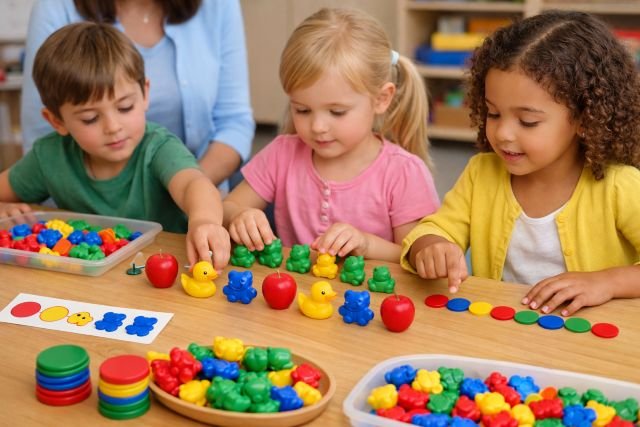
Repeating patterns are often the first type of sequence children learn. These patterns follow a consistent rule, such as clap-stomp-clap-stomp, or red-blue-red-blue. The key skill is recognizing the repeating unit, not just identifying what comes next.
Sound and movement patterns are especially effective for young learners. When children clap, jump, or tap in a repeating sequence, they are using their whole body to understand the pattern. Studies show that children who can identify and recreate repeating patterns are more likely to succeed in later math tasks.
Using everyday materials like blocks, beads, or household objects makes patterns more concrete. When children are encouraged to recreate the same pattern using different materials, they demonstrate true understanding rather than memorization.
Growing patterns and number sequences for kids
As children become comfortable with repeating patterns, they can explore growing patterns. A growing sequence for kids changes in a predictable way, such as adding one more block each time or increasing the number of steps in a movement pattern.
Building towers with blocks or creating stair-like structures allows children to see how quantities change. Asking questions like “What changed this time?” or “How many did we add?” encourages children to think about the rule behind the sequence. Research published through ERIC has found strong connections between early patterning skills and later mathematical growth.
Growing patterns also support early number sense and prepare children for addition and subtraction concepts. When these ideas are introduced through play, children are more likely to understand and enjoy them.
How to talk about sequences in kid-friendly language
Children do not need formal vocabulary to understand sequencing. Simple phrases such as “What comes next?” or “What happens first?” are enough to introduce the concept. Over time, older children can be introduced to the word “sequence” as a way to describe an ordered pattern.
Encouraging children to explain their thinking is more important than getting the right answer. When children describe why something comes next, they strengthen both language and reasoning skills. This aligns with research-based teaching strategies that emphasize discussion and reflection in early learning.
Real-world examples of teaching sequence for kids
In real-life settings, many children who struggle with worksheets thrive when learning through play. A child who resists printed pattern activities may eagerly participate in a movement-based sequence game or a building activity. These experiences help children see patterns as meaningful rather than abstract.
Another common situation involves children who can correctly complete patterns but cannot explain them. By asking children to describe the rule or recreate the pattern using new materials, adults can help bridge the gap between answer-focused learning and true understanding.
Optimizing learning without pressure
A simple and effective teaching approach involves modeling first, practicing together, and then letting the child try independently. This gradual release of responsibility supports confidence and reduces anxiety. Educational research supports this method as a way to scaffold learning while maintaining engagement.
Teaching sequence for kids should feel playful and supportive, not stressful. When children feel safe to experiment and make mistakes, they develop stronger problem-solving skills and a more positive attitude toward learning.
Why sequence for kids matters long term
Sequencing skills extend far beyond early math. Children use sequencing when telling stories, following directions, understanding cause and effect, and solving problems. These skills are essential for reading comprehension, science learning, and everyday decision-making.
Studies consistently show that early pattern recognition and sequencing abilities are linked to later academic achievement. By teaching sequence for kids through hands-on, meaningful experiences, adults are laying the groundwork for lifelong learning success.
Conclusion: the best way to teach sequence for kids
The most effective way to teach sequence for kids is through real-life experiences, playful exploration, and meaningful conversations rather than worksheets. When children build, move, talk, and experiment with patterns, they develop a deeper understanding of order and structure.
By using daily routines, games, and simple materials, adults can turn ordinary moments into powerful learning opportunities. Teaching sequences without worksheets not only improves comprehension but also fosters curiosity, confidence, and joy in learning — qualities that matter far more than filling in the right box on a page.