

If you’ve ever searched for the nordirland flag, you’ve probably noticed something confusing right away: people don’t agree on what it even is. Some point to the Union Flag (Union Jack). Others talk about the Ulster Banner. And many will tell you there is no single, universally accepted “Northern Ireland flag” at all. That ambiguity isn’t accidental — it’s a product of Northern Ireland’s history, its contested identities, and decades of conflict where symbols became shorthand for belonging, power, and exclusion.
- What is the “official” nordirland flag today?
- The Ulster Banner: where it came from, and why it lingers
- 1973: why “no official standing” matters so much
- How the law tried to manage “flag conflict” in public space
- The Good Friday Agreement and “parity of esteem”: why identity is officially plural
- Why the nordirland flag debate won’t “just go away”
- Case study: Belfast City Hall and the 2012 flag protests
- “Which flag should I use?” Context matters more than you think
- FAQ: quick answers optimized for featured snippets
- Conclusion: the nordirland flag is sensitive because it’s never “just a flag”
What makes the nordirland flag question uniquely sensitive is that flags in Northern Ireland often function less like neutral civic branding and more like political statements. In some contexts they signal constitutional preference (staying in the UK vs. a united Ireland). In others they reflect community identity (unionist/loyalist vs. nationalist/republican). And because daily life, policing, parades, and public buildings have all been battlegrounds for symbolism, “just flying a flag” can feel anything but simple.
What is the “official” nordirland flag today?
In strict legal and governmental terms, the Union Flag is the main official flag used for Northern Ireland in the UK constitutional framework. The Ulster Banner — often called the “Northern Ireland flag” in casual speech — does not have official status today, even though it still appears in sport and in some community settings.
That split between “official” and “commonly used” is one of the reasons the nordirland flag topic keeps resurfacing. People experience flags emotionally and socially, not just legally.
The Ulster Banner: where it came from, and why it lingers
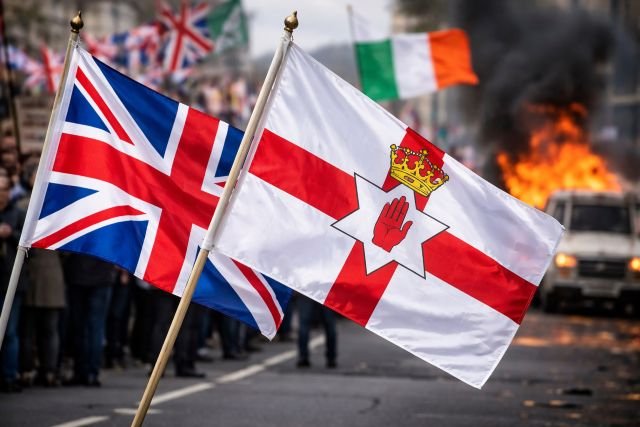
The flag most people mean when they say “Northern Ireland flag” is the Ulster Banner: a red cross on white, with a six-pointed star, a red hand, and a crown. Encyclopaedia Britannica describes it as an unofficial flag associated with Northern Ireland.
Historically, it’s tied to the former Northern Ireland government at Stormont. It was used prominently around the early 1950s, including during royal events, and then became widely associated with Northern Ireland internationally — especially through sport — despite later losing any formal governmental standing.
Here’s the key point: the Ulster Banner did not arise as a cross-community civic symbol meant to unite everyone in Northern Ireland. It developed within — and later became emblematic of — a state structure that many nationalists experienced as exclusionary. That historical memory shapes how people read the flag today.
1973: why “no official standing” matters so much
A turning point in nordirland flag history is the early 1970s, when Northern Ireland’s devolved parliament was dissolved and direct rule followed. Northern Ireland’s constitutional arrangements were reshaped through legislation in 1973.
Why does that matter for flags?
Because the Ulster Banner’s legitimacy was tied to a particular government and set of institutions. Once those institutions disappeared, the banner no longer represented an active civic authority in the same way. CAIN (Ulster University’s conflict archive) summarizes this clearly: the Ulster Banner was adopted in 1953, and after the 1973 constitutional changes, it ceased to have any official standing.
Yet symbols don’t vanish just because their legal basis shifts. In fact, they often become more potent—especially when communities feel their status is under pressure.
How the law tried to manage “flag conflict” in public space
Northern Ireland’s flag disputes aren’t only cultural; they’ve repeatedly become legal and administrative issues.
The 1954 Flags and Emblems Act: protecting one flag, escalating tensions
In the 1950s, Stormont passed the Flags and Emblems (Display) Act (Northern Ireland) 1954. Among other effects, it strengthened the legal protection of the Union Flag’s display in a way that became deeply controversial, and enforcement could inflame disorder. CAIN hosts the text of the Act, and historical summaries note flashpoints where disputes over flags contributed to unrest.
Later, elements of this approach were repealed; for example, legislation.gov.uk includes provisions relating to the repeal of the 1954 Act within later public order frameworks.
The takeaway is not “laws cause conflict,” but that laws about symbols can be perceived as taking sides—especially in a divided society.
The Flags Regulations (Northern Ireland) 2000: “designated days” and official buildings
Fast-forward to modern governance: the Flags Regulations (Northern Ireland) 2000 set out rules for flying the Union flag on specified government buildings on specified days. It also covers circumstances for other flags (for instance around particular visits or Europe Day in certain cases).
The existence of detailed regulations tells you something important: flags are treated as an area requiring formal control because practice can quickly become politicized.
The UK government’s general guidance on designated days explicitly notes that Northern Ireland’s flag-flying is governed by legislation rather than the general guidance used elsewhere.
The Good Friday Agreement and “parity of esteem”: why identity is officially plural
To understand why the nordirland flag question is so charged, you need the identity architecture created by the Belfast/Good Friday Agreement (1998).
The Agreement recognizes (in widely cited language) the birthright of people in Northern Ireland to identify as British or Irish or both, and stresses the need for rigorous impartiality and respect across identities.
That matters for symbols, because a single official civic flag would ideally be capable of representing people across those identities. Northern Ireland hasn’t found a widely accepted way to do that—so the default becomes a tug-of-war between existing flags already loaded with meaning.
Why the nordirland flag debate won’t “just go away”
1) Flags are identity shortcuts in a place where identity shapes politics
In many regions, flags are background décor. In Northern Ireland, they often feel like a referendum banner. That’s because constitutional status, policing, education, language rights, and even sports affiliations have long been entangled with identity debates.
One reason sensitivity persists is that “neutral” space is limited. If a public building flies one community’s preferred flag, others can experience it as an erasure.
2) Demographics and identity are more mixed than outsiders assume
Northern Ireland is not cleanly split into two blocks. Identities overlap and shift. To see how varied identity can be, it helps to look at official data. NISRA (Northern Ireland Statistics and Research Agency) publishes Census 2021 identity tables that break down national identity categories (including “British only,” “Irish only,” mixed categories, and more).
That diversity makes a single flag harder: a symbol that feels affirming to one group can feel excluding to another, and a “compromise” can still feel like loss.
3) Sport keeps the Ulster Banner visible — even when politics rejects it
Even when a symbol has no official status, sport can keep it alive. Britannica notes the Ulster Banner as an unofficial Northern Ireland flag; public discussion repeatedly returns to how Northern Ireland is represented in competitions.
This is not a niche issue: sporting symbolism is high-visibility and emotionally resonant, which means disputes can spread quickly into wider public debate.
Case study: Belfast City Hall and the 2012 flag protests
If you want a concrete example of why this topic is so politically sensitive, Belfast City Hall is one of the most cited modern flashpoints.
In December 2012, Belfast City Council voted to limit the days the Union flag would fly from City Hall (moving away from flying it every day). That decision triggered large-scale protests and disorder, with significant injuries and arrests reported in the aftermath.
You don’t have to take a side to see what happened here: a procedural change to flag policy was interpreted by many as a direct threat to identity. And because distrust was already high, the flag became a lightning rod for wider frustrations — about representation, cultural respect, and who “owns” civic space.
“Which flag should I use?” Context matters more than you think
People often search “nordirland flag” because they’re trying to do something practical: design a poster, write a school project, pick an icon for a website, or plan event decor.
Here’s the most useful real-world framing: the “right” flag depends on what you’re representing.
If you mean Northern Ireland as a region of the UK in an official UK-state sense, the Union Flag is the clearest governmental default, and the law around government buildings is especially specific in Northern Ireland.
If you mean a community, cultural tradition, or a sports context, you may see the Ulster Banner used—but be aware that many people view it as strongly unionist-coded and not representative of everyone.
If your goal is cross-community inclusion, many organizations avoid choosing either and use neutral branding (logos, wordmarks, or shared civic emblems). That’s not cowardice; it’s often a deliberate attempt to respect plural identities in line with the post-1998 ethos.
FAQ: quick answers optimized for featured snippets
What is the official nordirland flag?
For government purposes, the Union Flag is the main official flag used in Northern Ireland, and flag-flying on government buildings is governed by specific Northern Ireland regulations.
Is the Ulster Banner the real Northern Ireland flag?
The Ulster Banner is widely recognized and frequently used as an unofficial Northern Ireland symbol, but it does not have official standing today and is politically contested.
Why do flags cause conflict in Northern Ireland?
Because flags act as identity signals tied to Northern Ireland’s constitutional question and community affiliation, and public display can be experienced as inclusion or exclusion—especially in shared civic spaces.
What are the Flags Regulations (Northern Ireland) 2000?
They are regulations that specify when and where the Union flag must be flown on certain Northern Ireland government buildings (including designated days), plus rules for other flag-flying circumstances.
Conclusion: the nordirland flag is sensitive because it’s never “just a flag”
The simplest way to understand nordirland flag history is this: Northern Ireland never developed a single shared civic symbol that everyone feels belongs to them. The Union Flag has official weight and legal regulation in government contexts, while the Ulster Banner remains visible and emotionally powerful for many — yet is widely viewed by others as excluding or politically loaded.
In a society shaped by contested sovereignty and layered identities — explicitly recognized in the Good Friday Agreement — symbols carry memory. They carry grievance. They carry pride. So if you’re writing, designing, teaching, or hosting, the most practical “tip” is also the most respectful one: decide what you’re representing, know your audience, and treat flags as part of Northern Ireland’s lived politics, not as neutral decoration. That’s the real reason the nordirland flag remains so politically sensitive.