

If your skin stings after washing, turns red “for no reason,” or feels tight the minute you step out of the shower, you’re not alone — and you’re not imagining it. Sensitive skin is incredibly common, with large surveys showing that around 60–70% of women and 50–60% of men report having some degree of sensitive skin.
- What “sensitive skin” actually means (and why cleansers matter)
- What is olive oil soap?
- Why olive oil soap can feel calmer on sensitive skin
- Olive oil soap for sensitive skin vs. syndet bars: what’s the difference?
- How to choose the best olive oil soap for sensitive skin
- How to use olive oil soap without triggering dryness or tightness
- Best-fit scenarios: when olive oil soap is a smart choice
- When olive oil soap might not be enough
- FAQ: olive oil soap for sensitive skin
- Conclusion: choosing olive oil soap without the guesswork
In that context, it makes sense so many people are hunting for a cleanser that feels like a reset, not a punishment. That’s where olive oil soap often enters the conversation: a simple, traditional bar that can cleanse while feeling gentler than many harsh, fragrance-heavy options.
This guide breaks down what olive oil soap is, why it can work well for sensitive skin, what to watch out for (because “natural” doesn’t automatically mean “non-irritating”), and how to choose the calmest bar for your specific triggers.
What “sensitive skin” actually means (and why cleansers matter)
Sensitive skin usually isn’t a single disease. It’s more like a “reactivity pattern”: skin that responds with burning, itching, tightness, redness, or discomfort to things that don’t bother other people. Recent dermatology reviews describe it as a largely subjective condition that can happen with or without visible signs, and can be triggered by environmental factors, products, stress, and more.
Cleansers are a big deal because they touch your skin daily, often twice a day. Even if you have the world’s best moisturizer, stripping your barrier at the cleansing step can keep you stuck in a cycle of dryness and irritation.
One reason is pH. Traditional soap typically has a higher pH (often ~8.5–11), while the skin’s surface and many gentler synthetic cleansers (syndets) tend to sit closer to ~5.5–7. When sensitive skin is already “on edge,” that mismatch can matter.
So if classic soap can be high pH, why do so many sensitive-skin people still like olive oil soap? The answer is in formulation, simplicity, and what you personally react to.
What is olive oil soap?
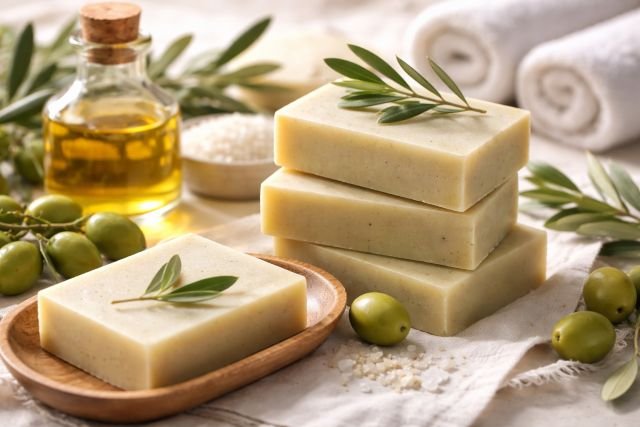
At its core, olive oil soap is made when olive oil is saponified—combined with an alkali (commonly sodium hydroxide for a hard bar) to create soap. Many olive oil soaps are inspired by traditional styles like Castile-type soaps, where olive oil is the main fat.
A key detail: a well-made bar often includes “superfatting,” meaning some oil remains un-saponified. That leftover oil can make the bar feel more conditioning—one reason many people with dryness or reactivity describe it as “less stripping.”
Why olive oil soap can feel calmer on sensitive skin
1) Fewer “usual suspects” for irritation
A lot of sensitive-skin flare-ups are less about the cleanser category and more about the extras: heavy fragrance, essential oils, aggressive exfoliants, or long ingredient lists. Olive oil soap is often appealing because many versions are short-ingredient and fragrance-free, which can reduce exposure to common triggers.
If you’ve ever used a “pretty-smelling” body wash and felt the sting immediately, you know what this means in real life.
2) Barrier-friendly lipids — especially for dryness-prone sensitivity
Olive oil contains a mix of lipids and minor components that are commonly discussed in skin science (fatty acids, tocopherols/vitamin E, phenolic compounds, and more). Plant oils in general are widely reviewed for potential anti-inflammatory, antioxidant, and barrier-support roles in topical use, depending on composition and how they’re formulated.
In plain language: if your sensitivity is strongly tied to dryness and barrier disruption, a simpler, more conditioning-feeling cleanser can be a meaningful upgrade.
3) The “quiet cleanse” effect (less residue, less drama)
Some people react to residual surfactants or the “squeaky clean” feel of stronger cleansers. A basic olive oil soap can create a rinse-clean experience that feels calmer — especially when followed immediately by moisturizer.
That said, this is personal: others find true soap (any soap) too drying because of pH and cleansing strength. Your results will depend on the specific bar and your skin’s baseline.
Olive oil soap for sensitive skin vs. syndet bars: what’s the difference?
Here’s the most helpful way to think about it:
Syndet bars are engineered to be mild and often pH-balanced closer to skin, while classic soap bars often sit at a higher pH. For many people with eczema-prone or highly reactive skin, dermatology literature commonly points to gentle, low-irritant cleansing and pH considerations as part of barrier support.
So why not just choose syndet every time?
Because sensitive skin isn’t one thing. If your main issue is fragrance and preservatives (not cleansing strength), a very plain olive oil soap might outperform a more complex “gentle wash” that still includes something you react to. The best cleanser is the one your skin tolerates consistently.
Practical takeaway:
If your sensitivity looks like tightness, flaking, eczema-like dryness, or you’re in a winter flare, you may do better with a pH-appropriate syndet or a very conditioning soap + immediate moisturization. If your sensitivity is mainly “ingredient-triggered,” you may do better with minimalist olive oil soap.
How to choose the best olive oil soap for sensitive skin
Look for these “calm-clean” traits
Fragrance-free (not just “unscented”). “Unscented” can still include masking fragrance. If you’re reactive, fragrance-free is safer.
No essential oils. Many essential oils are natural — but still common irritants for sensitive skin.
Short ingredient list. Especially if you’re trying to identify triggers.
Added humectants (optional). Some bars include glycerin or similar skin-friendly hydrators.
Clearly stated olive oil percentage (or “100% olive oil” style). This can be helpful when comparing bars.
Be cautious with these common irritants
Botanical blends (lavender, citrus, tea tree), scrubs (oat “bits,” pumice), and strong “detox” additives can be too much during a sensitivity phase.
Colorants aren’t always a problem, but if you’re flare-prone, simpler is usually better.
How to use olive oil soap without triggering dryness or tightness
This is where most people accidentally sabotage a “gentle” cleanser.
Step 1: Keep water lukewarm
Hot water amplifies tightness and can worsen barrier stress. Lukewarm is your friend.
Step 2: Short contact time
Treat cleansing like a quick rinse-and-release. Lather, cleanse, rinse—no long “soak” with soap on the skin.
Step 3: Pat dry, don’t rub
Rubbing can turn mild sensitivity into visible redness fast.
Step 4: Moisturize within 60 seconds
This is the simplest “case study” scenario I see again and again: someone switches to a gentler cleanser, but still waits 10 minutes before moisturizing. The tightness remains, and they assume the cleanser failed. Lock in hydration right away.
Step 5: Patch test new bars
Even a minimalist bar can trigger an individual allergy. Try the inner arm for a few days before full-body use.
Best-fit scenarios: when olive oil soap is a smart choice
You’re sensitive + fragrance-reactive
A plain olive oil soap (fragrance-free, essential-oil-free) can be a relief if your biggest trigger is scent additives.
You’re sensitive + dry, but not eczema-flaring
Many people with “tight, dry, reactive” skin do well with a conditioning-feeling bar — especially when paired with immediate moisturizer.
You want a simple routine
When your skin is unpredictable, simplicity is a strategy.
When olive oil soap might not be enough
If you’re in an eczema flare or your skin barrier is severely compromised
Because traditional soap can run higher pH, some eczema-prone skin does better with pH-appropriate syndets and dermatologist-guided routines. Reviews on cleanser pH and soap vs syndet properties highlight how pH differences can affect barrier integrity and mildness.
If you’re acne-prone and very oily
Some olive oil soaps are fine, but others may feel too rich for facial use (especially if super-fatted). Consider using it for body, and a gentle facial cleanser designed for acne-prone sensitivity.
If you react to olive-derived ingredients
Uncommon, but possible — especially if you have multiple botanical sensitivities. Patch testing matters.
FAQ: olive oil soap for sensitive skin
Is olive oil soap good for sensitive skin?
Often, yes—especially if it’s fragrance-free and minimal ingredient. Many sensitive-skin reactions are triggered by fragrance and complex formulas rather than the base cleanser type. However, because traditional soap can be higher pH, some very dryness-prone or eczema-prone people do better with pH-balanced syndets.
Can olive oil soap help with redness and irritation?
It can help indirectly by reducing exposure to common irritants (like fragrance) and by supporting a calmer routine. Sensitive skin is widespread and multifactorial, so results depend on your triggers.
Is Castile soap the same as olive oil soap?
“Castile” traditionally refers to soap made primarily from olive oil, but modern products vary. Always check the ingredient list and whether it contains fragrance or essential oils.
Can I use olive oil soap on my face?
Some people can, especially with dry or sensitive facial skin, but facial skin is more reactive than body skin. Start slow (2–3x/week), keep contact time short, and moisturize immediately.
Does olive oil soap clog pores?
“Clogging” is individual. A super-fatted bar can feel richer; acne-prone skin might prefer a gentler facial cleanser and keep olive oil soap for the body.
Conclusion: choosing olive oil soap without the guesswork
If your skin is reactive, the best cleanser is the one that keeps your routine boring — in the best way. A well-formulated olive oil soap can be a genuinely calming option for sensitive skin, especially when it’s fragrance-free, essential-oil-free, and paired with smart habits like lukewarm water, short cleansing time, and immediate moisturization.
But sensitivity is personal. If your skin is eczema-prone or feels worse with any true soap, consider a pH-balanced syndet cleanser instead — cleanser pH and formulation can influence barrier comfort and irritation potential.