

If you’ve searched for aleppo soap lately, you’ve probably noticed something weird: wildly different prices, ingredient lists that don’t match, and “Aleppo-style” bars that look perfect—but feel off in use. That’s because Aleppo soap has become a target for imitation, and not all “Aleppo” bars are actually the traditional Syrian soap people expect.
- What “Real Aleppo Soap” actually means (and why it’s easy to fake)
- Real Aleppo soap ingredients: the non-negotiables
- How to read the label like a pro (INCI, origin, and ingredient order)
- Visual + sensory checks: what real Aleppo soap usually looks and smells like
- The quickest fake-spotting checklist for online shopping
- Why fakes aren’t just annoying — they can be a skin risk
- Real-world scenarios: how buyers get tricked (and how you won’t)
- Choosing the right laurel oil percentage for your skin
- FAQ
- Conclusion: buy Aleppo soap with confidence (and stop wasting money on fakes)
Real Aleppo soap is simple, specific, and time-tested: a hard bar traditionally made from olive oil and laurel (bay laurel) oil, then aged for months so it becomes mild and long-lasting. Many fakes copy the look but skip the method, swap ingredients, or hide the real formula behind vague marketing.
This guide will help you confidently identify the real thing before you buy — whether you’re shopping online, in a boutique, or at a market — so you get an authentic bar that performs like Aleppo soap should.
What “Real Aleppo Soap” actually means (and why it’s easy to fake)
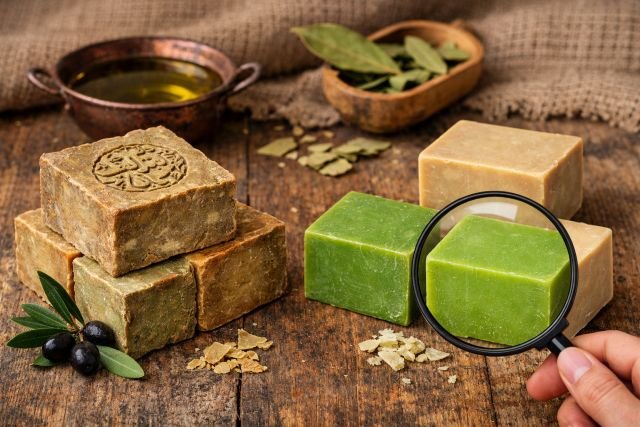
Traditional Aleppo soap is most commonly described as a soap made primarily from olive oil and laurel berry oil (often called bay laurel oil), then cured/aged for a long period so the bar hardens and becomes milder with time. This long drying/aging step is a defining feature: as it ages, the outer color turns golden while the inside stays green, and the bar becomes firm and long-lasting.
Why do counterfeits exist? Because soaps are easy to produce, easy to private-label, and easy to market. Counterfeit trade is also big business — global estimates put counterfeit and pirated goods at up to 2.3% of global trade (2021 data), and up to 4.7% of EU imports. Even if your soap isn’t a “counterfeit brand,” the incentive to cut costs (cheaper oils, fast curing, fillers, heavy fragrance) is real.
Real Aleppo soap ingredients: the non-negotiables
At its core, Aleppo soap is defined by a short ingredient story. The authentic “feel” comes from what’s inside the bar — and what’s not.
The classic ingredient profile
Most credible descriptions converge on a base of:
- Olive oil
- Laurel (bay laurel) oil
- Water + lye (sodium hydroxide) used for saponification (turned into soap during the process)
Even general references emphasize that Aleppo soap is fundamentally olive + laurel oil, then aged for months.
How laurel oil percentage is used (and how sellers abuse it)
Laurel oil content strongly affects price and how the bar behaves on skin. Many sellers label Aleppo bars by % laurel oil (for example 5%, 20%, 40%). That’s normal — if it’s real and honestly labeled.
Where fakes creep in:
- The % is printed, but the INCI list doesn’t support it.
- The product uses “fragrance” or essential oils to mimic laurel’s scent instead of real laurel berry oil.
- The bar is “Aleppo-style” (fine as a concept) but sold as if it’s genuine Aleppo soap.
Pro tip: If a label claims a high laurel percentage but the bar is unusually cheap, perfectly uniform, and strongly perfumed, treat it as suspicious and verify the INCI list.
How to read the label like a pro (INCI, origin, and ingredient order)
If you want the fastest way to spot fakes, learn to read the back label.
Step 1: Look for an INCI ingredient list
In many markets (especially the EU), cosmetics labeling relies on INCI naming conventions so ingredients are identifiable across countries.
A real Aleppo soap INCI list often resembles:
- Sodium Olivate (saponified olive oil)
- Sodium Laurate (saponified laurel oil)
- Aqua (water)
- Glycerin (naturally formed during saponification; sometimes listed)
What raises eyebrows:
- “Parfum/Fragrance” high on the list (strong scent is not a hallmark of traditional Aleppo)
- Multiple colorants (CI numbers) to “fake” the inside/outside color
- Long lists of additives that turn it into a different product category
Step 2: Check whether “laurel” is real laurel oil
Authentic labeling should clearly reflect Laurus nobilis (bay laurel) in some form, not just vague “plant oils.” If the brand explains how to interpret laurel oil percentages and INCI, that’s a good sign because transparency is hard to fake consistently.
Step 3: Don’t ignore compliance clues (especially online)
If a site selling into regulated markets can’t provide:
- A complete ingredient list
- A manufacturer/responsible party
- A country of origin statement (where applicable)
…that’s a risk signal. Even legitimate handmade sellers usually provide this information because shoppers ask for it constantly.
Visual + sensory checks: what real Aleppo soap usually looks and smells like
Counterfeits often win on appearance — because they can be factory-perfect. Real Aleppo soap often looks a little imperfect, and that’s not a flaw.
1) The color pattern: golden outside, green inside
A hallmark often mentioned is the aged exterior turning golden while the interior remains green, reflecting aging and chemical changes over time.
A perfectly uniform green bar (or perfectly uniform tan bar) doesn’t automatically mean fake—but it should make you check the label and seller details more carefully.
2) The stamp (helpful, not definitive)
Many authentic producers stamp bars. But stamps can be copied, and some genuine soaps are un-stamped depending on maker or reseller. Use the stamp as one clue, not the whole decision.
3) The scent: subtle, herbal, not perfumey
Real Aleppo soap tends to smell mild and herbal/earthy. If it smells like a strong cologne, “spa fragrance,” or sweet perfume bomb, odds are it’s not traditional Aleppo soap — or it’s heavily modified.
4) The lather: low to moderate and “creamy”
Many traditional olive-oil soaps don’t foam like modern surfactant-based cleansers. If a bar creates instant huge bubbles and squeaky-strip clean, it may contain added surfactants or a different fatty acid profile than expected.
The quickest fake-spotting checklist for online shopping
When you can’t hold the bar, you need a smarter filter.
Product photos that should trigger a double-check
- Bars that look identical to machine-molded hotel soaps
- Bright, artificial green interiors across every bar (uniform dye look)
- Overly polished edges with no variation
Listing language that often correlates with fakes
- “Aleppo soap with laurel scent” (scent ≠ laurel oil)
- “Aleppo-inspired” sold under the headline “Authentic Aleppo”
- “Made in France/Turkey/elsewhere” but marketed as “from Aleppo” without clarity
(Some countries make excellent Aleppo-style soaps. The issue is misrepresentation.)
Seller transparency signals (green flags)
- Clear INCI list and laurel oil percentage explanation
- Batch/cure details or aging explanation
- Photos of the actual bars you’ll receive (not stock renders)
Why fakes aren’t just annoying — they can be a skin risk
A fake bar isn’t always “dangerous,” but it can be unpredictable. If someone swapped in cheaper oils, added heavy fragrance, or skipped proper curing, you may get irritation, dryness, or breakouts.
Also, “natural” doesn’t automatically mean “barrier-friendly” for everyone. Dermatology literature has debated topical olive oil’s effects in some contexts, with some concerns about barrier impact in atopic skin.
That doesn’t mean you must avoid Aleppo soap — just that you should patch test if you’re eczema-prone, very sensitive, or buying a new formula.
Real-world scenarios: how buyers get tricked (and how you won’t)
Scenario 1: “40% laurel oil” at a bargain price
You find a “40% laurel” bar for the price of a basic bath soap. The listing has no INCI, only marketing claims, and it smells strongly perfumed in reviews.
What’s likely happening: The seller is using fragrance and coloring to imitate laurel character, or the percentage is inflated.
What to do: Only buy if the INCI list clearly supports real laurel oil content and the brand is transparent about sourcing.
Scenario 2: “Aleppo soap” with a long ingredient list
It includes coconut oil, palm oil, shea butter, fragrance, and colorants.
Is it automatically bad? Not necessarily. It might be a perfectly fine soap.
But: It’s not traditional Aleppo soap in the way most consumers expect.
What to do: Decide based on your goal: authenticity and simplicity, or just a nice scented bar.
Scenario 3: Marketplace sellers with constantly changing listings
Same photos, different brand names, inconsistent ingredients.
What’s likely happening: Drop-shipped commodity soap with a trending keyword.
What to do: Buy from sellers who can consistently document ingredients and origin.
Choosing the right laurel oil percentage for your skin
Even when the soap is real, stronger isn’t always better.
- Lower laurel percentages (often around 5–10%) are commonly positioned as gentler for daily use and sensitive skin.
- Mid-range percentages are often marketed as a balanced option.
- Very high percentages are often framed for oilier skin or specific concerns, but they can feel more intense/drying for some people.
If you’re new to Aleppo soap, starting lower and adjusting is usually the smarter (and cheaper) path.
If you’re publishing this article, add a few simple, high-intent visuals. Here are SEO-friendly alt tags that naturally include the keyword aleppo soap:
FAQ
What is Aleppo soap?
Aleppo soap is a traditional hard soap most commonly made from olive oil and laurel (bay laurel) oil, then aged for months so it becomes mild, firm, and long-lasting.
How can I tell if Aleppo soap is real?
Check for a clear INCI ingredient list (often including sodium olivate and sodium laurate), realistic laurel oil percentage claims, mild herbal scent (not heavy perfume), and seller transparency about origin and production.
Are “Aleppo-style” soaps fake?
Not always. “Aleppo-style” can be an honest description for soaps inspired by the method but made elsewhere or with additional oils. The problem is when “Aleppo-style” is marketed as “authentic Aleppo soap” without clarity.
Is Aleppo soap good for sensitive skin?
Many people find it gentle, but skin responses vary. If you’re sensitive or eczema-prone, patch test first and consider starting with a lower laurel oil percentage. Also remember that topical olive-oil-heavy products aren’t ideal for everyone.
Why are there so many fakes online?
Trending products attract imitation. Counterfeit and misrepresented goods are a large global problem in general trade, which creates an incentive for sellers to copy popular categories and keywords.
Conclusion: buy Aleppo soap with confidence (and stop wasting money on fakes)
Real aleppo soap is one of those rare products where simplicity is the whole point — olive oil, laurel oil, and a long aging process that creates a bar with a distinctive look and feel. Fakes usually cut corners in the same predictable ways: vague labels, unrealistic laurel percentage claims, heavy fragrance, and too-perfect factory appearance paired with too-good pricing.
If you remember just one thing, make it this: the label and the seller’s transparency matter more than the stamp or the story. When the INCI list is clear, laurel oil is honestly represented, and the brand can explain what you’re buying, you’re far more likely to end up with a genuine bar that performs like Aleppo soap should.