


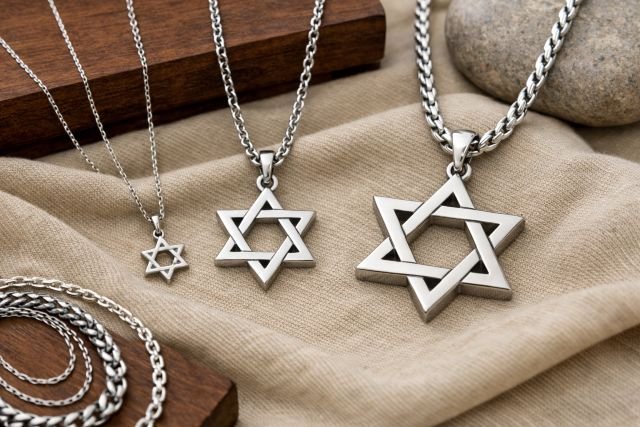
Buying a magen david necklace is one of those decisions that feels simple — until you realize how much “size” affects everything: how it sits on your chest, whether it layers well, how durable it is for everyday wear, and even how the pendant’s symbolism reads from a distance. The good news is you don’t need a jeweler’s bench to choose well. You just need a practical way to match pendant size, chain length, and chain thickness to your body, wardrobe, and how you plan to wear it.
- What makes a Magen David necklace “the right size”?
- Step 1: Choose the pendant size (small, medium, or statement)
- Step 2: Pick the chain length that places the pendant where you want it
- Step 3: Match chain thickness to the pendant (so it’s durable and balanced)
- Step 4: Choose a chain style that suits a Star-shaped pendant
- Step 5: Measure at home in 60 seconds (and avoid returns)
- Real-world scenarios: choosing what actually works
- Common mistakes people make
- FAQs
- Conclusion: choosing the right magen david necklace is about proportion and placement
This guide breaks down exactly how to pick the right Magen David pendant size and the best chain to pair with it — so it looks intentional, feels comfortable, and holds up over time.
What makes a Magen David necklace “the right size”?
A Magen David (Star of David) pendant is essentially a geometric shape, so proportion matters more than it does with many other pendants. The “right size” is the one that looks balanced on your frame and sits at a placement that fits your lifestyle — whether that’s subtle and close to the collarbone, or more visible and statement-like.
A quick note on meaning: the Star of David is widely recognized as a Jewish symbol and marker of Jewish identity, including its prominent place on the flag of Israel.
That’s why many people choose a size and placement that matches how publicly they want to wear it (everyday, formal events, tucked under clothing, or fully visible).
Step 1: Choose the pendant size (small, medium, or statement)
Most shoppers get stuck here because product listings show millimeters, but your brain wants to know: “Will this look tiny or bold on me?”
A helpful rule: pendant size is typically measured by its longest dimension (often height in mm). Smaller sizes read as delicate; larger sizes read as statement.
Small Magen David pendant (subtle, everyday)
If you want something understated — especially for daily wear, office settings, or layering — go small. Small pendants tend to sit nicely near the collarbone and look intentional with thinner chains.
Best for: minimalist style, layering, smaller frames, gifting when you’re unsure.
Medium Magen David pendant (the “most versatile”)
Medium is the sweet spot if you want the symbol to be clearly recognizable without feeling loud. On most people, it reads as “classic” and works with both casual and dressy outfits.
Best for: one-and-done everyday necklace, most wardrobes, most body types.
Statement Magen David pendant (bold, visible)
If you want the symbol to be noticeable from a few feet away — or you prefer statement jewelry — go larger. Just remember: bigger pendants need stronger chains (more on that next), and placement matters so it doesn’t flip or bounce uncomfortably.
Best for: statement looks, ceremonial wear, wearing over sweaters, higher visibility.
Pro tip: If you’re choosing between two sizes, pick based on where you’ll wear it most. A pendant that looks perfect over a sweater can feel too large on a thin T-shirt, and vice versa.
Step 2: Pick the chain length that places the pendant where you want it
Chain length isn’t just “short vs long” — it determines where the pendant sits and how it interacts with necklines. Standard necklace lengths commonly include 16″, 18″, 20″, 22″, 24″, and 30″.
Here’s how those usually wear in real life:
16-inch chain (high and close)
This tends to sit at or near the base of the neck/collarbone area. Great for delicate pendants and layering, but it can feel snug if you have a thicker neck or prefer breathing room.
18-inch chain (the classic everyday)
Often considered the “default” length for a reason — it usually places the pendant just below the collarbone, flattering on many body types and easy to wear with most tops.
20-inch chain (slightly lower, more relaxed)
A 20″ chain drops the pendant a bit lower on the upper chest. It’s a great option if you don’t like the feeling of jewelry near your throat, or if you want the Magen David to sit clearly below a crew neck.
22–24-inch chain (layering-friendly, sweater-ready)
These lengths are popular when you want the pendant to show over higher necklines or outerwear. They’re also useful if you want a more masculine or relaxed drape.
30-inch chain (long and statement)
This is a more fashion-forward length and can work well for bold pendants — just be mindful of movement and flipping (thicker chains help).
Placement tip: If you already own a necklace you love the placement of, measure it end-to-end and use that length as your baseline. Many jewelers recommend this “use what already fits” approach because it’s the most realistic to your body and preferences.
Step 3: Match chain thickness to the pendant (so it’s durable and balanced)
This is where a lot of “pretty online, disappointing in person” purchases happen.
A chain has to do two jobs:
- look proportional to the pendant, and
- be strong enough to hold it comfortably.
Bench jeweler guidance emphasizes choosing a chain with enough strength to support the pendant’s weight and intended wear.
Thin chains (delicate look)
These feel airy and elegant, but they’re more vulnerable to kinks and breaks — especially with active daily wear or heavier pendants.
Best for: small pendants, minimalist style, occasional wear.
Medium chains (balanced, everyday durable)
This is usually the safest choice for a typical Magen David pendant. It looks proportional and holds up well for daily use.
Best for: medium pendants, daily wear, gifting when unsure.
Thick chains (bold + extra strength)
Thicker chains look more substantial and are generally better for large pendants. They also resist flipping and tangling more than ultra-thin chains.
Best for: statement pendants, wearing over sweaters, people who are hard on jewelry.
If you see chain thickness described in gauge or mm and you want to convert, jewelers commonly use gauge-to-mm conversion references like Kitco’s tables.
Step 4: Choose a chain style that suits a Star-shaped pendant
Because the Magen David is a symmetrical, angular pendant, chain style changes the vibe more than you might expect.
- Cable chain: classic, simple, and lets the pendant be the star (literally).
- Box chain: sleek, modern, and tends to look great with geometric pendants.
- Rope chain: more visual texture; can feel dressier, but may compete with a small pendant.
- Curb chain: bolder and flatter; often reads more “street” or masculine.
When jewelers talk about chain selection, they often stress complementing the design while maintaining strength for the pendant.
Step 5: Measure at home in 60 seconds (and avoid returns)
You can get this right without tools beyond a soft tape measure (or a string + ruler).
For chain length
Wrap a string around your neck and let it drop to where you want the pendant to sit, then measure the string. If you’re between sizes, go slightly longer — you can often shorten with the clasp, but you can’t add length without an extender.
For pendant proportion
Use paper: cut a small triangle-based star outline roughly the size listed (e.g., 15–25 mm), tape it to your shirt, and look in a mirror from 2–3 feet away. This sounds silly, but it’s the closest “try-on” you can do online.
Real-world scenarios: choosing what actually works
Scenario 1: Everyday wear, subtle identity piece
You want something you can wear daily, possibly under clothing, and that doesn’t snag. A smaller to medium pendant with an 18″ chain and medium thickness usually feels effortless and secure.
Scenario 2: Layering with other necklaces
If you plan to layer, spacing matters more than pendant size. Keep one necklace around 16–18″ and choose the Magen David at 18–20″ so it sits distinctly below the shorter layer. Standard length charts show how these common sizes typically fall.
Scenario 3: Statement look over sweaters
Go longer (22–24″) so the pendant sits over the fabric. Pair with a thicker chain so it doesn’t visually disappear and so it holds up to friction from knitwear.
Common mistakes people make
Mistake: choosing pendant size without considering chain thickness
A larger pendant on a very thin chain often looks unbalanced and can be less durable for everyday wear. Jeweler guidance repeatedly ties chain selection to pendant weight and strength.
Mistake: selecting chain length based on “average”
“Standard” lengths are useful, but your neck, posture, and preferred neckline matter. Many sizing guides recommend measuring or comparing to a necklace you already own for accuracy.
Mistake: forgetting lifestyle factors
If you’re active, work with your hands, or wear necklaces 24/7, durability and comfort matter more than a super delicate look.
FAQs
What is the best size for a magen david necklace?
For most people, a medium pendant is the most versatile: it’s recognizable, balanced, and easy to style across casual and formal outfits. Pendant sizing guidance typically frames “medium” as the everyday sweet spot between subtle and statement.
What chain length should I choose for a Magen David pendant?
An 18″ chain is the most common everyday choice because it usually places the pendant just below the collarbone. Standard length charts frequently list 16″, 18″, and 20″ as core options and show their typical placement.
Should a Magen David pendant be on a thin or thick chain?
Match the chain thickness to the pendant size and your lifestyle. Thin chains suit small pendants and delicate looks; medium thickness is the most reliable everyday option; thicker chains are best for large pendants and higher durability. Bench jeweler buying guidance emphasizes chain strength relative to pendant weight.
Can I wear a magen david necklace every day?
Yes — many people do. For daily wear, prioritize a durable chain style and thickness, and choose a length that won’t snag on clothing. Chain selection guidance focuses on strength, design compatibility, and wear conditions.
What does the Magen David symbolize?
The Star of David is widely recognized as a Jewish symbol associated with Jewish identity and Judaism, and it appears prominently on the flag of Israel.
Conclusion: choosing the right magen david necklace is about proportion and placement
The perfect magen david necklace comes down to three aligned choices: a pendant size that matches how visible you want the symbol to be, a chain length that places it exactly where it flatters your neckline, and a chain thickness that looks balanced and stays durable for your lifestyle. Use standard chain length guidance as your starting point , sanity-check pendant scale with sizing principles , and don’t ignore the jeweler’s rule that the chain must be strong enough for the pendant you’re asking it to carry .
If you want the simplest “safe choice” for most shoppers: go with a medium pendant, an 18″ chain, and a medium thickness chain in a classic style like cable or box — then adjust up or down based on how subtle or bold you want the look to be.