


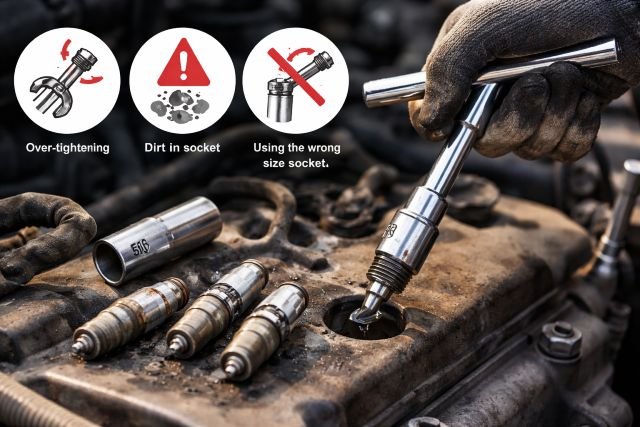
Cracking a spark plug during installation feels unfair: you’re doing “maintenance,” yet you end up with a misfire, a broken ceramic insulator, or (worst-case) damaged threads in the cylinder head. The truth is that spark plugs are tough in combustion, but surprisingly fragile when handled wrong.
- What “spark plug wrench 5/8” actually fits (and why it matters)
- The #1 cause of cracked plugs: incorrect torque (especially overtightening)
- Top mistakes that crack spark plugs (and how to stop doing them)
- How to install spark plugs safely with a spark plug wrench 5/8
- “Cracked but still running”: why small porcelain cracks cause big problems
- FAQs
- Conclusion: Use a spark plug wrench 5/8 without cracking plugs
If you’re using a spark plug wrench 5/8 (the common size for many modern plugs), small technique errors — like overtightening, starting threads with a ratchet, or using the wrong socket — can create hairline fractures you won’t even notice until the engine starts missing under load. Even a tiny crack in the porcelain can let spark “leak” to ground instead of jumping the gap, causing rough idle, hesitation, and random misfire codes.
This guide walks through the most common, real-world mistakes that crack spark plugs, why they happen, and exactly how to avoid them — using manufacturer guidance where it matters most.
What “spark plug wrench 5/8” actually fits (and why it matters)
A spark plug wrench 5/8 refers to a tool/socket that fits a 5/8-inch hex, which is roughly 16 mm—a very common spark plug hex size on many engines. But not all spark plugs are 5/8. Many also use 13/16″, and some use other metric hex sizes depending on design and packaging constraints.
Here’s why the sizing detail matters: a loose or incorrect fit increases the odds you’ll tilt the plug, chip porcelain, or apply uneven load while tightening — exactly the kind of stress that creates cracks.
The #1 cause of cracked plugs: incorrect torque (especially overtightening)
If there’s one “silent killer” behind cracked spark plugs, it’s torque.
Spark plug makers emphasize torque because it controls more than “tightness.” Proper torque helps the plug seat correctly and transfer heat to the cylinder head. Under-torque can reduce heat dissipation and contribute to overheating; over-torque can deform the metal shell and crush or crack the ceramic insulator.
NGK specifically warns that overtightening can deform the shell and lead to insulator cracks—sometimes hidden — plus internal distortion that affects heat transfer.
What overtightening looks like in real life
You install plugs “until they feel snug,” then give them “just a bit more” for safety. That last bit is where damage happens—especially with a short-handled wrench that encourages extra force, or with lubricated threads (more on anti-seize soon).
The fix
Use a torque wrench whenever possible and follow the spark plug manufacturer or vehicle service specification. Champion provides torque guidance charts and stresses finger-tight seating first, then torquing to spec.
Top mistakes that crack spark plugs (and how to stop doing them)
1) Starting the plug with a ratchet instead of your fingers
This is the most common “oops” that becomes expensive.
When you begin threading with a ratchet, you can’t feel resistance early — so you’re more likely to cross-thread. Once threads are misaligned, the plug can bind and the ceramic can crack from uneven stress while you force it down.
Better approach: always start the plug by hand (or by extension only, no ratchet) until it turns smoothly for several full rotations. Only then move to your wrench/torque wrench. This aligns with common manufacturer guidance emphasizing finger-tight seating before final torque.
2) Using the wrong socket instead of a dedicated spark plug socket
A normal 5/8 socket may “fit,” but it often lacks the internal retention (rubber insert or magnetic grip) and may be too bulky for tight plug wells. The result is frequent socket strikes and awkward angles that load the porcelain sideways — an easy way to create tiny cracks that show up later as misfires.
Better approach: use a true spark plug socket (thin-wall if needed) designed for plug wells, plus a steady extension. The goal is straight in, straight out.
3) Letting the plug drop into the plug well
Even a small drop can chip the ceramic or create a microfracture. The plug might install and run… until vibration and heat cycles finish the job.
Better approach: place the plug into the socket first (rubber insert or magnet holds it), then lower it gently into the well, keeping it aligned.
4) Applying anti-seize without adjusting torque (or when it’s not recommended)
This one causes endless debate — mostly because older habits persist.
Many modern spark plugs have plated threads designed to resist corrosion and aid removal. NGK does not recommend anti-seize on its spark plugs and notes the lubrication can change torque behavior, increasing the risk of overtightening.
One widely cited guidance point: lubricants like anti-seize can alter effective torque enough to meaningfully raise overtightening risk, and NGK has been quoted warning torque can change by up to ~20%, which can push you into the danger zone.
Better approach:
- Follow the plug manufacturer’s recommendation first.
- If you choose to use anti-seize against that guidance, understand you may need to reduce torque accordingly — or you’re increasing crack risk through overclamping and shell deformation.
5) Confusing “seat type” (gasket vs tapered) and tightening wrong
Spark plugs commonly seal with either a gasket seat (with a crush washer) or a tapered seat. The tightening method and torque behavior can differ. Manufacturers provide different instructions depending on seat type; NGK’s installation guidance stresses correct tightening as critical.
Better approach: verify the seat type of your plug and follow the correct method. If you’re using “turn angle” instead of torque, use the plug maker’s instructions — not a generic “quarter turn” rule.
6) Over-tightening to “prevent blow-by”
It’s a myth that tighter is always safer. Over-torque can deform the shell, compromise sealing behavior, and lead to insulator damage. NGK’s overtightening bulletin highlights deformation, cracking (sometimes hidden), and heat-transfer issues.
Better approach: correct torque prevents both leakage and damage. “More” is not “better.”
7) Removing plugs from a hot aluminum head (and forcing them)
If you remove spark plugs when the engine is very hot — especially with an aluminum head—you can increase the chance of thread damage and binding. When a plug binds and you force it, you can crack the ceramic from twisting stress.
Better approach: let the engine cool to a safe working temp, then remove plugs smoothly. If resistance is abnormal, stop and reassess instead of muscling through.
How to install spark plugs safely with a spark plug wrench 5/8
If you want a simple, repeatable process that reduces cracks dramatically, follow this workflow:
- Confirm fitment: verify the plug hex is truly 5/8″ (16 mm) and that your socket is a spark plug socket (thin-wall if required).
- Inspect new plugs: look for shipping damage, chipped porcelain, or bent electrodes.
- Lower gently: keep the plug straight in the well (socket insert helps).
- Hand-thread first: turn by hand multiple rotations with no resistance.
- Torque to spec: finalize with a torque wrench using the vehicle/service spec and plug maker guidance. Proper torque affects heat transfer and sealing.
- Avoid anti-seize unless specified: many plugs are plated; adding lubricant can change torque behavior and increase overtightening risk.
“Cracked but still running”: why small porcelain cracks cause big problems
A plug can be cracked and still spark sometimes. That’s what makes this failure so frustrating.
When the porcelain insulator has a crack, high voltage may arc through the crack to ground rather than across the electrode gap — leading to misfires that appear only under load, moisture, or higher cylinder pressure. And because some cracks are hidden after overtightening, you may not spot them until symptoms appear.
Common symptoms drivers notice include rough idle, hesitation, and misfire behavior — often intermittent — especially after recent plug service.
FAQs
What size is a 5/8 spark plug wrench in mm?
A 5/8-inch spark plug wrench fits a hex that’s about 16 mm. Many modern engines use this size, but not all—always verify the plug hex size for your specific engine.
Can overtightening crack a spark plug?
Yes. Manufacturers warn that overtightening can deform the plug’s metal shell and crack the ceramic insulator, sometimes in ways that are hard to see during inspection.
Do I need anti-seize on spark plug threads?
Often, no. Many modern spark plugs have plated threads and some manufacturers (like NGK) advise not using anti-seize because it can change torque behavior and raise overtightening risk.
Why did my new spark plug crack during installation?
The most common causes are over-torque, starting threads with a ratchet (cross-threading), using a non-spark-plug socket that slips/tilts, or dropping/impacting the plug during handling.
Should I use a torque wrench or is “snug” enough?
A torque wrench is strongly recommended. Spark plug makers emphasize torque because it affects seating, sealing, and heat transfer — and incorrect torque can lead to engine issues or plug damage.
Conclusion: Use a spark plug wrench 5/8 without cracking plugs
Using a spark plug wrench 5/8 is straightforward — until small mistakes stack up. The biggest plug-crackers are over-torque, poor alignment, starting threads with a ratchet, and using the wrong socket. The safest path is consistent: hand-thread first, keep the plug perfectly straight, use a proper spark plug socket, and torque to specification — because manufacturers explicitly warn that incorrect torque can deform the shell and crack the insulator (sometimes invisibly).
If you tighten plugs like a pro, you won’t just avoid cracks — you’ll avoid comebacks, misfires, and thread repairs that cost far more than the few extra minutes it takes to do it right.