


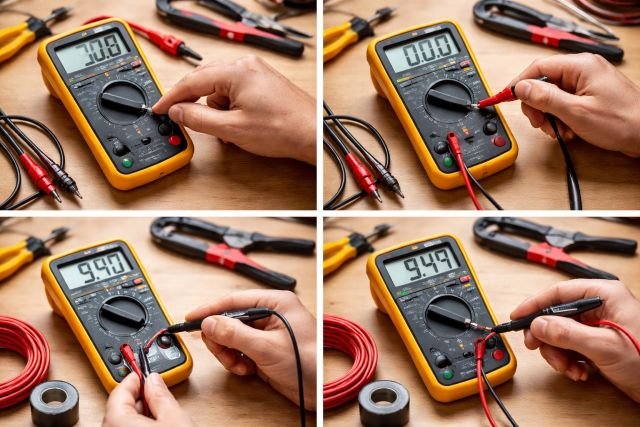
If you searched for nometre, you’re probably trying to measure something more accurately than a tape measure (or you’re seeing the term used online and want to use it “the right way”). In practice, “nometre” is often used as a catch-all term for modern, sensor-based measurement tools and workflows — especially where precision, repeatability, and traceability matter.
- What Is Nometre (and What It Usually Refers To)?
- When You Should Use a Nometre Workflow
- Before You Start: What You Need to Use Nometre Correctly
- Step-by-Step: How to Use Nometre Correctly
- Common Nometre Mistakes (and How to Fix Them)
- Real-World Scenarios: Using Nometre Correctly
- FAQ
- Conclusion: Using Nometre the Right Way
This guide shows you how to use nometre correctly from setup to reporting, with real-world tips that reduce errors and rework. That matters because measurement mistakes can snowball into expensive fixes — construction research regularly cites rework as a meaningful share of total cost in many projects.
What Is Nometre (and What It Usually Refers To)?
Because “nometre” is used inconsistently online, it helps to anchor on what correct measurement means:
- A measurement should be repeatable (you can get the same result again).
- It should be traceable (linked back to recognized standards through calibration).
- It should include uncertainty (a realistic range around the result).
That’s not just theory — international metrology references like the BIPM define the SI unit of length (the metre) and how it’s realized in practice.
And NIST provides clear guidance on metrological traceability and how measurement results should connect to standards.
For uncertainty, the GUM is the widely used basis for evaluating and expressing measurement uncertainty.
So, in this article, “nometre” means: a modern measurement tool + workflow (often digital) that you use to capture accurate dimensions/distances and report them reliably.
When You Should Use a Nometre Workflow
Use nometre when any of these are true:
- You need high precision (tight tolerances, small parts, QA checks).
- You need documentation (audits, client sign-off, compliance).
- You’re repeating measurements at scale (production, surveying, inspection).
- Mistakes are expensive (rework, scrap, delays).
That last point is why good measurement habits pay off: field rework and corrections can significantly affect schedule and budget in real projects.
Before You Start: What You Need to Use Nometre Correctly
A correct nometre setup is 80% preparation and 20% pressing buttons.
Check 1: Identify your measurement goal
Ask: “What decision will I make using this number?”
Example: “If this hole spacing is off by 0.3 mm, the assembly won’t fit.” That tells you the precision you need and how careful you must be about uncertainty reporting.
Check 2: Confirm the measurement unit and resolution
If you’re working at very small scales, confirm the unit (mm vs µm vs nm). The nanometre is 10⁻⁹ metres (1 nm = 0.000000001 m).
Check 3: Confirm calibration/traceability
If this measurement will be used for QA, clients, or certification, you want traceability to standards and a calibration plan aligned with recognized guidance (commonly referenced in ISO-style quality systems). NIST’s traceability policy explains what traceability is and what it is not.
Step-by-Step: How to Use Nometre Correctly
Step 1: Inspect the tool and environment
Most measurement failures come from “small” things:
- Dirty lens/sensor window
- Loose mounting
- Temperature swings
- Vibration
- Poor surface reflectivity (for optical/laser tools)
If the tool is digital/sensor-based, treat it like a camera + instrument: clean optics, stable mounting, consistent lighting.
Action tip: Let the tool and the object acclimate to the room temperature before a high-precision session. Temperature differences can subtly change dimensions and readings.
Step 2: Set the correct reference (zero / baseline)
Every “nometre” workflow needs a reference point.
- If it’s a distance device: define Point A and Point B clearly.
- If it’s a dimension gauge: set “zero” with a reference block/known standard.
- If it’s a scanning or imaging system: run the baseline routine (dark/white reference, focus, scale calibration).
This is also where traceability begins: your reference should be tied to a known standard or verified method.
Step 3: Calibrate (or verify) before measuring “for real”
Calibration can mean different things depending on your tool:
- Full calibration: performed by an accredited lab or internal metrology team.
- Verification check: a quick “known value” test before a job (highly recommended).
If you measure a known reference and your tool is consistently off, fix it before you measure production parts or site dimensions.
Why this matters: Good metrology practice doesn’t just give a number — it supports confidence in that number through standards and uncertainty evaluation.
Step 4: Choose the right measurement mode (and stick to it)
Digital tools often offer multiple modes (single-shot, continuous, average, scan, best-fit, etc.). Mode switching is a common cause of inconsistent results.
Rule of thumb:
If you need repeatability, prefer a mode that supports averaging or multiple samples, then document it.
Step 5: Capture measurements using a repeatable technique
Here’s a reliable “nometre” technique that works across many tools:
- Position the tool consistently (same angle, same contact pressure, same standoff distance).
- Take at least 3 readings.
- If results vary more than your tolerance, don’t average blindly — find the cause (surface, alignment, drift, vibration).
- Record the final result plus context: tool ID, mode, unit, environment notes.
This aligns with the broader idea that measurement results should be expressed in a way that reflects uncertainty and variability, not false precision.
Step 6: Apply uncertainty thinking (simple, practical version)
You don’t need a PhD in statistics to apply the GUM mindset.
Ask these three questions:
- Repeatability: If I measure again, how much does it vary?
- Bias: Am I consistently off from a known standard?
- Resolution: Can the tool even show the detail I’m claiming?
NIST’s uncertainty resources explain why uncertainty is about the distribution of possible values, not a single “perfect” number.
Practical example:
If your tool reads 100.00 mm but repeats between 99.98–100.02 mm, don’t report “100.0000 mm” like it’s exact. Report it at a level that matches variability.
Step 7: Document results like a pro (so others trust them)
If your measurements matter beyond your own use, your report should include:
- What you measured (feature/points)
- Method (mode, setup)
- Unit
- Tool ID/version
- Date/time and operator
- Any verification standard used
- Notes on conditions
- Result + uncertainty/variation note (as appropriate)
This is how measurement becomes defensible for audits, disputes, and quality reviews — exactly the point of traceability and uncertainty guidance.
Common Nometre Mistakes (and How to Fix Them)
Mistake 1: Confusing accuracy with precision
A tool can be precise (repeatable) and still wrong (biased). Verification against a known reference helps catch this.
Mistake 2: Measuring the wrong “feature”
Example: You meant edge-to-edge but measured center-to-center.
Fix: Define measurement points clearly and, if possible, annotate screenshots/scans.
Mistake 3: Ignoring uncertainty
Overconfident measurements create downstream surprises — especially in fabrication and construction where small errors can trigger costly fixes.
Mistake 4: Switching modes mid-job
Fix: Lock your method for the job, and write it down.
Real-World Scenarios: Using Nometre Correctly
Scenario 1: Site measurement to avoid rework
You’re measuring anchor bolt spacing before installing a base plate. A small spacing error forces re-drilling or plate modification.
A correct nometre workflow here is:
- Verify tool baseline on a known reference
- Measure the spacing multiple times
- Document point definitions (which bolt edges/centers)
- Report with an honest tolerance/variation note
That kind of discipline helps prevent expensive fixes that show up later as rework.
Scenario 2: QA inspection in manufacturing
You’re checking a critical dimension on 30 parts per hour. Speed matters — but so does consistency.
Correct usage:
- Quick verification at shift start (and after any drop/impact)
- Standardized measurement mode
- Sampling plan + recorded readings
- Outlier handling rules (don’t average away problems)
FAQ
What is nometre?
Nometre is commonly used online to describe a modern measurement tool and workflow—typically digital/sensor-based—focused on accurate, repeatable measurements supported by calibration, traceability, and uncertainty-aware reporting.
How do I use nometre correctly?
Use nometre correctly by stabilizing the environment, setting a clear baseline (zero/reference), verifying calibration with a known standard, taking repeat readings in a consistent mode, and documenting results with context and realistic uncertainty.
Why does calibration and traceability matter for nometre measurements?
Calibration and traceability matter because they connect your measurements to recognized standards and help others trust your results — especially in quality systems and regulated work. NIST explains traceability expectations and common misconceptions.
What’s the difference between a metre and a nanometre?
A metre is the SI base unit of length, defined via the distance light travels in vacuum in a specified fraction of a second.
A nanometre (nm) is one billionth of a metre (10⁻⁹ m).
Conclusion: Using Nometre the Right Way
Using nometre correctly isn’t just about getting a number — it’s about getting a number you (and others) can trust. When you follow a proper workflow—stable setup, clear reference, verification, repeatable technique, and uncertainty-aware reporting — you reduce disputes, avoid rework, and make better decisions faster. And because traceability and uncertainty are core to trustworthy measurement, authoritative guidance from bodies like BIPM, NIST, and the GUM framework is worth aligning with from day one.
If you want, paste the product/manual text or tell me what kind of “nometre” you’re using (laser distance meter, digital gauge, scanning system, etc.), and I’ll tailor the step-by-step instructions and troubleshooting section to that exact tool.