


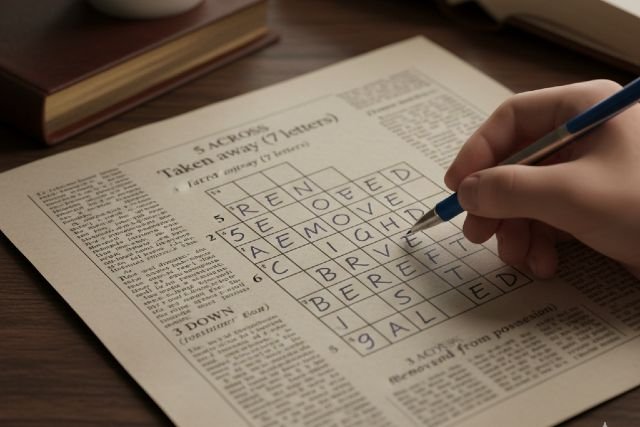
If you’re stuck on a taken away crossword clue, you’re dealing with one of those phrases that can mean five different things depending on the puzzle’s intent. Sometimes it’s about subtracting numbers, other times it’s about removing an object, and in tougher puzzles it can even hint at deprivation, abduction, or deletion.
- Quick definition for featured snippets: what “taken away” means in crosswords
- Why “taken away” is such a common crossword clue
- The most common meanings of a taken away crossword clue
- Common answers for “taken away” (with how to choose)
- How to solve a taken away crossword clue faster
- Examples: how the same clue can produce different answers
- FAQ
- Conclusion: mastering the taken away crossword clue is about context
This article breaks down the most common meanings behind “taken away,” shows which answers typically match each meaning, and gives you practical solving shortcuts so you don’t burn time cycling through wrong fits. Along the way, you’ll see real clue-to-answer patterns pulled from well-known crossword clue databases and authoritative definitions to keep your guesses grounded.
Quick definition for featured snippets: what “taken away” means in crosswords
In crossword puzzles, “taken away” usually signals one of these ideas: removed (physically taken), subtracted/deducted (math or scoring), deprived (something denied), or abducted (someone carried off). Which one applies depends on the clue’s tone, tense, and the letters you already have.
Merriam-Webster defines deprive as “to take something away from,” which closely matches one common crossword sense of “taken away.”
Why “taken away” is such a common crossword clue
Crossword editors love clue phrases that are simple on the surface but flexible underneath. “Taken away” is short, everyday language, but it can point to several answer families — especially because crosswords frequently reuse “remove/subtract” vocabulary in many tenses (remove/removed, deduct/deducted, subtract/subtracted).
Some clue databases even list dozens of potential matches for “taken away,” which explains why it can feel slippery without more context.
The most common meanings of a taken away crossword clue
1) “Taken away” = REMOVED (physical removal)
This is the most straightforward reading: something was taken off, taken out, or cleared away.
You’ll often see “taken away” cluing answers like REMOVED — especially in quick crosswords where the surface meaning matters most. For example, one British quick crossword listing includes REMOVED among the possible answers for “Taken away.”
When this meaning fits best:
- The clue reads like a real-world action (plates taken away, stain taken away, debris taken away).
- The puzzle is a simpler daily (quick crossword style).
- Your crossings suggest a general verb rather than a math term.
Related fill words you might see in similar puzzles: cleared, lifted, erased, eliminated. Merriam-Webster’s thesaurus for “took (away)” includes synonyms like removed and eliminated, which show up frequently as crossword answers.
2) “Taken away” = DEDUCTED / SUBTRACTED (math, scoring, totals)
In crosswords, “taken away” is also a classic math signal. It’s especially common when the surrounding theme or clue wording suggests numbers, points, totals, or accounting.
A closely related clue form is “takes away,” which crossword sources commonly answer as DEDUCTS, DETRACTS, or SUBTRACTS — all directly aligned with the arithmetic sense.
When this meaning fits best:
- The clue mentions totals, fees, discounts, penalties, points, or “from.”
- The tense is ongoing (“takes away”) rather than past (“taken away”).
- You already have letters that lean toward -TRACT- or -DUCT- patterns.
Practical tip: If you see crossings giving you -TRACT-, you’re likely in SUBTRACT(S/ED) territory. If you see DEDUCT-, it’s usually a “from a total” vibe rather than physical removal.
3) “Taken away” = DETRACTED (reduce value, diminish)
This one is easy to confuse with “distracted,” but in crossword language DETRACTED means “reduced” or “took away from” (as in “detracted from the overall impact”). Many clue databases group DETRACTED alongside “deducted” and “removed” for “Taken away.”
When this meaning fits best:
- The clue feels like critique language (took away from the effect, diminished the value).
- Crossings favor D-E-T-R-A-C-T-.
4) “Taken away” = DEPRIVED / STRIPPED (denied, robbed of)
Sometimes “taken away” isn’t about moving an object — it’s about denying someone something: rights, comfort, sleep, freedom.
Merriam-Webster’s definition of deprive (“to take something away from”) is basically a direct match for this reading, and “deprived” can appear as an answer when the clue implies loss of possession or experience rather than a literal removal.
When this meaning fits best:
- The clue leans emotional or human (“taken away from a child,” “taken away of hope” in a poetic clue).
- Crossings lead to DEPRIVED or related phrasing.
5) “Taken away” = ABDUCTED (carried off, kidnapped)
This meaning tends to show up when the subject is clearly a person (or sometimes “aliens” in playful puzzles). It’s less common than REMOVED/DEDUCTED, but it’s a frequent trick when you’ve been thinking “math” and the grid wants “crime drama.”
When this meaning fits best:
- The clue’s surface suggests a person was taken.
- Crossings point to ABDUCTED or KIDNAPPED-style patterns.
6) “Taken away” = DELETED / ERASED (text, data, writing)
In modern crosswords — especially tech-flavored clues — “taken away” may indicate something was deleted from a document, removed from a list, erased from a board.
This is where answers like ERASED or DELETED become strong contenders, especially if the clue mentions files, lines, entries, or edits. (And yes, editors love using “taken away” as a softer synonym for “deleted” in clue surfaces.)
Common answers for “taken away” (with how to choose)
Because a taken away crossword clue can map to multiple verb families, the fastest approach is not memorizing one “right” answer — it’s recognizing which family your clue belongs to.
Here are high-frequency answer candidates you’ll see across clue databases, plus the contexts where they usually win:
- REMOVED: physical action, “taken off/out,” general usage
- DEDUCTED: fees, totals, accounting, penalties
- SUBTRACTED / SUBTRACTS: explicit math vibe, “from a total”
- DETRACTED / DETRACTS: “took away from,” diminished impact
- DEPRIVED: denied, stripped of something (rights/sleep/comfort)
If you want a quick reality check when you’re stuck, crossword clue databases routinely show “taken away” grouped with removed / deducted / detracted, which reflects exactly why you should solve by context rather than by habit.
How to solve a taken away crossword clue faster
The next time you see a taken away crossword clue, use this quick decision process:
Step 1: Identify the “domain” of the clue (physical, math, emotional, tech)
Read the clue as if it were a sentence fragment in real life.
If it sounds like clearing plates → REMOVED family.
If it sounds like points/fees → DEDUCTED/SUBTRACTED family.
If it sounds like “took away from the effect” → DETRACTED family.
If it sounds like denial or loss → DEPRIVED family.
If it sounds like a person was taken → ABDUCTED family.
This works because crossword clue databases show these meanings clustering repeatedly around the same phrase.
Step 2: Let tense narrow your options
Crosswords are picky about grammar.
“Taken away” (past participle) often points to REMOVED, DEDUCTED, DETRACTED, ERASED, ABDUCTED.
“Takes away” (present) often points to DEDUCTS, SUBTRACTS, DETRACTS.
Step 3: Use letter patterns to choose between similar verbs
DEDUCTED vs DETRACTED are commonly confused because both fit “taken away.”
If you already have a U early → likely DEDUCTED.
If you have TRAC emerging → likely DETRACTED/SUBTRACTED.
If you have MOV → likely REMOVED.
Step 4: Watch for “from” as a hidden indicator
In crossword language, “from” is a giant arrow pointing toward subtract/detract.
If the clue implies “taken away from (something),” DETRACTED becomes unusually strong. That’s consistent with how “detract” is used in normal English (“detract from”).
Examples: how the same clue can produce different answers
Example A: “Taken away (7)”
With 7 letters, REMOVED fits perfectly. It’s also a commonly listed solution in quick crossword-style clue sets.
Example B: “Taken away (8)”
With 8 letters, DEDUCTED or DETRACTED often appear in databases for this exact clue wording.
Example C: “Takes away (9)”
With 9 letters, SUBTRACTS is a frequent match for the present-tense version.
Notice what’s happening: the letter count doesn’t just help you find an answer — it pushes you into the correct meaning family.
FAQ
What is the most common answer for “taken away” in crosswords?
It depends on the puzzle, but the most common answer families are REMOVED (physical), DEDUCTED/SUBTRACTED (math), and DETRACTED (“took away from”). Many crossword clue listings group these together for the same clue.
Does “taken away” always mean subtraction?
No. While “takes away” frequently signals subtracts/deducts, “taken away” can also mean physically removed, erased, deprived, or abducted depending on the clue’s surface and crossings.
How do I choose between DEDUCTED and DETRACTED?
Use context and the phrase structure. If it’s about totals, fees, or penalties, DEDUCTED is more likely. If it reads like “took away from the impact/quality,” DETRACTED fits the natural “detract from” usage and appears in clue listings for “taken away.”
What does “deprived” have to do with “taken away”?
“Deprived” matches the meaning of taking something away in the sense of denial or loss. Merriam-Webster defines deprive as “to take something away from,” which aligns with this crossword interpretation.
Conclusion: mastering the taken away crossword clue is about context
The fastest way to beat a taken away crossword clue isn’t guessing harder — it’s choosing the right meaning family early. In most puzzles, “taken away” points to REMOVED (physical), DEDUCTED/SUBTRACTED (math), or DETRACTED (diminished). Clue databases regularly cluster these exact answers together, which is why context and tense matter more than your first instinct.
If you treat “taken away” as a flexible signal — then let letter count, tense, and crossings do the final selection — you’ll solve it faster and with fewer dead ends.