


Bathrooms have quietly transformed from purely functional spaces into some of the most design-driven rooms in modern homes and commercial properties. By 2026, bathroom cabinet designs are no longer just about storage; they’re about technology, sustainability, personalization, and precision engineering.
- Why Are Bathroom Cabinet Designs Evolving So Rapidly?
- What Will Modern Bathroom Cabinets Look Like in 2026?
- How Is CAD Design Shaping the Future of Bathroom Cabinets?
- Are Sustainable Materials Influencing Bathroom Wooden Cabinet Designs?
- How Is Customization Becoming the New Standard?
- What Role Does Technology Play in Bathroom Cabinet Innovation?
- What Challenges Do Designers and Manufacturers Still Face?
- Why Are UK and US Markets Leading Bathroom Cabinet Trends?
- How Can Businesses Prepare for the Future of Bathroom Cabinets?
For business owners, architects, engineers, and tech decision-makers across the UK, USA, and global markets, bathroom cabinetry represents a powerful intersection of design innovation and CAD-driven execution. The future is being shaped not just by aesthetics, but by how intelligently designs are drafted, visualized, and manufactured.
So what exactly will define bathroom cabinets in 2026 and how is the CAD design and drafting industry influencing this evolution?
Let’s explore the trends, challenges, and opportunities shaping the next generation of bathroom cabinet designs.
Why Are Bathroom Cabinet Designs Evolving So Rapidly?
The short answer: changing user expectations and smarter design tools.
According to data from Statista, the global bathroom furniture market is projected to grow steadily through 2026, driven by urbanization, premium housing demand, and renovation projects.
But growth alone isn’t the whole story. Today’s end users expect:
- Highly customized layouts
- Space-saving solutions for compact bathrooms
- Sustainable and moisture-resistant materials
- Seamless integration with modern bathroom technology
Meeting these expectations requires more than good ideas; it demands accurate CAD drafting, intelligent modeling, and data-driven design workflows.
What Will Modern Bathroom Cabinets Look Like in 2026?
In 2026, “modern” doesn’t mean flashy, it means refined, efficient, and intelligently designed.
Here’s what’s defining modern bathroom cabinet designs globally:
Key Visual & Functional Traits
- Clean, handle-less profiles with push-to-open mechanisms
- Floating cabinets for a lighter, more spacious feel
- Slim profiles optimized for urban bathrooms
- Integrated lighting (LED strips, sensor lighting)
- Hidden storage that maximizes usability
Behind these features is precise bathroom vanity CAD drawings, allowing manufacturers and installers to achieve millimeter-level accuracy before production begins.
How Is CAD Design Shaping the Future of Bathroom Cabinets?
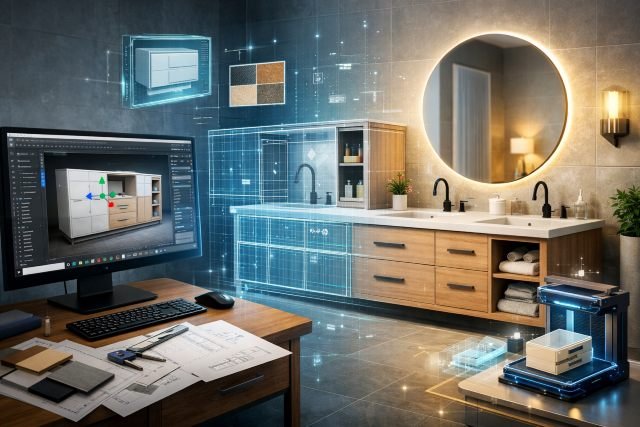
CAD design has become the backbone of modern bathroom interior planning.
In both the UK and USA, design teams increasingly rely on advanced CAD drafting and 3D modeling to:
- Visualize cabinetry within real bathroom layouts
- Test multiple configurations without physical prototypes
- Coordinate cabinets with plumbing, electrical, and lighting plans
- Reduce on-site errors and costly revisions
According to Autodesk industry insights, construction and interior design firms using detailed 3D CAD models report up to 30% fewer design clashes during execution.
This is particularly important for bathroom cabinetry, where tight spaces and moisture exposure leave little room for error.
Are Sustainable Materials Influencing Bathroom Wooden Cabinet Designs?
Absolutely and this is one of the biggest shifts heading into 2026.
Bathroom wooden cabinet designs are making a strong comeback, but with a modern twist. Instead of traditional solid wood that struggles in humid environments, designers are opting for:
- Engineered wood with moisture-resistant coatings
- FSC-certified timber for sustainability compliance
- Bamboo and fast-renewable wood alternatives
- Laminated wood finishes with high durability
According to the UK Green Building Council, over 60% of commercial renovation projects now prioritize sustainable material sourcing.
From a CAD perspective, this trend increases the need for accurate material specification and detailing within cabinet drawings ensuring finishes perform as expected long-term.
How Is Customization Becoming the New Standard?
One-size-fits-all cabinetry is quickly becoming obsolete.
In 2026, customization is no longer a luxury, it’s an expectation.
Clients increasingly want:
- Cabinets tailored to exact room dimensions
- Personalized storage layouts
- Design consistency across multiple properties or units
- Faster turnaround from concept to installation
This shift is driving demand for bathroom vanity CAD drawings that can be easily modified, scaled, and reused across projects especially in multi-unit residential and hospitality developments.
For startups and developers, CAD-driven customization reduces costs while delivering a premium end result.
What Role Does Technology Play in Bathroom Cabinet Innovation?
Bathroom cabinets are quietly getting smarter.
While not every cabinet will be “high-tech,” 2026 designs often include:
- Integrated charging stations inside vanity drawers
- Motion-sensor lighting for energy efficiency
- Soft-close mechanisms modeled and tested in CAD
- Compatibility with smart mirrors and digital fittings
According to McKinsey’s construction technology report, digital design adoption improves project delivery speed by 20–30%.
CAD drafting ensures these technologies are planned, aligned, and coordinated long before manufacturing begins.
What Challenges Do Designers and Manufacturers Still Face?
Despite innovation, the industry isn’t without its hurdles.
Key Challenges in 2026
- Designing for increasingly smaller bathrooms in urban areas
- Managing moisture resistance across different climates
- Aligning cabinet design with plumbing and electrical layouts
- Balancing cost, sustainability, and aesthetics
These challenges highlight why bathroom interior design services are increasingly integrated with CAD specialists ensuring cabinets aren’t just beautiful, but buildable and durable.
Why Are UK and US Markets Leading Bathroom Cabinet Trends?
The UK and USA remain key trendsetters due to:
- Strong renovation and housing markets
- Higher adoption of digital design workflows
- Strict building and material compliance standards
- Demand for premium, customized interiors
In both regions, architects and developers are prioritizing data-driven cabinet design, using CAD drawings to streamline approvals, manufacturing, and installation.
This creates significant opportunities for CAD design and drafting professionals supporting bathroom cabinetry projects worldwide.
How Can Businesses Prepare for the Future of Bathroom Cabinets?
For business owners, startups, and decision-makers, preparation means investing in design accuracy and scalability.
Smart steps include:
- Adopting standardized CAD libraries for cabinets
- Using parametric designs for faster customization
- Collaborating early between designers, engineers, and manufacturers
- Leveraging detailed CAD drawings to reduce rework
The companies that succeed in 2026 won’t just follow trends they’ll design with precision from day one.
Final Thoughts:
The future of bathroom cabinet designs in 2026 is defined by more than visual appeal. It’s about how well ideas are translated into reality through accurate CAD drafting, intelligent material choices, and forward-thinking design strategies.
As bathrooms continue to evolve into high-value, high-impact spaces, the role of CAD design and drafting will only grow more critical. Businesses that understand this connection will lead the market, not chase it.
At the conclusion of many successful projects, teams often collaborate with experienced UK-based CAD design companies that specialize in bathroom cabinetry, vanity drawings, and interior detailing, ensuring every modern design truly wows on screen and in real life.
FAQs
1. What are the top bathroom cabinet design trends for 2026?
In 2026, bathroom cabinet designs focus on minimalist aesthetics, floating vanities, integrated lighting, and smart storage solutions. Sustainability and space optimization are key drivers, especially in urban homes and commercial projects.
2. How is CAD technology improving modern bathroom cabinet designs?
CAD technology enables designers to create accurate bathroom vanity CAD drawings, test layouts virtually, and reduce installation errors. This leads to faster project delivery, better customization, and fewer on-site changes.
3. Are bathroom wooden cabinet designs suitable for modern bathrooms?
Yes. Modern bathroom wooden cabinet designs use engineered and moisture-resistant wood materials that perform well in humid environments while offering a warm, premium aesthetic.
4. Why are custom bathroom cabinet designs becoming more popular?
Custom designs allow homeowners and developers to maximize storage, fit unique layouts, and align cabinets with plumbing and lighting plans, especially in compact or high-end bathrooms.
5. What role do bathroom interior design services play in cabinet planning?
Bathroom interior design services ensure cabinets are functionally aligned with space planning, ergonomics, and building standards, while CAD drawings help visualize the final result before manufacturing.
6. How do modern bathroom cabinets support sustainability goals?
Modern cabinets use eco-friendly materials, efficient manufacturing methods, and long-lasting finishes, helping projects meet sustainability targets and reduce long-term maintenance costs.
7. What should architects and developers consider when designing bathroom cabinets for 2026 projects?
They should focus on CAD-driven precision, modular designs, sustainable materials, and future-ready layouts that adapt easily to changing user needs and smart bathroom technologies.