

A brush cutter is one of those farm tools you don’t fully appreciate until weeds, grass, and woody growth start stealing your time. If you’ve ever spent a long afternoon hacking through thorny brush along field borders, irrigation channels, fence lines, or orchard rows, you already know the real “cost” isn’t just money — it’s hours of labor, fatigue, and missed work elsewhere.
- What is a brush cutter in farming?
- Why a brush cutter saves hours on the farm
- Brush cutter types for farming: choose your “power class”
- Gas vs battery vs PTO: which brush cutter power source fits your farm?
- Blade and attachment choices that change everything
- Buying guide: how to choose the best brush cutter for farming
- A quick comparison table: which brush cutter setup saves the most time?
- Safety: the “hidden” factor that protects your time
- Real-world scenarios: picking the right brush cutter for typical farms
- Maintenance that keeps your brush cutter fast (and extends its life)
- FAQ: brush cutter for farming
- Conclusion: the right brush cutter pays you back in hours
The right brush cutter setup can turn that grind into a fast, controlled routine. And because farms aren’t one-size-fits-all, the “best” brush cutter depends on your land, crop layout, vegetation thickness, and how often you clear.
This guide breaks down powerful brush cutter options that genuinely save time, how to choose the right type, what features matter most, and how to use one safely and efficiently.
What is a brush cutter in farming?
A brush cutter is a powered cutting tool designed to slice through dense vegetation — thick grass, tall weeds, scrub, and light woody stems — where a standard string trimmer struggles. On farms, brush cutters are commonly used for:
- Field edges and bunds
- Orchard and plantation undergrowth
- Canal/ditch banks
- Fence lines
- Pasture cleanup and trail maintenance
- Clearing around poles, pumps, and sheds
Unlike a regular trimmer that relies mainly on nylon line, a brush cutter can use metal blades (and other heavy-duty attachments) for tougher growth.
Why a brush cutter saves hours on the farm
Time savings come from two things: higher cutting capacity and less stop-start work. When your tool can chew through thick patches without bogging down, you finish faster and avoid constant rework.
To understand the labor gap, it helps to look at how time-intensive vegetation control can be when done manually. The FAO notes that hand weeding with traditional hoes can take about 140 hours for one person to weed one hectare (dropping to about 65 hours per hectare by the third weeding).
Brush cutting isn’t the same as crop weeding with hoes — but the takeaway is the same: manual vegetation control is a massive time sink. Mechanized cutting is about reclaiming that time so labor goes to higher-value tasks (irrigation timing, pest scouting, harvesting prep, repairs).
Even in professional vegetation work, productivity is measurable in area per hour. A Quebec forestry research summary (motor-manual brushcutting work) reports model error terms in hours per hectare, reinforcing that brushcutting productivity can be tracked and optimized like any farm operation.
And a peer-reviewed study on mechanized roadside brush clearing measured clearing productivity ranging from 0.19 to 0.61 hectares per productive machine hour depending on stump diameter and conditions.
Bottom line: when you match the tool to the growth type, brush cutting becomes a predictable, fast maintenance job rather than a recurring battle.
Brush cutter types for farming: choose your “power class”
Handheld brush cutter (most versatile for small–mid farms)
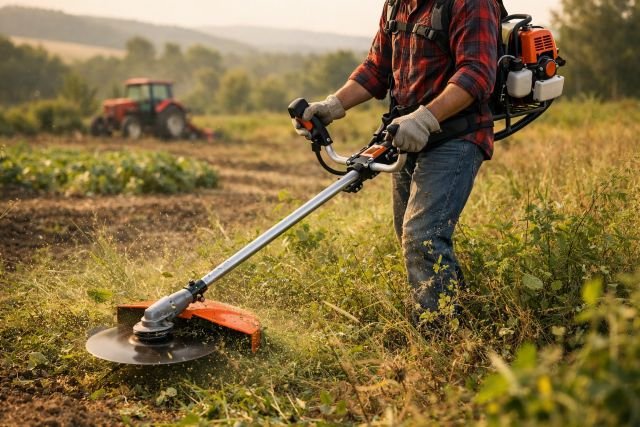
This is the familiar shoulder-slung unit with bicycle handles or a loop handle. It’s ideal for farms that need frequent cleanup in tight areas: around trees, along edges, near irrigation, and in uneven terrain.
Best for: smallholders, orchards, mixed farms, terraces, and irregular boundaries
Typical vegetation: tall grass, weeds, light scrub, thin woody stems (with blade)
Walk-behind brush cutter (fatigue-saver for heavy grass and slopes)
Walk-behind units look like rugged mowers designed for rough growth. They reduce upper-body fatigue and are great when you’re clearing lots of thick grass repeatedly or working on slopes where carrying a tool is miserable.
Best for: pasture edges, large boundary runs, slope work
Typical vegetation: thick grass, heavy weeds, light brush (varies by model)
Tractor-mounted / PTO brush cutter (fastest for large acreage)
If you’re clearing wide strips, reclaiming overgrowth, or maintaining rough pasture at scale, tractor-mounted cutters deliver the biggest time savings. These are sometimes called rotary cutters or “brush hogs,” but the key idea is the same: acreage per hour is dramatically higher.
Best for: large farms, pasture management, land clearing projects
Typical vegetation: grass, weeds, dense brush (depending on deck rating)
Gas vs battery vs PTO: which brush cutter power source fits your farm?
Gas brush cutters (2-stroke and 4-stroke)
Gas models are popular because they’re powerful, portable, and refuel fast. For thick scrub and long sessions, gas still dominates many farms.
Tradeoff to know: emissions and air pollution are higher for small gasoline engines, especially 2-strokes. An EPA report on gasoline-powered lawn and garden equipment (including brush cutters) notes these engines contribute substantially to VOCs and fine particulate emissions in the “landscape maintenance equipment” category, with two-strokes responsible for the vast majority of fine PM from that category.
That doesn’t mean “don’t buy gas.” It means: if you run gas often, favor efficient models, maintain them well, and use proper PPE.
Battery brush cutters (quiet, low-maintenance, great for frequent touch-ups)
Battery brush cutters shine when your job is frequent trimming and moderate brush control—especially near livestock, homes, or worker areas where noise and fumes are a concern.
Best for: routine maintenance, orchard rows, boundary touch-ups
Limitations: runtime and sustained torque for thick woody growth
PTO/tractor-powered cutters (maximum output)
If your goal is speed across big areas, PTO power wins. You’re trading nimble precision for raw coverage.
Best for: large boundary strips, pasture cleanup, reclaiming fields
Limitations: requires tractor access; less precise around trees/posts
Blade and attachment choices that change everything
A brush cutter’s performance depends as much on the cutting head as the engine.
When to use trimmer line vs blade
- Trimmer line is for soft weeds and grass where you don’t want to risk hitting stones or fence wire.
- Metal blades are for thick weeds, reeds, and brush where line breaks constantly.
Common farm-use blades
- 3-tooth / grass blades: tall grass, thick weeds
- Brush knives: denser weeds and scrub
- Saw blades: woody stems and saplings (use with extra care and correct guard)
If your main complaint is “it takes forever,” the fix is often switching to the correct blade for your vegetation — especially if you’re still trying to solve brush problems with line.
Buying guide: how to choose the best brush cutter for farming
1) Match engine power to the thickest growth you face
Don’t buy for the average day — buy for the worst patches that slow you down. If you regularly cut woody stems, you need higher torque and the right blade/gear head.
2) Prioritize harness and handle design (this is where time savings become real)
A powerful tool that exhausts the operator doesn’t save time — it just shifts the cost into fatigue. A solid harness and bicycle handles can extend comfortable working time and improve control.
3) Look for anti-vibration and easy-start features
Reducing vibration helps you work longer with better precision. Easy-start systems reduce frustration during stop-start farm tasks.
4) Think about service and parts availability
On farms, downtime is expensive. Favor brands with local parts, service support, and readily available blades/line heads.
5) Consider vegetation + terrain, not just acres
One hectare of flat grass is not the same as one hectare of thorny scrub on uneven bunds. Terrain and obstacles can be productivity killers, and research on brushcutter performance shows obstacles and vegetation conditions influence time consumption.
A quick comparison table: which brush cutter setup saves the most time?
| Farm situation | Fastest practical option | Why it saves hours |
|---|---|---|
| Orchard rows + fence lines | Handheld brush cutter (blade + harness) | Precision + power in tight spaces |
| Thick grass along bunds | Walk-behind brush cutter | Less fatigue, steady pace |
| Large pasture cleanup | Tractor/PTO cutter | Highest area covered per hour |
| Frequent light maintenance near workers/livestock | Battery brush cutter | Quick starts, low noise, low fumes |
Safety: the “hidden” factor that protects your time
A brush cutter throws debris, creates noise, and can cause injury if used casually. Safe technique prevents accidents that cost far more time than any tool could save.
OSHA’s PPE guidance emphasizes assessing hazards and using appropriate protective equipment for eye/face hazards, hearing hazards, and more.
Manufacturer safety guidance for brushcutting PPE commonly includes helmet/head protection, face/eye protection, hearing protection, gloves, and protective boots.
Practical farm rule: Dress for the worst-case impact — flying stones, snapped branches, and blade contact risk. If your farm work includes clearing near gravel or dry woody brush, treat face/eye and hearing protection as non-negotiable.
Real-world scenarios: picking the right brush cutter for typical farms
Scenario 1: Orchard farmer clearing undergrowth twice a month
You want fast start-up, low fatigue, and control around trunks and drip lines. A handheld brush cutter with a harness and a grass/brush blade is usually the sweet spot. Battery can work well if growth is mostly soft weeds.
Scenario 2: Mixed farm with canals, bunds, and thorny boundary scrub
Gas handheld models often win here because you need sustained power and quick refueling. The big time saver is keeping two cutting setups ready: line head for soft edges, blade for scrub patches.
Scenario 3: Large acreage pasture and rough field edges
If you already have a tractor, the fastest solution is usually PTO-based cutting for wide areas, plus a handheld brush cutter for the “detail work” the tractor can’t reach.
Maintenance that keeps your brush cutter fast (and extends its life)
A brush cutter loses time-saving value when it bogs down, overheats, or eats through line/blades.
High-impact habits:
- Keep blades sharp and replace damaged blades early (dull blades waste fuel and time).
- Clean air filters regularly (dusty farm conditions clog fast).
- Check and tighten fasteners—vibration loosens hardware over time.
- Store fuel correctly (old fuel causes hard starting and rough running).
If you operate gasoline units regularly, it’s also worth paying attention to emissions-related maintenance. The EPA’s discussion of emissions from small engines is a reminder that tune and engine type matter.
FAQ: brush cutter for farming
What is the best brush cutter for farming?
The best brush cutter for farming is the one matched to your vegetation and terrain: handheld models for precision work (orchards, fence lines), walk-behind units for heavy grass with less fatigue, and tractor/PTO cutters for large areas where speed matters most.
Can a brush cutter cut small trees?
Yes, many brush cutters can cut small woody stems and saplings when fitted with the correct metal blade and guard. For thicker saplings, you’ll need a more powerful unit and a blade designed for woody growth — plus careful technique and PPE.
Is a 2-stroke or 4-stroke brush cutter better for farm use?
2-strokes are often lighter with strong cutting performance for their size, while 4-strokes can be more fuel-efficient and produce less smoke. Emissions from small gasoline engines — especially 2-strokes — are a known concern in aggregate.
What safety gear should I wear when using a brush cutter?
At minimum: eye/face protection, hearing protection, gloves, long pants, and sturdy boots. OSHA’s PPE guidance highlights selecting protection based on hazard assessment, and manufacturer guidance commonly recommends helmet/head protection and face/eye protection for brushcutting.
Conclusion: the right brush cutter pays you back in hours
A brush cutter isn’t just a tool purchase — it’s a time strategy. When you choose the right type (handheld, walk-behind, or PTO), match power to the thickest growth you face, and run the correct blade for the job, you stop “fighting vegetation” and start managing it on schedule.
The farms that save the most time with brush cutters do three things consistently: they buy for real conditions (not marketing), they invest in operator comfort and safety, and they maintain the tool so performance stays sharp. Do that, and you’ll feel the payoff in reclaimed hours — week after week.