


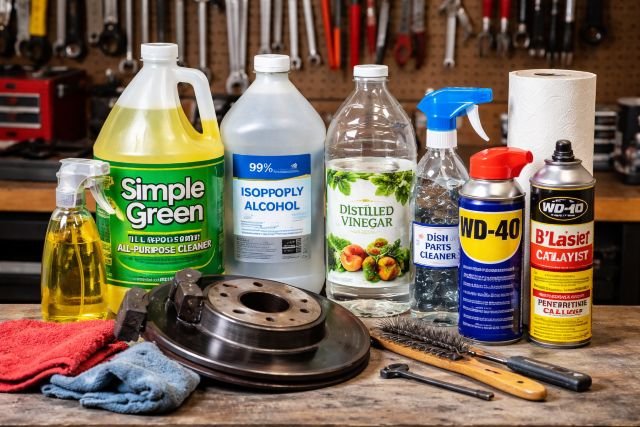
If you’ve ever started a brake job and realized you’re out of brake cleaner, you know the feeling: you’ve got the wheel off, your hands are dirty, and you’re staring at a rotor that needs to be oil-free before anything goes back together.
- What brake cleaner actually does (and why substitutes often fail)
- Quick definition for featured snippets: “Brake cleaner alternative”
- The #1 rule: rotor/pad surfaces need “clean and dry,” not just “clean”
- Best brake cleaner alternatives for rotors and pads (residue matters most)
- Good brake cleaner alternatives for calipers, brackets, and greasy areas
- What NOT to use as a brake cleaner substitute (common mistakes)
- Chlorinated vs non-chlorinated brake cleaner: why safety still matters even when you’re “just substituting”
- How to choose the right substitute (simple decision guide)
- Real-world scenarios: what to do when you’re out of brake cleaner
- FAQ: Brake cleaner alternatives
- Conclusion: The best brake cleaner alternative depends on the surface
The good news is you can still finish safely — if you pick the right substitute. The bad news is some “common-sense” cleaners can leave residue, swell rubber seals, contaminate pads, or create serious health hazards when heat is involved.
This guide breaks down the best brake cleaner alternatives (including what to use on rotors vs. calipers), what to avoid, and how to get a clean, squeal-free result without compromising braking performance.
What brake cleaner actually does (and why substitutes often fail)
Brake cleaner is designed to do three things at once:
- Cut grease, brake fluid, and oily film fast
- Evaporate quickly
- Leave little-to-no residue behind
That last part — residue-free evaporation — is the reason random degreasers can be risky. Brakes rely on friction. Any leftover film can reduce bite, create noise, or contaminate pads.
Also, many traditional brake cleaners use strong solvents such as tetrachloroethylene/perchloroethylene (PCE) or other chemicals with well-documented health and regulatory concerns. For example, CDC/NIOSH lists occupational exposure information for tetrachloroethylene, and EPA has ongoing risk evaluation and risk management actions around PCE under TSCA.
Quick definition for featured snippets: “Brake cleaner alternative”
A brake cleaner alternative is any product or method that removes grease and brake dust from brake components while drying fast and leaving minimal residue — without damaging rubber seals, paint, or friction material.
The #1 rule: rotor/pad surfaces need “clean and dry,” not just “clean”
When you’re substituting for brake cleaner, treat these surfaces differently:
- Rotor faces & pad friction surfaces: must be residue-free and dry
- Caliper body, bracket, dust shield: can tolerate slower cleaners (as long as you rinse/wipe fully)
If you accidentally get oily cleaner on pads, you may not be able to “wipe it off.” Pad contamination is a common reason for persistent squeal and reduced braking.
Best brake cleaner alternatives for rotors and pads (residue matters most)
1) 99% isopropyl alcohol (IPA): the safest “finish cleaner”
If you want the closest “clean and dry” behavior with minimal drama, 99% isopropyl alcohol is one of the most reliable substitutes for brake cleaner on rotor faces.
Why it works:
- Evaporates quickly
- Generally leaves minimal residue (especially compared with household cleaners)
- Widely available
How to use it like a pro:
- Use a clean, lint-free towel
- Wet the towel, wipe the rotor face, then wipe again with a dry towel
- Repeat until the towel comes away clean
Tip: 70% IPA works in a pinch, but it’s slower to dry and contains more water—fine for wiping rotors if you finish with a dry wipe, but not ideal if you’re racing the clock.
2) Acetone: very effective, but handle with care
Acetone is a powerful degreaser that evaporates fast, making it a common shop substitute.
Where it shines:
- Removing oily fingerprints and light grease from rotor faces
- Cleaning metal tools and brackets
Cautions:
- Can damage some paints, plastics, and finishes
- Very flammable
- Strong fumes — ventilation matters
If your “out of brake cleaner” moment is happening in a closed garage, acetone can feel harsh quickly. Use airflow and avoid open flames/sparks.
3) Electronics/contact cleaner (plastic-safe, residue-free types)
Some electrical contact cleaners are formulated to evaporate cleanly and leave minimal residue, which can make them a workable substitute for brake cleaner on metal rotor hats or rotor faces—but only if the product is explicitly labeled residue-free.
What to watch:
- Some contact cleaners leave a protective film (not what you want on brakes)
- Choose “residue-free” and avoid “lubricating” versions
This option is especially useful if you already have it in the garage and can’t get brake cleaner today.
Good brake cleaner alternatives for calipers, brackets, and greasy areas
4) Dish soap + hot water (best for non-friction areas)
It sounds too simple, but hot water with a grease-cutting dish soap is an excellent cleaner for caliper brackets, dust shields, wheels, and the outside of calipers.
Why it works:
- Surfactants lift grime instead of dissolving it into a film
- Safer on rubber and paint than aggressive solvents (in most cases)
- Cheap and easy
The key is drying:
- Rinse thoroughly
- Dry completely (compressed air or a towel)
- Keep it off pads and rotor faces unless you plan a final alcohol wipe
5) Citrus degreaser (use it smart, then remove residue)
Citrus degreasers can be great for heavy grime, but many leave residue if not rinsed well. That’s why they’re better for:
- Caliper exteriors
- Suspension parts
- Engine bay grime that’s drifted onto the knuckle area
If you use citrus degreaser near brakes:
- Rinse/wipe thoroughly
- Finish rotor faces with 99% IPA
For a more eco-conscious approach, look for products recognized by programs like EPA Safer Choice, which helps identify products formulated with safer chemical ingredients.
6) Parts washer solvent (only for removed parts, not assembled brakes)
If you have a small parts washer setup, it’s great for:
- Caliper brackets (removed)
- Hardware clips (removed)
- Bolts and metal components
But do not let parts washer solvent touch pads or rotor faces unless you know it evaporates residue-free — and many don’t.
What NOT to use as a brake cleaner substitute (common mistakes)
WD-40 and penetrating oils
These are lubricants. They leave film by design. If you spray WD-40 anywhere near pad/rotor contact surfaces, you risk permanent contamination.
Engine degreaser sprays that “shine”
If the label suggests a shine or protective finish, it likely leaves residue.
Gasoline
It’s a dangerous combination of flammability + unpredictable additives + health hazards. Skip it.
Carb/throttle body cleaners (sometimes risky)
Some can work on metal, but formulas vary and may be harsh on rubber or leave residue. If you use them on brackets, keep them away from boots and seals and do a final wipe.
Chlorinated vs non-chlorinated brake cleaner: why safety still matters even when you’re “just substituting”
A lot of the “what can I use instead of brake cleaner?” conversation exists because brake cleaner chemistry can be intense.
Some chlorinated brake cleaners contain tetrachloroethylene/perchloroethylene (PCE). SDS documents for certain brake cleaners list tetrachloroethylene and outline exposure guidance.
From a health/regulatory standpoint:
- EPA has published risk evaluation information and has taken risk management action related to PCE.
- CDC/NIOSH provides hazard and exposure-limit information for tetrachloroethylene.
- EPA also highlights serious risks for chemicals like methylene chloride (used in some solvent products), including neurotoxicity and cancer concerns with longer exposures.
Critical safety warning: never weld or heat parts cleaned with certain solvents
If you clean metal and then weld/heat it, solvent breakdown can create extremely toxic gases. Some brake cleaner SDS documents explicitly warn that vapors can decompose to corrosive gases and possibly phosgene under extreme heat.
Practical takeaway:
- For any welding/cutting/torch work, avoid aerosol solvent cleaners entirely and use methods approved for hot work (mechanical cleaning, dedicated aqueous cleaners, and strict ventilation).
How to choose the right substitute (simple decision guide)
If you’re cleaning rotor faces right now
Use:
- 99% isopropyl alcohol (best balance)
- Acetone (effective but harsher)
- Residue-free contact cleaner (if verified)
Avoid:
- Anything oily, “protective,” or slow-drying
If you’re cleaning greasy brackets and hardware
Use:
- Dish soap + hot water
- Citrus degreaser (then rinse/wipe thoroughly)
- Parts washer solvent (removed parts only)
Finish:
- Wipe rotor faces with 99% IPA before reassembly
Real-world scenarios: what to do when you’re out of brake cleaner
Scenario 1: You touched the rotor with greasy hands during pad replacement
You don’t need a full chemical bath. You need a clean finish.
Best move:
- Wipe rotor faces with 99% isopropyl alcohol using a lint-free towel
- Rotate rotor and repeat until the towel stays clean
Scenario 2: Sticking caliper bracket is packed with grime
This is where soap/water or citrus degreaser shines.
Best move:
- Remove bracket hardware
- Scrub with hot soapy water (or citrus degreaser), rinse and dry
- Use a final IPA wipe on any areas that might contact the rotor
Scenario 3: You accidentally got cleaner on the pads
If it was alcohol and it evaporated instantly, you may be okay. If it was anything oily or unknown, assume contamination.
Best move:
- Don’t gamble with braking performance
- Consider replacing the pads (often cheaper than chasing noise and poor bite)
FAQ: Brake cleaner alternatives
What can I use if I don’t have brake cleaner?
For rotor faces, 99% isopropyl alcohol is one of the best brake cleaner alternatives because it evaporates quickly and leaves minimal residue. For brackets and calipers, hot soapy water or a citrus degreaser (followed by thorough rinsing and drying) works well.
Can I use rubbing alcohol as brake cleaner?
Yes — especially 99% isopropyl alcohol. Lower concentrations (like 70%) can work but may dry slower due to higher water content. Always finish with a dry wipe so the rotor face is clean and dry.
Can I use acetone instead of brake cleaner?
Often yes, on metal rotor faces and brackets, because it degreases and evaporates quickly. But acetone is flammable, can damage some plastics/paints, and has strong fumes—use ventilation and keep it away from rubber components.
Is it okay to use WD-40 to clean brakes?
No. WD-40 leaves an oily film and can contaminate pads and rotors, reducing friction and braking performance.
Is brake cleaner dangerous?
It can be. Some formulas contain solvents with significant health concerns, and exposure guidance exists for chemicals found in certain products. CDC/NIOSH provides hazard information for tetrachloroethylene, and EPA has published risk evaluation/risk management information for PCE.
Conclusion: The best brake cleaner alternative depends on the surface
Running out of brake cleaner doesn’t have to stop your repair, but it does mean you need to be picky. For rotor faces and anything near pad contact, prioritize fast-evaporating, residue-free substitutes like 99% isopropyl alcohol (or acetone if you can use it safely). For greasy brackets and caliper exteriors, soap-and-water or a good degreaser can work — as long as you rinse, dry, and finish critical surfaces properly.
If you want to make your shop safer long-term, consider products aligned with programs like EPA Safer Choice for routine cleaning, and always respect heat-related warnings found in safety data sheets (including the risk of highly toxic breakdown products under extreme heat).