

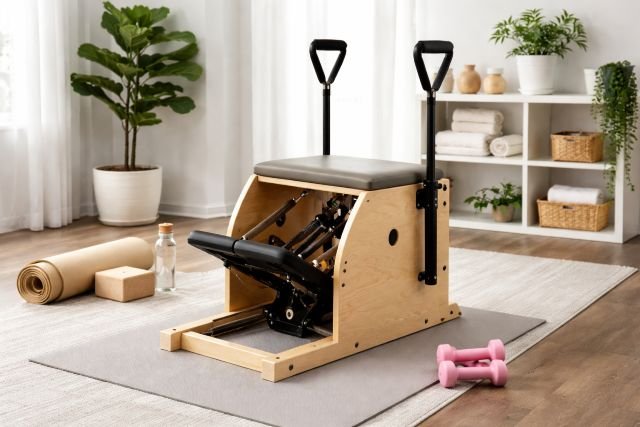
If you’re shopping for a pilates chair for home, you’re already on the right track: this compact piece of Pilates equipment can deliver surprisingly intense full-body training — without taking over your living room. A chair is especially helpful if you want strength-focused sessions (legs, glutes, arms, core), balance work, and “upright” Pilates that feels practical for everyday movement.
- Quick definition: what is a Pilates chair?
- Why a Pilates chair works so well at home
- Best Pilates chair for home: top picks (with real “who it’s for” guidance)
- Buying guide: how to choose the right Pilates chair for your home
- What results can you realistically expect?
- Common mistakes to avoid with a home Pilates chair
- Simple at-home programming: a realistic weekly plan
- FAQ
- Conclusion: choosing the right Pilates chair
It’s also a good moment to buy. Pilates participation has been rising sharply in recent years; one report cited by media coverage based on SFIA participation data puts Pilates participation at 12.9 million in the U.S., up from 9.2 million in 2019 (nearly 40% growth) — a sign that more people are building Pilates into long-term routines at home and in studios.
This guide covers the best home options (from studio-grade to budget-friendly), what features actually matter, and how to choose the right chair for your space, body, and goals.
Quick definition: what is a Pilates chair?
A Pilates chair (often called a Wunda Chair or Stability Chair) is a compact apparatus with a padded seat and a spring-loaded pedal (single or split). You use it seated, standing, and even prone to train strength, control, mobility, and coordination — similar principles to a reformer, but in a smaller footprint.
Historically, the Wunda Chair is tied to Joseph Pilates’ early designs; documentation around early chair design and patents places its development in the early 1930s (filed 1931, patented 1934, per Pilates history research).
Why a Pilates chair works so well at home
A home chair shines for three reasons: intensity, versatility, and space efficiency.
First, it’s intense. The pedal springs create resistance that challenges your “deep” stabilizers — especially through single-leg work, standing presses, and rotational patterns.
Second, it’s versatile. You can train lower body strength (step-ups, presses), upper body pushing/pulling (triceps press, chest press variations), and core integration (pikes, standing series).
Third, it fits. Many chairs are designed specifically for studios and homes with limited space. For example, Balanced Body markets the EXO Chair as compact and home-friendly while still durable enough for regular use.
Best Pilates chair for home: top picks (with real “who it’s for” guidance)
1) Best overall for most homes: Balanced Body EXO Chair (Split Pedal)
If you want a long-term, “won’t outgrow it” chair, the Balanced Body EXO Chair is a standout. The split-pedal version adds variety (bilateral vs. unilateral work) and can convert to a single pedal—useful if multiple family members use the chair or if you’re progressing from basics to more advanced coordination.
Balanced Body highlights features like fast spring adjustments (their “cactus” attachment system), broad resistance options, and an expanded seat designed to widen exercise variety.
Great for: beginners who plan to stick with Pilates, intermediate/advanced users, households with multiple users, people who want smoother progression.
2) Best for maximum variety (and teaching-style setups): Balanced Body Combo Chair
If you like the idea of a “chair you can grow into,” the Combo Chair is designed for lots of programming flexibility. Balanced Body positions it as an evolution of the Wunda Chair concept, adding a padded split pedal to expand movement options.
If you expect to do a wide mix — strength days, mobility days, athletic-style days — this is a strong “do-everything” pick.
Great for: variety seekers, people who want a studio-style feel at home, those who want split-pedal options for asymmetry/balance work.
3) Best for rehab-friendly support and upright training: Merrithew Split-Pedal Stability Chair
If you value stability work, upright patterns, and a chair that plays nicely with modifications, Merrithew’s Split-Pedal Stability Chair is built around that use case. Merrithew specifically frames it as suitable for rehab clients or those who need to stay seated/upright, while still offering high-performance options for athletes and fitness enthusiasts.
Many buyers also prioritize handles for confidence and alignment cues; product listings commonly emphasize adjustable handles and the option to lock pedals together.
Great for: cautious beginners, people returning from injury (with clinician guidance), older adults building strength/balance, anyone who wants handles and a more “supported” feel.
4) Best “classical feel” and craftsmanship: Gratz Wunda Chair
If you’re drawn to classical Pilates apparatus and want a chair that feels like it belongs in a traditional studio, Gratz is often on the shortlist. Their Wunda Chair is marketed as a portable, functional option suitable for professional and home studios, with solid wood construction and spring resistance options.
This is less about “budget value” and more about materials, heritage, and that classic apparatus experience.
Great for: classical Pilates enthusiasts, studio-like home setups, buyers who want premium craftsmanship.
5) Best budget-friendly entry: AeroPilates Precision Pilates Chair (Stamina)
If you’re newer to chair work or simply want an affordable way to see if you’ll use it consistently, the AeroPilates Precision Pilates Chair is a common entry point. It’s positioned as compact and versatile for home use, with exercises performed sitting, standing, or lying.
A practical rule: if you’re unsure you’ll stick with chair workouts 2–4 times per week, starting here can make sense — then upgrading later if you fall in love with chair training.
Great for: budget buyers, first-time chair users, smaller spaces, people who want “try it first” value.
6) Best for portability / small-group style vibe: Peak Pilates MVe Chair
Peak Pilates describes the MVe Chair as sleek, stable, portable, and even stackable (useful more for studios, but it signals space-conscious design).
Great for: people who may move the chair frequently, multi-use rooms, those who like a more contemporary/fitness-forward build.
Buying guide: how to choose the right Pilates chair for your home
Single pedal vs. split pedal
A single pedal is simpler: fewer moving parts, fewer coordination demands, often a lower price. A split pedal adds a new layer — unilateral strength, anti-rotation control, and asymmetry training (which can be excellent, but also more challenging).
If you’re newer, split pedal is still fine if you choose a chair that can lock into one pedal or convert (some models are designed exactly for that).
Springs and resistance range
Spring options affect who can use the chair and how long you’ll grow with it. Balanced Body notes that some chairs use heavy springs with multiple attachment points for resistance changes, and their product pages emphasize a wide resistance range for progressive training.
For households, more resistance options usually equals fewer compromises.
Handles: yes or no?
Handles aren’t just for beginners. They can improve form feedback in lunges, dips, standing presses, and balance sequences. If you’re training at home without an instructor watching, handles can also add confidence and safety — especially during step-up/step-down patterns and standing work. Merrithew’s handle-focused positioning is a good example of this design logic.
Seat comfort and padding
A small detail that matters: seat padding and pedal padding affect whether you’ll want to use the chair. If your hamstrings, knees, or wrists are sensitive, prioritize comfort features and the ability to add pads/cushions.
Footprint, storage, and flooring
Measure your actual workout “bubble,” not just the chair. Many movements require space in front of and behind the chair for leg lines and arm reaches. Also consider:
- A stable mat underneath (to reduce sliding and protect floors)
- Whether you’ll move it often (wheels/weight matter)
- Ceiling clearance if you’ll do standing arm work with handles
Build quality and long-term value
A chair is a dynamic load tool. Wobble is not a cute quirk — it changes your mechanics. If you plan to use the chair for years, a studio-grade option usually becomes the better value-per-session.
This ties into the broader home-fitness shift: market researchers project continued growth in home fitness equipment in the coming years, reflecting sustained demand for at-home training tools.
What results can you realistically expect?
A pilates chair is not “just toning.” With consistent training, you’re building:
- Lower body strength (especially glutes, quads, calves, hip stabilizers)
- Core control under load (anti-extension/anti-rotation patterns)
- Shoulder stability (scapular control in presses/pulls)
- Balance and proprioception (especially with split pedals)
Research on Pilates broadly (not chair-only) also supports meaningful outcomes. For example, a systematic review focused on Pilates and chronic low back pain evaluated RCT evidence around core activation and related outcomes. An umbrella review covering Pilates across multiple outcomes also synthesizes evidence across reviews and meta-analyses.
Practical translation: if your goal is “feel stronger in daily life,” chair work tends to deliver — because it forces controlled strength in positions that resemble real movement (standing, stepping, stabilizing).
Common mistakes to avoid with a home Pilates chair
Going too heavy too soon
Chair exercises can feel “easy” until your stabilizers fatigue — then your body cheats. Start lighter than your ego wants, build clean reps, then increase resistance.
Skipping alignment cues because you’re alone
Without an instructor, you need simple self-checks: stacked ribs over pelvis, long spine, slow tempo, controlled return. If you lose the return, the spring is running the show, not you.
Treating it like a stair stepper
Yes, chair work can get cardio-ish, but speed often hides control problems. You’ll get better results by slowing down and making each rep precise.
Simple at-home programming: a realistic weekly plan
If you want steady results without overthinking it, aim for 3 sessions/week:
- Day 1: legs + glutes + core integration (presses, step-ups, standing series)
- Day 2: upper body + posture + mobility (triceps, chest press variations, spinal articulation)
- Day 3: full-body flow + balance (split pedal work, controlled transitions)
Keep sessions 20–35 minutes. Consistency beats epic workouts.
FAQ
What is the best Pilates chair for home use?
The best Pilates chair for home use is one that matches your space, budget, and support needs. Studio-grade options like the Balanced Body EXO Chair and Combo Chair prioritize durability and progression, while options like Merrithew’s Stability Chair emphasize supported upright training with handles.
Is a split-pedal Pilates chair better than a single pedal?
A split-pedal chair is “better” if you want unilateral training, balance, and anti-rotation work. A single pedal is better if you want simplicity and often a lower price. Some chairs let you lock or convert pedals, giving you both approaches.
Do I need handles on a Pilates chair?
Handles are recommended if you’re a beginner, prioritize balance and confidence, or plan to do lots of standing work. They can also help advanced users refine alignment and scapular control during challenging strength patterns.
Can a Pilates chair help with back pain?
Pilates-based exercise is often studied for back pain and core activation, and multiple reviews analyze outcomes like pain, disability, and function in chronic low back pain populations. That said, equipment choice matters less than appropriate programming and technique — especially if pain is ongoing or severe.
Conclusion: choosing the right Pilates chair
A pilates chair is one of the most space-efficient ways to get studio-style resistance training at home — especially if you want stronger legs, a more capable core, better balance, and workouts that feel functional.
If you want the safest “buy once, use for years” option, look hard at the Balanced Body EXO Chair (Split Pedal) for overall versatility and progression.
If you want a supported, upright-friendly setup with handles, Merrithew’s Split-Pedal Stability Chair is a strong fit.
If you’re budget-conscious, starting with AeroPilates can be a smart trial run — then upgrade later once your habit is solid.