


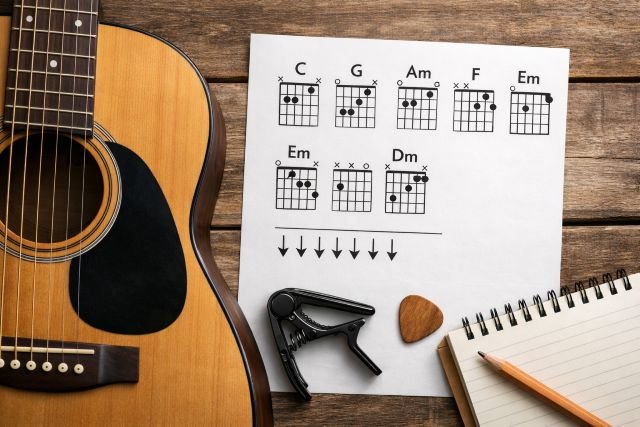
If you’re searching for build my life chords, you’re probably trying to do one of two things: play it simply (fast) or play it accurately (confidently). This guide gives you both — an easy-to-follow chord chart, practical capo/key options, and a strumming pattern that works for solo practice or full-band worship settings.
- Build My Life chords and the quickest way to start
- Full chord chart for Build My Life (easy G shapes)
- Build My Life strumming pattern (most popular options)
- Chord tips that make Build My Life sound “right”
- Key, capo, and transposing: what most players do
- Common questions
- How to practice Build My Life (real-world workflow)
- Quick note on reading chord charts (so the symbols don’t trip you up)
- Conclusion: playing Build My Life chords with confidence
“Build My Life” is commonly led as a slow, steady 4/4 worship groove. One widely shared chart lists Tempo: 72 BPM and Time Signature: 4/4, and notes the song can be played in G-shapes with Capo 1 (sounding in Ab) — a super common worship-music approach.
Build My Life chords and the quickest way to start
Here’s the simplest “get playing in 2 minutes” setup:
Play in G chord shapes with Capo 1 (this matches a common posted key of Ab).
Keep your right hand relaxed and aim for a soft, even strum — this song usually feels best when it’s not overplayed.
A number-system chart also shows the core movement as 1 → 4(add2) → 2 with slash-bass options like 1/3, which translates very naturally into G-shapes on guitar.
Full chord chart for Build My Life (easy G shapes)
Below is a practical chord map using G-shapes (good for most acoustic leaders). Variations exist across chord sites, but these shapes match the “G with capo” approach and the common add2/sus flavor you hear in worship arrangements.
Capo: 1
Play (shapes): Key of G (sounds Ab)
Time: 4/4
Tempo: ~72 BPM
Chords you’ll use most
G, C(add2), Em7, Dsus4 (or D), G/B, Am7
Tip: If you’re newer, you can play C instead of Cadd2, and D instead of Dsus4 — you’ll still sound great.
Intro (common feel)
G | G
(Then into verse)
Verse progression (typical)
G Cadd2
Em7
G/B Cadd2
Em7
(repeat)
This matches the “1, 4add2, 2, 1/3…” style flow you’ll see in number charts, adapted into guitar-friendly shapes.
Chorus progression (typical)
Cadd2
Em7 Dsus4
G (or G/B)
Am7
Cadd2
Em7 Dsus4
G (or G/B) Am7
If your chorus feels “too bright,” lean into Em7 and Dsus4 longer with softer downstrokes.
Bridge (“I will build my life…”)
Cadd2
Em7 Dsus4 Am7
G/B
(repeat)
One published chart shows this bridge living on the “4add2 → 2 → 5sus → 6m7” movement (number system), which translates very naturally to the shapes above when you’re in G-shapes with capo.
Build My Life strumming pattern (most popular options)
Because the song is around 72 BPM, you don’t need a busy rhythm to make it feel full—your consistency matters more than complexity.
Option 1: Beginner-friendly worship pattern
Down, Down, Up, Up, Down, Up
Count it as: 1 2 & & 4 &
This pattern locks in well at slower tempos and keeps the groove moving without overpowering vocals.
Option 2: Even simpler (great for leading)
Downstrokes only (light)
Count it: 1 2 3 4
When you’re singing and playing, this is often the cleanest choice — especially early on.
Option 3: Build-and-release dynamic pattern
Verse: Down, Down, Up, Up, Down, Up (soft)
Chorus: same pattern, but slightly stronger downbeats
Bridge: downstrokes first time through, then return to full pattern
This helps your arrangement feel like it’s growing, even if the chords don’t change much.
Chord tips that make Build My Life sound “right”
Use add2 and sus chords for that modern worship color
A common chord-number chart explicitly uses 4add2 and 5sus colors.
On guitar, that translates nicely to shapes like Cadd2 (instead of plain C) and Dsus4 (instead of plain D). Those little changes are why your strumming can stay simple, yet the song still sounds lush.
Keep your changes smooth with light “pivot fingers”
If you’re in G-shapes:
- When moving G → G/B, keep your ring and pinky planted (if you use the common G with pinky/ring on the 3rd fret of B and high E).
- When moving Cadd2 → Em7, aim to move as little as possible and let open strings ring.
Don’t rush the chord changes
At ~72 BPM, it’s tempting to change early because there’s “space.” Resist that. Let chords ring to the end of the bar and use your strum hand to keep time.
Key, capo, and transposing: what most players do
You’ll see the song posted in multiple keys depending on the vocalist and arrangement. One chord chart lists Key: Ab and specifically notes Capo 1 in G, which is a common worship-guitar trick: keep friendly open chords while matching the band’s key.
If your singer needs a different range, you have two easy options:
- Keep the same chord shapes and move the capo.
- Use a transposed chord chart from a reputable chord site (then still aim for add2/sus flavor).
Common questions
What are the main Build My Life chords?
Most acoustic versions revolve around G, Cadd2, Em7, Dsus4, G/B, and Am7, with add2/sus color that matches modern worship arrangements.
What strumming pattern works best for Build My Life?
A reliable go-to is Down, Down, Up, Up, Down, Up, especially at the song’s slow worship tempo (~72 BPM).
What capo do I use for Build My Life?
A commonly shared approach is Capo 1 with G-shapes, which aligns with charts listing the key as Ab while keeping guitar chords easy.
Is Build My Life beginner-friendly on guitar?
Yes. The chord shapes are approachable, and the tempo is slow enough to focus on clean changes. If add2/sus chords feel tricky, you can simplify to basic majors/minors and still keep the song recognizable.
How to practice Build My Life (real-world workflow)
If you want this song to feel comfortable — especially if you’re leading — practice it like a set, not like an exercise.
Start by looping the verse progression for 3–5 minutes with downstrokes only. When your left hand stops panicking, add the full strumming pattern. Then do the same with the chorus. After that, practice the transitions: verse → chorus, chorus → bridge, bridge → chorus.
This style of repetition matters because many new guitarists quit early; Fender’s consumer research (reported widely in guitar media) noted millions of new learners entered the hobby in a short window, highlighting how important it is to have simple, repeatable practice systems that keep you progressing.
Quick note on reading chord charts (so the symbols don’t trip you up)
If you see chord charts with add2/sus, slash chords, or number-system notation, that’s normal — especially in worship settings. A good chord-chart primer explains how these charting systems help guitarists move from “memorizing” to “understanding” progressions.
If you want an even deeper, musician-focused explanation of interpreting chord diagrams, Ted Greene’s educational materials are also a respected reference point among guitar educators.
Conclusion: playing Build My Life chords with confidence
To play build my life chords well, you don’t need flashy technique — you need a steady tempo, clean chord changes, and the right chord colors. Start with G-shapes and Capo 1 (a widely used approach for matching Ab), keep the song grounded in 4/4 around 72 BPM, and use a dependable strumming pattern like Down, Down, Up, Up, Down, Up to carry the dynamics.
Once that feels easy, bring in the worship “shine” with Cadd2 and Dsus4, and your version will immediately sound more like the recordings and band charts.