


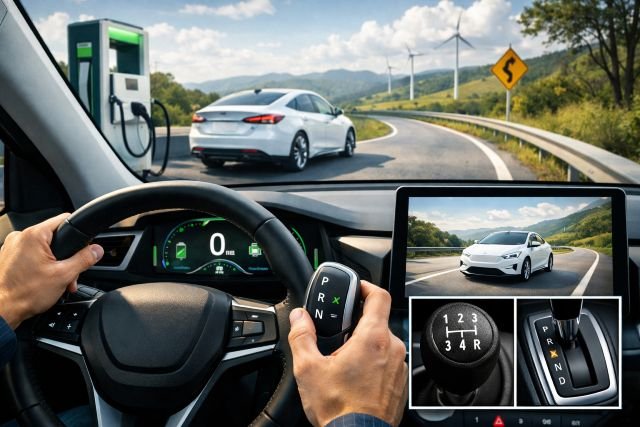
If you’ve ever wondered are all electric cars automatic, you’re not alone. Many first-time EV drivers slide into the seat, look for a clutch pedal, and quickly realize… there isn’t one. Then the next question hits: if there are no gears to shift like a normal car, what exactly is happening when I accelerate, slow down, or cruise?
- Quick answer: Are all electric cars automatic?
- Why most EVs don’t need a traditional transmission
- Are all electric cars automatic transmission cars?
- Why EVs feel so different to drive
- Featured-snippet definition: What does “automatic” mean in an EV?
- Are there any electric cars that “shift gears”?
- EV vs gas automatic: what’s actually different?
- Common questions people ask before buying an EV
- Real-world driving scenarios: why EVs feel “different” in daily life
- Actionable tips for first-time EV drivers
- Conclusion: Are all electric cars automatic?
The short version is that most electric cars behave like automatics, but not because they’re using the same kind of automatic transmission you’d find in a gas car. EVs feel different to drive because the motor delivers torque instantly, most EVs use a single-speed reduction gear, and regenerative braking changes how slowing down works. That combination alters everything from takeoff smoothness to how often you touch the brake pedal.
Let’s break it down in a driver-friendly way — with the technical truth intact.
Quick answer: Are all electric cars automatic?
In everyday driving terms, yes — almost all electric cars are “automatic” because you don’t manually shift gears and there’s no clutch pedal. The overwhelming majority use a single-speed transmission (a fixed reduction gear), so you simply choose Drive and go.
However, it’s more accurate to say: EVs don’t require manual shifting, and nearly all are engineered to be operated like automatics. A few rare exceptions exist in the sense that some EVs use multi-speed gearboxes (mostly for performance), but they still shift automatically rather than asking the driver to do it. Porsche’s Taycan, for example, uses a two-speed transmission on the rear axle — yet the driver still drives it like an automatic.
Why most EVs don’t need a traditional transmission
Gasoline engines make power in a narrower RPM band, so they need multiple gears to stay in an efficient, useful range. Electric motors are different: they can produce strong torque from very low RPM and operate efficiently across a wide speed range. That’s why many EVs can pair the motor with a single fixed gear ratio and still deliver quick acceleration plus highway capability.
So when people say “EVs don’t have transmissions,” they’re usually simplifying. Most EVs do have a gearbox of sorts — it’s just not a multi-gear automatic with frequent shifts. Edmunds describes it as a single-speed transmission with reduction gearing that matches motor speed to wheel speed.
The “single-speed” experience is the first big reason EVs feel different
No gear hunting. No shift shock. No rev climbing and dropping. It’s one continuous surge.
That smoothness often surprises drivers coming from even a very good automatic transmission.
Are all electric cars automatic transmission cars?
Here’s the nuance that matters for SEO and accuracy:
- If “automatic” means no manual shifting and no clutch, then yes, almost all EVs are automatic in operation.
- If “automatic transmission” means a conventional multi-gear hydraulic automatic, then most EVs do not use that.
Most EVs use a single-speed reduction gear, not a multi-gear automatic.
Why EVs feel so different to drive
Even if you’ve driven automatics your whole life, an EV can still feel like a completely new category. Here are the biggest reasons.
1) Instant torque changes the “launch” feel
EVs can deliver maximum torque from a stop (or very low speeds), so acceleration is immediate. There’s no waiting for the engine to climb in RPM, no downshift delay, and no turbo spool moment.
That instant response is why many EVs feel “effortless” in city traffic — and why new drivers often overshoot their first few takeoffs.
2) Regenerative braking changes how slowing down works
When you lift off the accelerator in many EVs, the motor can act like a generator and slow the car while sending energy back to the battery. FuelEconomy.gov explains regenerative braking as recovering energy that would otherwise be wasted during braking and storing it back in the battery.
This is a huge part of the EV driving feel: deceleration can start the moment you ease off the pedal.
The U.S. Department of Energy has also highlighted that net regenerative braking can recover a meaningful portion of energy on standard drive cycles (their fact-of-the-week notes about 22% net regen recovery on the EPA combined city/highway cycle).
3) One-pedal driving can make the brake pedal feel “optional”
Many EVs offer “one-pedal driving,” where lifting off the accelerator brings strong regenerative braking — sometimes enough to slow to very low speeds in normal traffic.
This is where EVs can feel dramatically different than a gas automatic. Some drivers love it (less pedal switching), others prefer lighter regen and a more familiar coast. And automakers tune it differently, so your experience varies by brand and model.
4) No “engine braking” sound, fewer vibrations
A gas vehicle provides feedback through engine noise, vibration, and shifting cues. EVs remove a lot of that sensation. The cabin can feel quieter, acceleration can feel deceptively quick, and speed can creep up without the audio cues your brain is used to.
Featured-snippet definition: What does “automatic” mean in an EV?
An electric car is “automatic” because it doesn’t require manual gear changes or a clutch. Most EVs use a single-speed reduction gear and rely on motor control software to deliver smooth acceleration and deceleration.
Are there any electric cars that “shift gears”?
Yes, but it’s rare — and it’s not the same as driving a manual.
Multi-speed EVs: the real, mechanical kind
One of the most famous examples is the Porsche Taycan, which uses a two-speed transmission on the rear axle to help with both hard acceleration and efficiency at higher speeds. Porsche specifically notes first gear for acceleration and second gear for efficiency and high-speed power reserves.
Even in these cases, the shifting is automatic. The driver still selects Drive like any automatic car.
“Fake shifting”: when EVs simulate gears for feel
Some performance EVs simulate gear shifts to create a more familiar or engaging driving experience — especially for track use.
The Hyundai Ioniq 5 N includes an “e-Shift” feature designed to emulate an eight-speed dual-clutch style experience (it’s essentially a software overlay).
This doesn’t make it a manual. It’s a driving feel choice — and a reminder that much of what we interpret as “how a car drives” is feedback and calibration, not just hardware.
EV vs gas automatic: what’s actually different?
Here’s a quick comparison for clarity:
| Driving characteristic | Gas automatic (typical) | Electric vehicle (typical) |
|---|---|---|
| Gears | Multiple gear ratios | Usually single-speed reduction gear |
| Acceleration response | May downshift, build RPM | Immediate torque response |
| Deceleration when lifting off | Often coasts (varies) | Often slows via regen / one-pedal option |
| Brake feel | Mostly friction brakes | Blended braking (regen + friction) |
| Sound/feedback | Engine + shifting cues | Quieter, smoother, fewer “events” |
Common questions people ask before buying an EV
Do any EVs come with a manual transmission?
In mass-market reality, EVs are overwhelmingly designed for automatic-style operation. Even EVs with multi-speed gearboxes still shift automatically for the driver. (There have been prototypes and niche conversions, but they’re not typical consumer offerings.)
Why does an EV slow down so fast when I let off the accelerator?
That’s regenerative braking. The motor is harvesting energy back into the battery while creating resistance that slows the car. FuelEconomy.gov explains that this recovered energy can later be used to propel the vehicle.
Does regen really make a difference?
Yes — especially in stop-and-go driving. DOE materials and FuelEconomy.gov both emphasize regen as a key efficiency advantage for EVs, particularly in city conditions.
Is one-pedal driving better for the battery or brakes?
It can reduce friction brake use, which may reduce brake wear. Battery impact depends on conditions (state of charge, temperature, traction limits). Think of one-pedal as an efficiency and feel feature, not a guaranteed “always better” setting.
Real-world driving scenarios: why EVs feel “different” in daily life
City traffic
EVs tend to feel easiest in stop-and-go conditions because instant torque reduces hesitation and regen reduces constant brake use. It can feel like the car is “reading your mind” once you adapt your foot control.
Highway merging
Many drivers notice how calmly EVs merge. There’s no downshift drama — just a smooth surge. That’s one of the most “automatic-but-better” feelings people describe.
Downhill roads
Regen can provide confident speed control downhill without riding the brakes. That’s also why EV efficiency often shines in hilly cities (though battery temperature and charge level can affect regen strength).
Actionable tips for first-time EV drivers
- Start with a lighter regen setting for the first day or two if your EV allows it, then increase it as your foot control improves.
- Practice smooth pedal modulation in an empty lot: aim for gentle takeoff and gentle lift-off. It’s the quickest way to make one-pedal driving feel natural.
- Expect regen limits when the battery is very full or very cold. In those conditions, the car may coast more and rely more on friction braking.
Conclusion: Are all electric cars automatic?
So, are all electric cars automatic? For practical driving, yes — almost all EVs are automatic to operate: no clutch, no manual shifting, and usually a single-speed reduction gear. Even the few EVs with multi-speed gearboxes (like the Porsche Taycan’s two-speed rear setup) still shift automatically, not manually.
What makes EVs feel so different isn’t just the lack of shifting — it’s the whole experience: instant torque, regenerative braking, and the option for one-pedal driving that changes how you control speed. FuelEconomy.gov and the U.S. Department of Energy both highlight regen as a key efficiency feature, especially in stop-and-go driving, which is one reason EVs can feel so smooth and responsive in everyday use.