


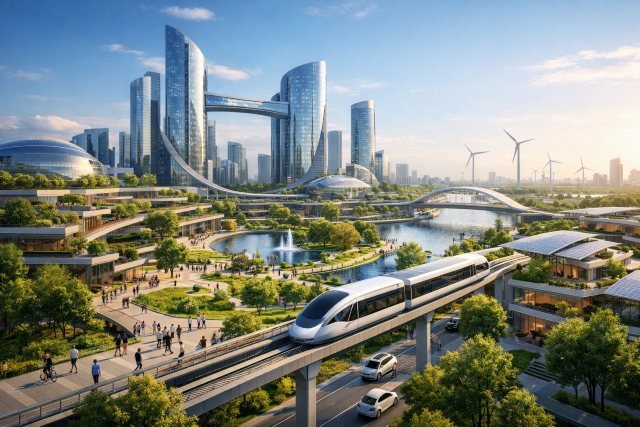
Cities are changing faster than ever, and the way we design them has to evolve just as quickly. Axurbain is emerging as a modern approach to building better cities by combining smart technology, environmental sustainability, and human-centered urban design into a single practical framework. Instead of treating cities as networks of roads and buildings, Axurbain treats them as living systems — built around how people move, breathe, work, connect, and thrive.
- What Is Axurbain?
- Why Cities Need the Axurbain Approach Now
- Axurbain vs. Smart Cities: What’s the Difference?
- Core Principles of Axurbain Urban Design
- How Axurbain Designs Better Neighborhoods
- Mobility in Axurbain: Moving Beyond Car-First Cities
- Axurbain and Climate Resilience: Designing Cities That Survive the Future
- Technology in Axurbain: Data-Driven Cities Done Right
- Real-World Inspiration: Cities Already Moving Toward Axurbain
- Actionable Tips: How City Leaders Can Start Using Axurbain Today
- Common Challenges of Axurbain Adoption (And How to Solve Them)
- FAQs: Axurbain and Better Cities
- Conclusion: Why Axurbain Is the Future of Better Cities
This matters because the pressure on cities is rising. The United Nations projects that 68% of the world’s population will live in urban areas by 2050, adding around 2.5 billion more people to cities — mostly in Asia and Africa. That growth can either deepen problems like congestion, inequality, and pollution — or become the opportunity of a generation to rebuild cities that work better for everyone.
Axurbain is not just another “smart city” buzzword. It’s a more balanced concept that insists technology must serve people, not replace them. It also insists sustainability can’t be an add-on — it has to be part of the city’s foundation. And most importantly, it believes city design should strengthen community, not isolate people into disconnected neighborhoods.
What Is Axurbain?
Axurbain is a modern urban development approach that combines smart technology, sustainable infrastructure, and community-focused planning to build cities that are efficient, resilient, inclusive, and livable.
Unlike traditional urban planning models that prioritize expansion, Axurbain prioritizes balance: growth that reduces emissions, improves public health, supports local economies, and increases quality of life.
Multiple recent explainers describe Axurbain as a framework where technology enables better decision-making, sustainability shapes infrastructure choices, and human experience guides design.
Why Cities Need the Axurbain Approach Now
The need for better cities isn’t theoretical — it’s urgent. Urban areas face overlapping crises: climate risks, housing affordability, infrastructure strain, public health threats, and social fragmentation.
One of the strongest reasons Axurbain matters is how urban design affects health. The World Health Organization estimates air pollution kills around seven million people every year, and most of the exposure happens in or around dense urban environments.
Cities also play a major role in the energy and climate equation. The International Energy Agency reports that buildings alone account for about 30% of global final energy consumption and 26% of global energy-related emissions. This means that smarter building standards, district energy systems, and sustainable retrofits are not optional — they’re essential.
Axurbain responds to these pressures by designing cities with measurable outcomes in mind: cleaner air, lower emissions, stronger communities, and improved mobility.
Axurbain vs. Smart Cities: What’s the Difference?
This is one of the most common questions people ask.
A smart city often emphasizes technology: sensors, surveillance systems, traffic automation, predictive analytics, and connected infrastructure. That can be helpful, but it can also become overly tech-centric, expensive, and disconnected from community needs.
Axurbain takes a broader view. It uses technology, but only as a tool. The focus is on how urban decisions improve human life.
Think of it this way:
- Smart city models can optimize efficiency.
- Axurbain models optimize efficiency + equity + sustainability + well-being.
Recent Axurbain explainers repeatedly highlight this balance: human-centered design, ecological sustainability, and technology as an enabler, not the main objective.
Core Principles of Axurbain Urban Design
Axurbain works because it operates from a clear foundation. While different publications explain it differently, the principles tend to fall into three core categories.
1) Human-Centered Design
Axurbain begins with how people actually live. That means prioritizing walkability, comfort, safety, and social connection. It also means designing public space as a core feature — not leftover space between roads.
Human-centered cities reduce stress, support mental well-being, and improve productivity. You can feel the difference in places designed around people instead of cars: neighborhoods become places you stay, not just places you pass through.
2) Sustainability Built Into the System
Sustainability in Axurbain isn’t limited to a few parks or solar panels. It’s built into land use, materials, energy systems, and mobility. The model encourages green infrastructure, renewable energy integration, and climate-resilient architecture — so cities can withstand floods, heat waves, and extreme weather.
3) Technology That Improves Life (Not Surveillance)
Technology in Axurbain should help cities run better: traffic systems that reduce congestion, sensors that detect air quality, and data platforms that help planners make evidence-based decisions.
But the key is accountability. Tech should support transparency and citizen benefit — not become a tool for exclusion or control. That balance is what makes Axurbain more sustainable socially as well as environmentally.
How Axurbain Designs Better Neighborhoods
A major strength of Axurbain is how it reshapes neighborhoods — because neighborhoods are where quality of life is actually experienced.
Here are the changes Axurbain typically promotes:
Walkable, Mixed-Use Districts
Axurbain pushes against rigid zoning that separates homes, offices, and services. Instead, it supports mixed-use environments where daily needs are reachable within a short walk or transit ride.
This reduces vehicle dependency, lowers emissions, and encourages local business growth.
Public Space as a Social Engine
Many cities suffer from “public space poverty.” People don’t gather because there’s nowhere safe, comfortable, or accessible to gather.
Axurbain rebuilds public space as a core investment: shaded seating, green corridors, plazas, community markets, libraries, and multi-use parks. These aren’t cosmetic upgrades — they’re infrastructure for social stability.
Affordable Housing + Inclusion
While Axurbain isn’t a full housing policy, it supports inclusion by aligning development incentives with affordability. It also encourages housing diversity: family units, small apartments, accessible designs, and mixed-income communities.
Mobility in Axurbain: Moving Beyond Car-First Cities
Mobility is where many cities fail. Car-first planning leads to congestion, expensive infrastructure, pollution, and inequity because only certain groups can access opportunities.
Axurbain mobility design prioritizes:
- Integrated public transport
- Safe cycling infrastructure
- Walkable street networks
- Last-mile connectivity
- Transit-oriented development
Copenhagen is often cited as an example of how cycling infrastructure and people-first street planning can improve health, safety, and mobility efficiency.
In an Axurbain city, transit isn’t something you use only because you can’t afford a car. It becomes the fastest, safest, and most convenient option for everyone.
Axurbain and Climate Resilience: Designing Cities That Survive the Future
Climate resilience is one of the most practical reasons Axurbain matters. Cities face higher flood risks, heat waves, drought stress, and infrastructure failure.
Axurbain promotes resilience through:
- permeable streets and water-sensitive design
- green roofs and cooling corridors
- flood-resistant construction materials
- distributed energy systems
- urban tree cover expansion
It also supports “regenerative” thinking — designing systems that restore ecosystems rather than degrade them.
This is especially important because climate change and air quality are increasingly linked. For example, the World Meteorological Organization has warned that wildfires are fueling air pollution hotspots, adding another layer of urban health risk.
Technology in Axurbain: Data-Driven Cities Done Right
Technology is powerful — but only when applied responsibly.
Axurbain uses smart systems to:
- optimize traffic flow and reduce delays
- monitor air quality and noise pollution
- track energy demand and improve efficiency
- detect infrastructure strain early
- improve emergency response time
However, Axurbain differs from many tech-first models by making privacy and transparency part of governance.
A city can be connected without becoming intrusive. The best Axurbain implementations use technology to reduce friction in daily life while keeping citizens informed and protected.
Real-World Inspiration: Cities Already Moving Toward Axurbain
Even though “Axurbain” as a term is still emerging in media and planning discussions, many cities already apply its principles.
Copenhagen (Mobility + Sustainability)
The city’s investment in cycling, pedestrian zones, and clean urban design demonstrates how sustainable mobility can become a cultural standard.
Barcelona (Superblocks + Human-Centered Streets)
Barcelona’s “superblock” model reduces traffic inside neighborhoods, increases walkability, and expands public space.
Singapore (Smart Infrastructure + Green Urbanism)
Singapore shows how data-driven infrastructure and green space planning can coexist when governance is strong and long-term oriented.
Axurbain can be understood as a framework that connects these approaches into a single planning philosophy.
Actionable Tips: How City Leaders Can Start Using Axurbain Today
Axurbain doesn’t require a city to rebuild from scratch. It works especially well when applied step-by-step.
Start with One District
Pick one neighborhood and implement: walkability upgrades, community space improvements, smart mobility systems, and sustainability retrofits. Use it as a living pilot.
Measure What Matters
Track outcomes like commute times, air quality, business activity, and public satisfaction. Axurbain depends on evidence-driven improvement.
Prioritize Equity Early
If improvement leads to displacement, you lose long-term community trust. Protect affordability and local business access from the start.
Upgrade Buildings, Not Just Roads
Because buildings contribute significantly to energy use and emissions, city improvement should focus heavily on retrofits and green building standards.
Common Challenges of Axurbain Adoption (And How to Solve Them)
No urban transformation is easy. Axurbain faces challenges like:
Budget Constraints
Smart and green infrastructure can require high initial investment. But long-term savings from efficiency and health improvements can be significant.
Policy Fragmentation
Cities often have departments working in silos. Axurbain works best when planning, transport, housing, and sustainability teams share goals.
Community Trust
If citizens feel excluded from planning, they resist change. Axurbain requires transparency and participatory governance.
FAQs: Axurbain and Better Cities
What does Axurbain mean?
Axurbain refers to a modern city-building framework that blends smart technology, sustainability, and community-centered design to improve urban life and resilience.
Is Axurbain the same as a smart city?
No. Smart cities focus mainly on technology. Axurbain includes technology but prioritizes human well-being, sustainability, equity, and community design as the foundation.
Can existing cities adopt Axurbain principles?
Yes. Axurbain is well-suited for retrofits: improving transit, upgrading buildings, adding green infrastructure, and using data-driven planning without rebuilding the city from scratch.
Why is Axurbain important for the future?
Because urban populations are growing rapidly. By 2050, 68% of people will live in cities, meaning urban systems must become more sustainable, resilient, and inclusive.
What problems does Axurbain solve?
Axurbain helps address congestion, pollution, inequality, inefficient infrastructure, climate risks, and disconnected urban communities by redesigning cities as healthy and efficient ecosystems.
Conclusion: Why Axurbain Is the Future of Better Cities
The future of cities can’t be built on yesterday’s planning logic. As urban populations expand, the cost of poor design becomes too high — financially, environmentally, and socially. Axurbain offers a modern approach to building better cities by combining the three forces that matter most: people, planet, and technology.
When Axurbain is applied correctly, it creates cities that are not only smarter, but kinder. Not only greener, but more livable. And not only efficient, but more equitable. In a world where urban living will soon define the human experience, Axurbain is a practical blueprint for building cities that truly work for everyone.