


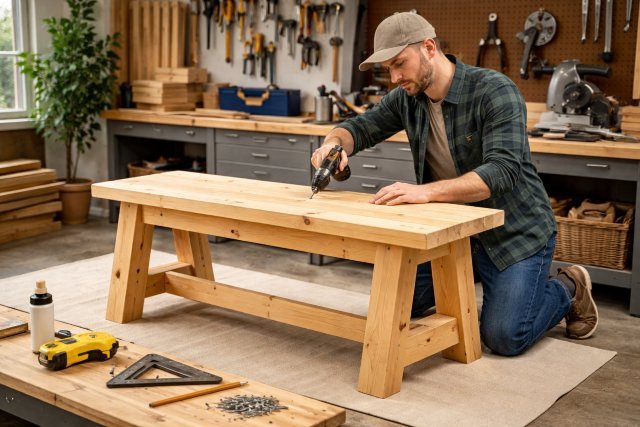
A bench from wood is one of the most satisfying DIY projects you can build because it hits that perfect intersection of function, style, and durability. You’re not just making furniture — you’re creating something that will carry real weight, survive daily use, and add character to your home or garden.
- Why Build a Bench From Wood Instead of Buying One?
- Choosing the Right Wood for a Strong, Long-Lasting Bench
- Bench Dimensions That Feel Right
- Tools and Materials You’ll Need
- How to Build a Bench From Wood
- How to Make Your Bench Look Stylish
- Best Finish for a Bench From Wood
- Strength Tips: How to Prevent Sagging Over Time
- Common Mistakes When Building a Wooden Bench
- FAQs
- Conclusion: Build a Bench From Wood That Lasts
The best part? You don’t need a full workshop or years of experience. With smart lumber choices, solid joinery, and a finish designed for your environment, you can build a bench that looks professionally made and lasts for years.
In this guide, I’ll walk you through everything — from picking the best wood to designing for strength, preventing wobble, and adding style details that make your bench look like a custom piece.
Why Build a Bench From Wood Instead of Buying One?
A store-bought bench often looks great in photos but uses thinner materials, basic fasteners, and shortcut construction that can loosen over time. A handmade bench gives you control over:
- Strength: You choose the lumber thickness and support structure.
- Comfort: You decide the seat height, depth, and back angle (if included).
- Style: Modern, rustic, farmhouse, minimalist — you control the look.
- Longevity: You can build it to survive weather, kids, and heavy use.
Wood is also naturally engineered for structural performance — its load capacity depends on grain direction, species, and dimensions, and those are things you can optimize while building. The American Wood Council explains how understanding wood strength and span behavior is key to designing sturdy structures.
Choosing the Right Wood for a Strong, Long-Lasting Bench
The wood you select directly affects how long your bench lasts and how much maintenance it needs. This is especially important if your bench from wood will live outdoors.
Best Wood Options for Outdoor Benches
If your bench is going outside, durability comes down to natural decay resistance or pressure treatment. According to the USDA Forest Products Laboratory and related USDA-based durability tables, certain heartwoods (like redwood and western red cedar) are naturally more decay resistant than many common structural woods.
Top outdoor wood choices include:
- Western Red Cedar (lightweight, rot-resistant, easy to work)
- Redwood Heartwood (excellent decay resistance; more expensive)
- Teak (premium durability; high natural oils; costly)
- Pressure-treated Pine (budget-friendly, very durable, heavier)
If you’re building for outdoor use and want the best blend of cost and performance, cedar and redwood heartwood are popular because they naturally resist decay.
Best Wood Options for Indoor Benches
Indoor benches can prioritize appearance and workability:
- Oak: extremely strong and classic looking
- Maple: hard, smooth, modern appearance
- Walnut: premium aesthetic, slightly softer but very stable
- Pine: easy to cut and affordable (but dents easier)
If the bench will be used as seating in a high-traffic space, hardwoods like oak or maple hold up better long-term.
Bench Dimensions That Feel Right
A stylish bench can still feel uncomfortable if the proportions are off. Here are standard ergonomic dimensions that work well for most people:
- Seat Height: 17–19 inches
- Seat Depth: 14–18 inches
- Bench Length:
- 36 inches (2 people tight fit)
- 48 inches (comfortable for 2 adults)
- 60 inches (3 adults)
For stability, the real key is leg placement. If the legs are too close together, the bench feels “tippy.” A good rule is to place the legs about 6–10 inches from each end depending on length, then add a stretcher to lock them together.
Tools and Materials You’ll Need
This project can be built with basic tools, and you can upgrade the result simply by using better joinery and fasteners.
Tools (Basic Setup)
- Tape measure and pencil
- Circular saw or miter saw
- Drill/driver
- Clamps
- Sander (or sanding block)
Materials
- 2×4 or 2×6 lumber (or hardwood boards)
- Exterior-rated screws (for outdoor benches)
- Waterproof wood glue (optional but recommended)
- Sandpaper (80, 120, 180, 220 grit)
- Finish: oil, stain + sealer, or spar urethane
If the bench is outdoors, choose corrosion-resistant screws to prevent staining and failure over time.
How to Build a Bench From Wood
This method creates a bench that’s strong, stylish, and reliable for daily seating.
Step 1: Pick a Bench Design That Matches Your Space
Before cutting a single board, decide what kind of bench you’re building:
- Entryway bench (clean look, indoor finish)
- Dining bench (long, higher seat)
- Garden bench (weatherproof)
- Storage bench (with hidden compartment)
A simple “four-leg + stretcher + thick seat” design is best for beginners because it’s hard to mess up and easy to reinforce.
Step 2: Cut Your Lumber (Simple and Accurate)
For a classic 48-inch bench, you’ll typically cut:
- Seat boards (two or three boards depending on width)
- Legs (four pieces)
- Long aprons (front and back supports)
- Short aprons (side supports)
- Lower stretcher (optional but recommended)
Tip: Always label your cuts as you go. Most bench mistakes happen when boards get swapped or flipped.
Step 3: Build the Frame First (This Is Where Strength Comes From)
The frame is the skeleton of the bench. If the frame is rigid, the bench won’t wobble — even after years of use.
To create a solid frame:
- Attach the front and back aprons to the legs.
- Add side aprons.
- Reinforce corners with blocks or diagonal bracing.
This creates a rectangle frame under the seat.
The American Wood Council notes that load behavior in wood structures depends heavily on proper sizing and support design, which is why a rigid frame matters more than thick seat boards alone.
Step 4: Use Waterproof Glue for a Stronger Bench (Optional but Smart)
Wood glue isn’t just for looks — it increases bond strength and reduces movement over time.
If you’re building a bench from wood that may face moisture or temperature swings, use a waterproof glue such as Titebond III, which is specifically rated to pass the ANSI/HPVA Type I water-resistance standard.
Pro tip: Glue + screws together works best. Screws provide clamp-like pressure, while glue creates a strong bond across the grain.
Step 5: Install the Seat (And Prevent Cracks)
Seat boards expand and contract with humidity. If you screw them down too tightly or don’t allow small gaps, boards can cup or split.
Here’s how to do it right:
- Drill pilot holes to avoid splitting.
- Keep fasteners consistent.
- If building outdoors, leave a tiny spacing between boards for drainage.
For outdoor builds, use deck screws or exterior-rated fasteners because standard screws can corrode and stain wood over time.
Step 6: Add a Stretcher for Extra Strength (Highly Recommended)
If you want a bench that feels rock-solid, add a stretcher connecting the legs.
Why it matters:
- Stops side-to-side racking (wobble)
- Distributes load more evenly
- Makes the bench feel “heavy-duty”
This is the difference between a bench that feels okay and one that feels professionally built.
How to Make Your Bench Look Stylish
A strong bench is great, but a stylish bench is what makes people ask where you bought it.
Here are a few style upgrades that take minimal effort:
Round Over the Edges
Use a router with a round-over bit (or sand by hand). Sharp edges look unfinished and feel uncomfortable on legs.
Use Symmetry in Your Seat Boards
Choose boards with similar grain patterns and color tones. That one small detail makes a DIY bench look high-end.
Add Tapered Legs
A subtle taper gives a modern, elegant look. You can do this with a circular saw and a straight-edge guide.
Contrast Materials
Pair a wooden top with black-painted legs for a modern industrial style. Or keep all wood for farmhouse style.
Best Finish for a Bench From Wood
Finishing is what determines whether your bench lasts 2 years or 10.
Indoor Finishing Options
- Clear polyurethane (durable, easy maintenance)
- Hardwax oil (natural feel, easy repair)
- Stain + topcoat (custom color)
Outdoor Finishing Options
Outdoor benches need UV + water protection, plus flexibility in changing temperatures. That’s why many builders choose exterior-rated sealers or spar-type finishes.
Why Spar Urethane Is Popular Outdoors
Spar urethane is designed to handle outdoor movement and weather exposure better than many rigid indoor finishes. It’s widely used in marine and exterior applications because of its durability and resistance characteristics. (For deeper research on wood finishing and durability, the USDA Wood Handbook covers finishing and exterior performance factors in detail.)
Key outdoor finishing tips:
- Seal end grain aggressively (it absorbs moisture fastest)
- Apply multiple thin coats
- Sand lightly between coats
- Recoat annually if exposed to full sun and rain
Strength Tips: How to Prevent Sagging Over Time
A bench can look perfect on day one and start sagging months later if the structure isn’t designed for load distribution.
To avoid sagging:
- Use thick seat boards (at least 1 inch)
- Add center support under long benches
- Use aprons and stretchers (not just legs)
- Avoid knots on load-bearing areas
Wood structural performance is influenced by span and load, and understanding these basics helps avoid undersized supports.
Common Mistakes When Building a Wooden Bench
Even experienced DIY builders run into predictable problems. Here are the biggest ones:
1) Skipping Pilot Holes
This causes wood splitting and weakens joints.
2) Using Interior Screws Outdoors
They corrode, break, and stain wood.
3) Not Squaring the Frame
If the frame isn’t square, the bench will rock forever.
4) No Stretcher Support
A bench without stretchers loosens faster with repeated sitting.
5) Finishing Too Soon
If wood is damp (especially outdoor lumber), sealing it can trap moisture and lead to warping.
FAQs
What is the best wood for a bench from wood?
For indoor benches, oak, maple, and walnut are great choices. For outdoor benches, cedar and redwood heartwood are excellent because they naturally resist decay, while pressure-treated wood is budget-friendly and durable.
How thick should the wood be for a bench seat?
A bench seat should be at least 1 inch thick, but 1.5 inches is better for long benches. If your bench is longer than 48 inches, add a center support to prevent sagging.
How do you make a wooden bench stronger?
Use a rigid frame with aprons, add stretchers between legs, and use both glue and screws at critical joints. Wood strength and structural behavior improve dramatically with proper support and span planning.
Should I use wood glue for an outdoor bench?
Yes — if you use a waterproof glue rated for exterior use. For example, Titebond III is designed to meet ANSI/HPVA Type I water-resistance standards.
How do I protect my wooden bench from weather?
Choose rot-resistant wood, apply an exterior-rated finish, seal end grain carefully, and recoat regularly if the bench sits in direct sun and rain. The USDA Wood Handbook provides foundational guidance on finishing and durability factors.
Conclusion: Build a Bench From Wood That Lasts
A bench from wood is one of those rare DIY projects that pays you back every day — whether it’s a seat in your entryway, a dining bench that hosts family meals, or a garden bench that becomes your favorite outdoor spot.
If you want a bench that’s both strong and stylish, focus on three things: choose the right wood, build a rigid frame with support, and finish it properly. When you combine smart design with proven materials — like decay-resistant lumber and waterproof wood glue — you end up with a bench that doesn’t just look good… it stays solid for years.