

If your arms look “tall” from the side but not wide from the front, you’re probably undertraining the inner portion of the biceps — better known as the short head. The good news: the right bicep brachii short head exercises can make your biceps look thicker and wider without needing fancy tricks — just smarter angles, better tension, and enough weekly volume.
- What is the bicep short head (and why it affects “width”)?
- The fastest way to bias the short head: shoulder flexion + stable curls
- Bicep brachii short head exercises that build mass and width
- The science behind “more growth”: volume, effort, and recovery
- The best routine for width: a repeatable 2-day short head plan
- Progression rules (how to actually add mass)
- Common mistakes that kill short head growth
- FAQ
- Conclusion: Build width with the right angles, volume, and progression
This guide breaks down exactly how to bias the short head (as much as anatomy allows), which curl variations tend to do it best, and a practical routine you can repeat every week for visible width gains.
What is the bicep short head (and why it affects “width”)?
The biceps brachii has two heads: the long head and the short head. The short head originates on the coracoid process of the scapula, then joins the long head down the arm.
In the mirror, the short head sits more on the inner/front side of the upper arm. Building it tends to improve the “fullness” you see from the front — what most lifters describe as biceps width.
A quick clarity point: you can’t truly “isolate” one head like turning on a light switch. But you can choose exercises and positions that often shift emphasis by changing shoulder angle, resistance curve, and how stable the movement is.
The fastest way to bias the short head: shoulder flexion + stable curls
A common pattern in both coaching practice and EMG-based comparisons is that curling with the shoulder flexed (upper arm in front of your torso) tends to feel more “inner biceps,” and is frequently used to bias the short head. Think preacher curls and spider curls.
Research examining different curl variations shows that changing shoulder position meaningfully changes how the biceps are challenged across the range of motion. For example, a study on dumbbell curl variations reported different activation patterns depending on the exercise setup (incline vs standard vs preacher), highlighting how mechanics shift the challenge through the rep.
So the goal isn’t “magic short-head isolation.” The goal is:
Pick positions that keep tension where your short head tends to contribute strongly, and load them progressively.
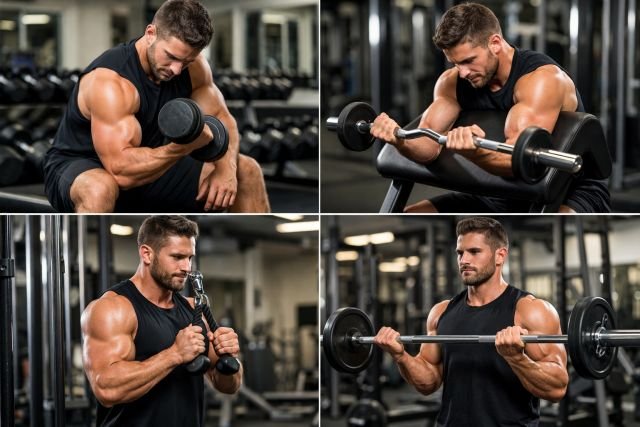
Bicep brachii short head exercises that build mass and width
Below are the most reliable choices for short-head-biased training, plus exactly how to do them for growth.
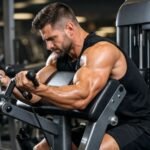
1) Preacher curl (dumbbell, EZ-bar, or machine)
If you only pick one movement for width, make it the preacher curl. The setup naturally keeps your upper arm forward and reduces cheating, which is perfect for hypertrophy. Research comparing curl variations shows preacher-style curls can shift where in the range you’re challenged.
Form cues that actually matter:
- Lock your triceps/upper arm into the pad; don’t let the shoulder roll forward.
- Use a controlled eccentric (lowering) for 2–3 seconds.
- Stop 1–2 reps shy of failure most sets; go to near-failure on the last set.
Best rep range: 8–12 for mass, 12–15 for pump-focused volume.
2) Spider curl (chest-supported on an incline bench)
Spider curls are basically a “preacher curl you can micro-adjust.” Because your chest is pinned, you reduce momentum and keep tension on the biceps.
Why it works for width: shoulder is flexed and you’re forced to curl clean. This is one of the easiest ways to make the short head do honest work.
Pro tip: Use dumbbells or an EZ-bar. If you have cables, spider curls with a low cable can feel even smoother.
3) High-cable curl (front double-biceps style)
High-cable curls are underrated for short-head hypertrophy because you can keep constant tension and line up resistance with your curl path.
How to bias short head more:
- Keep elbows slightly in front of your ribs.
- Let the forearms supinate hard (pinkies up at the top).
- Pause 1 second at peak contraction.
4) Close-grip EZ-bar curl
A narrower grip often makes people “feel” more inner biceps, and it can be a great heavy-ish builder when done strictly.
Key: Keep elbows slightly forward (not pinned behind your torso). This keeps the movement closer to the shoulder-flexed family that tends to work well for width.
5) Concentration curl (strict version)
Concentration curls are not just a “finisher.” Done heavy enough and progressed over time, they’re a legitimate hypertrophy tool — especially if you pause and control the lowering.
Make it growth-focused:
- Avoid tiny weights + endless reps.
- Use 8–12 reps, slow eccentric, and add load over weeks.
The science behind “more growth”: volume, effort, and recovery
If you want your short head to grow, it needs enough weekly work. A large meta-analysis on resistance training volume found a dose-response relationship, where more weekly sets generally produced more hypertrophy, and higher volumes showed superior gains versus very low volumes.
A practical takeaway most lifters can use:
- Aim for ~10–16 hard sets per week for biceps (total), split across 2–3 sessions.
- Keep most sets at 1–3 reps in reserve (RIR); push closer to failure on a couple sets per workout.
Rest time matters too. A systematic review on inter-set rest intervals notes that both short and longer rests can work, but longer rests may help you maintain performance and total volume load — often useful for hypertrophy.
The best routine for width: a repeatable 2-day short head plan
This is built for mass and “front-view thickness.” It also avoids overuse by mixing angles and resistance profiles.
Weekly schedule
Train biceps directly twice per week, ideally with 48–72 hours between sessions (example: Monday + Thursday).
Day 1: Short head strength + stable tension
- EZ-bar preacher curl – 4 sets × 6–10 reps
- Spider curl (dumbbells) – 3 sets × 8–12 reps
- High-cable curl (pause at top) – 3 sets × 12–15 reps
Rest 90–150 seconds on preacher, 60–120 seconds on the others.
Day 2: Width volume + long-length balance
- Close-grip EZ-bar curl – 3 sets × 6–10 reps
- Incline dumbbell curl – 2 sets × 10–12 reps
- Concentration curl – 3 sets × 10–15 reps
Why include incline curls if we’re chasing width? Because balanced biceps growth tends to look bigger overall, and different curl setups load different parts of the movement. Curl-variation research shows mechanics meaningfully change the challenge through the range.
Progression rules (how to actually add mass)
Most biceps routines fail because they don’t progress cleanly. Use this simple method:
Double progression
- Pick a rep range (example: 8–12).
- Keep the same weight until you can hit the top of the range on all sets with solid form.
- Then increase load by the smallest jump available and repeat.
Example (preacher curl 4×6–10):
When you can do 10,10,9,8 with strict reps, keep the weight. When you hit 10,10,10,10, increase next week.
Common mistakes that kill short head growth
Letting elbows drift behind your torso
When your elbows slide back, you often shift the emphasis and turn curls into a half-swing. Keep elbows slightly forward on most width-focused work.
Going too heavy on “cheat curls,” too soon
Cheat reps aren’t evil, but for short head mass, strict tension is king. Use controlled reps for 80–90% of your sets.
Treating biceps like they recover instantly
Biceps get hit during rows, pulldowns, and chin-ups. If you train back hard, your biceps volume adds up fast. Keep weekly direct sets sensible, then adjust based on soreness and performance.
FAQ
What are the best bicep brachii short head exercises for width?
The most reliable choices are preacher curls, spider curls, and high-cable curls, because they keep the upper arm more forward and reduce cheating, which helps maintain consistent tension and effort.
How many sets per week for bigger biceps?
A strong general target is 10–16 hard sets per week for biceps (total), split across 2 sessions. Research on training volume shows a dose-response trend where higher weekly sets produce greater hypertrophy compared to very low volumes.
Do close-grip curls target the short head?
They can bias it for many lifters, especially when elbows stay slightly forward and you supinate hard. It’s not pure isolation, but it’s a useful heavy builder in a width-focused plan.
Should I train biceps to failure for mass?
Occasionally, yes — but not constantly. Most growth work can be done 1–3 reps short of failure, with a couple near-failure sets per workout. This usually gives you better weekly performance and recovery.
Conclusion: Build width with the right angles, volume, and progression
If your goal is thicker, wider arms, you don’t need 15 random curls — you need a few high-quality bicep brachii short head exercises done with precision and progressed over time. Prioritize shoulder-forward movements like preacher curls, spider curls, and high-cable curls, hit a sustainable weekly set target (roughly 10–16 hard sets for biceps), and progress with patience. Volume research supports that higher weekly work generally drives more hypertrophy, as long as recovery is managed.
Stick to the routine above for 8–12 weeks, track your loads and reps, and your “front-view” arm width will start to look like you actually train biceps on purpose.