

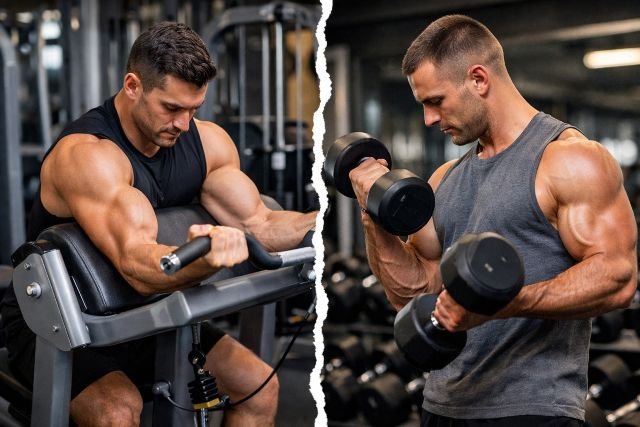
If your goal is bigger arms, you’ve probably wondered whether a bicep curl machine is better than dumbbells — or if dumbbells are the only “real” way to build impressive biceps. The truth is more nuanced (and more useful): both can build size extremely well, but they do it through slightly different advantages in stability, tension, progression, and fatigue management. Once you understand those differences, you can pick the right tool for your body, your gym setup, and your exact arm goal — without wasting months guessing.
- Quick answer
- What actually builds “bigger arms” (so you stop debating the wrong thing)
- Bicep curl machine benefits for arm growth (and why it often “feels” better)
- Dumbbells for biceps growth: why they still deserve a spot
- The science summary: do machines or free weights build more muscle?
- “But which one builds bigger arms for me?” (decision rules that actually help)
- The best answer for most lifters: combine them
- A practical programming example (simple, effective, repeatable)
- Technique cues that make either option grow more biceps
- One overlooked factor: fatigue management (why machines sometimes “win” in the real world)
- FAQ
- Conclusion: which builds bigger arms?
Below, you’ll get a research-backed comparison, practical programming advice, and simple “when to choose what” rules — so you can grow your arms faster.
Quick answer
For pure biceps size, a bicep curl machine and dumbbells can both build bigger arms when you train close to failure, progressively overload, and do enough weekly sets. Machines often win for consistent tension and easy progression; dumbbells often win for natural movement freedom and long-term carryover. A combined approach is usually best for most lifters.
This aligns with a large 2023 systematic review/meta-analysis finding no meaningful difference in hypertrophy between machine-based and free-weight training overall when programs are matched.
What actually builds “bigger arms” (so you stop debating the wrong thing)
Arm size comes mostly from hypertrophy of the biceps brachii (plus brachialis and brachioradialis). Regardless of tool choice, the biggest drivers are:
Progressive overload (more reps, weight, or hard sets over time),
high-quality tension (especially through the mid-to-long muscle lengths),
enough weekly volume, and
training close to failure with solid technique.
A widely cited meta-analysis on training volume shows a dose-response trend: doing more weekly sets generally produces more hypertrophy, up to a point.
And broader evidence syntheses continue to support that how you program (sets, effort, progression) often matters more than whether you used a cable stack or a dumbbell.
So instead of asking “machine or dumbbells?”, a better question is:
Which tool lets you apply more high-quality hard sets to your biceps, consistently, week after week?
Bicep curl machine benefits for arm growth (and why it often “feels” better)
A bicep curl machine typically stabilizes your torso and upper arm position, letting your biceps do the work without as much “leakage” through momentum, swinging, or shoulder involvement. That matters because biceps growth responds to consistent, repeatable tension.
1) Consistent tension and cleaner reps
Machines usually reduce balance demands, so you can keep tension where you want it — on elbow flexion—especially as you approach failure. That often makes the last 3–5 reps more productive, because they stay strict.
2) Easier progressive overload (especially week to week)
With machines, load jumps are predictable, setup is consistent, and you can track performance with less noise. If your gym has a good curl machine, this can be a huge advantage for hypertrophy, because progress is easier to measure and repeat.
3) Great for high-effort training with less joint “mess”
When you’re fatigued, dumbbell curls can turn into a full-body movement. Machines reduce cheating and help you push closer to failure safely.
4) Some machines match strength curves better
Certain machines use cams or resistance profiles that keep tension higher where you’re strongest or weakest. This isn’t automatically “better,” but it can make sets feel smoother and keep effort high across the rep.
Research context: When comparing free weights and machines broadly, the best evidence doesn’t show a hypertrophy winner overall. The 2023 meta-analysis found no significant difference in hypertrophy between modalities (effect size near zero).
That means machines can build size just fine — provided your training quality is high.
Dumbbells for biceps growth: why they still deserve a spot
Dumbbells are simple, brutally effective, and adaptable to different arm lengths and shoulder structures.
1) Natural movement freedom (often better comfort)
Not everyone fits every machine. With dumbbells, you can slightly adjust your elbow path, wrist angle, and grip width to match your joints. That can mean less wrist/elbow irritation and more consistent training over months.
2) Huge exercise variety for complete arm development
Dumbbells let you easily rotate variations that bias different elbow flexors and positions:
- supinated curls (classic biceps bias)
- hammer curls (brachialis/brachioradialis emphasis)
- incline curls (more stretch at the shoulder)
Shoulder position matters. Research has shown biceps activation and mechanics can change depending on how the shoulder is positioned during curl variations.
3) Real-world carryover and coordination
Dumbbells demand more stabilization through the wrist/forearm and shoulder, which can translate well to other pulling movements. For some lifters, that’s a big “bonus adaptation.”
4) Strong activation evidence for conventional dumbbell curls
While muscle activation (EMG) doesn’t equal hypertrophy by itself, it can be a useful signal for which movements demand more biceps contribution. A recent EMG-focused paper found the conventional dumbbell curl produced higher biceps activation than a different curl variation (Bayesian curl) in their setup.
The science summary: do machines or free weights build more muscle?
If you’re hoping for a simple “X builds bigger arms,” the highest-level research usually won’t give it to you—because hypertrophy outcomes depend heavily on programming and effort.
The most important finding
A 2023 systematic review/meta-analysis comparing free weights vs machine-based training reported no detectable difference in hypertrophy in direct comparisons.
So if your plan is solid, both tools can build big arms.
What does differ (and why you might still choose one)
That same review found strength gains are more specific to the tool you train with (free-weight tests improved more with free-weight training, machine tests tended to improve more with machine training).
In plain English: you get better at what you practice. That’s one reason dumbbells feel more “functional,” and machines feel more “trackable.”
Novices: machines and free weights both work
A randomized trial in novice males compared machine-only, free-weight-only, and a mixed approach over 10 weeks, designed to look at size and performance changes across training modes.
The big practical lesson for beginners: you don’t need to “earn” dumbbells by doing machines first, and you don’t need to avoid machines to grow — pick what helps you train consistently and pain-free.
“But which one builds bigger arms for me?” (decision rules that actually help)
Choose a bicep curl machine if…
You struggle to keep dumbbell curls strict, especially near failure, and your sets turn into swinging reps. Machines make it easier to keep tension on the biceps and standardize your form.
You’re trying to push volume up (more weekly sets) without wrecking your elbows or lower back from bracing and cheating. If you want more hard sets with less technique breakdown, the bicep curl machine is often the simplest path.
You want reliable progression. If you like tracking reps and load precisely, machines usually reduce day-to-day variability.
Choose dumbbells if…
The curl machine at your gym feels awkward on your wrists or elbows, or you can’t line up the pivot points comfortably. A “bad-fitting” machine can limit effort and consistency.
You want variation without complicated setup. Dumbbells make it easy to rotate grips and angles across a training block.
You want more carryover into chin-ups, rows, and general arm control. Dumbbells usually demand more coordination and stabilization.
The best answer for most lifters: combine them
If hypertrophy is your main goal, a simple hybrid approach is hard to beat:
Use the bicep curl machine for your heavier, trackable work (where you push close to failure with strict form), and use dumbbells for variations that train the biceps at different lengths and angles.
Why this works: you get the machine’s consistency plus the dumbbell’s adaptability. Since overall hypertrophy differences are minimal when volume and effort are matched, the “best” choice is often the one that keeps training high-quality and progressing.
A practical programming example (simple, effective, repeatable)
Here’s a straightforward structure that fits most people trying to grow arms while still training back:
Twice per week direct biceps (example)
Day A:
Start with your bicep curl machine for controlled sets near failure in a moderate rep range. Keep your upper arm stable and aim for consistent technique week to week.
Day B:
Use dumbbells in a variation that gives you a strong stretch or a different grip (for example, incline curls or hammer curls) and again push close to failure with clean reps.
In terms of weekly sets, many lifters grow well in the mid-range (often roughly 5–15+ hard sets per week depending on training age, recovery, and how much back training you do). The research on volume supports that doing more productive sets tends to help — up to your recovery limit.
Technique cues that make either option grow more biceps
For the bicep curl machine
Align your elbow with the machine’s pivot as well as you can. A poor fit can shift stress into the shoulder or wrist and reduce biceps tension.
Control the eccentric (lowering) phase. A steady eccentric helps keep tension consistent, and machines make this easier to standardize.
Pause briefly near the stretched position if your elbows tolerate it, but don’t relax into the bottom.
For dumbbell curls
Use a slight forward lean or keep ribs down to avoid turning curls into a body swing. If your last reps need momentum, the set was probably too heavy.
Let the forearm rotate naturally during supinated curls. For many people, forcing a rigid wrist position is what irritates elbows.
Consider shoulder position as a “knob.” Some curl setups change biceps length and mechanical demands.
One overlooked factor: fatigue management (why machines sometimes “win” in the real world)
In a perfect lab setting, hypertrophy outcomes can be similar. In real gyms, people often grow more from whichever tool lets them:
- train hard without pain,
- keep form strict as fatigue climbs,
- add sets without turning them into sloppy reps.
Machines often help with that. And interestingly, newer machine formats can even automate eccentric overload or drop-set style resistance, producing high neural drive demands in controlled conditions.
You don’t need fancy machines to grow, but it highlights the broader point: machines can be very effective at delivering hard, fatigue-heavy work safely.
FAQ
Is a bicep curl machine better than dumbbells for hypertrophy?
It can be, if it helps you train closer to failure with stricter form and more consistent progression. Research comparing machines and free weights overall shows no significant hypertrophy difference when training is matched, so the “better” option is usually the one you can overload consistently.
Do machines isolate the biceps more?
Often yes, because they reduce balance and body movement. But “more isolation” doesn’t automatically mean more growth — it means it may be easier to keep tension on the target muscle when you’re fatigued.
Are dumbbells necessary for big arms?
No. You can build large arms with machines alone if your training includes progressive overload, enough weekly sets, and hard effort.
What rep range is best for biceps size?
Multiple rep ranges can build muscle if sets are taken close to failure. Evidence comparing low vs high loads shows hypertrophy can occur across loading zones when effort is high.
Should I train biceps before or after back?
If biceps are a priority, put at least one direct biceps slot earlier in the week or early in the session when you’re fresher. If back strength is your priority, train biceps after pulling work.
Conclusion: which builds bigger arms?
If you’re choosing between a bicep curl machine and dumbbells to build bigger arms, the evidence-based answer is that either can work extremely well, and overall hypertrophy differences are small when training is matched. The real winner is the tool that lets you accumulate more high-quality, close-to-failure reps over time with steady progression and minimal joint irritation.
For most people, the fastest path is a blend: use the bicep curl machine for strict, trackable overload, and use dumbbells for variation, comfort, and different arm angles. Do that consistently, add volume gradually, and your sleeves will start to feel tighter.