


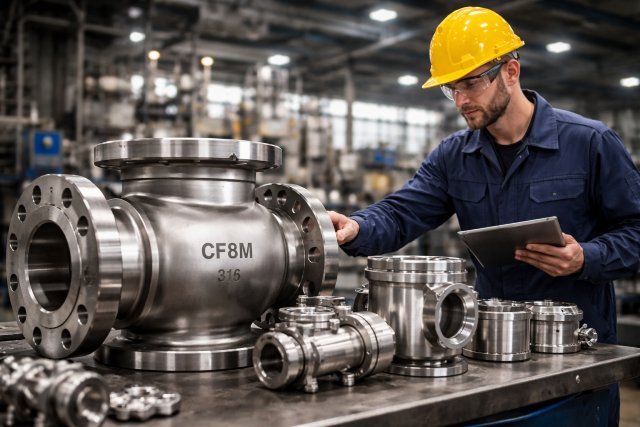
If you’ve ever sourced valve bodies, pump casings, or corrosion-resistant cast components, you’ve probably run into CF8M Stainless Steel. It’s widely specified because it balances corrosion resistance, mechanical strength, and castability for complex shapes — without jumping into the cost of higher-alloy “super” stainless grades.
- What is CF8M Stainless Steel?
- CF8M Stainless Steel chemical composition (and why it matters)
- Key properties of CF8M Stainless Steel
- Common uses of CF8M Stainless Steel in industry
- CF8M vs 316 stainless steel: what’s the difference?
- Benefits of CF8M Stainless Steel (why buyers keep choosing it)
- Practical selection tips (how to spec CF8M correctly)
- FAQ: CF8M Stainless Steel
- Conclusion: Why CF8M Stainless Steel is a go-to casting grade
CF8M Stainless Steel is the cast equivalent of 316 stainless steel (wrought), standardized for pressure-containing and corrosion-resistant cast parts. It’s commonly ordered under ASTM casting specifications and shows up in chemical processing, marine service, water treatment, and food-grade equipment where chlorides and aggressive fluids are part of daily reality.
What is CF8M Stainless Steel?
CF8M is an austenitic stainless steel casting grade typically supplied under ASTM A351/A351M (pressure-containing castings) and also seen in related casting specs like ASTM A743/A744 depending on the application. The standard scope for ASTM A351 explicitly covers castings for valves, flanges, fittings, and other pressure-containing parts, which is exactly where CF8M dominates.
A quick “translation” for buyers:
CF8M ≈ cast 316 (molybdenum-bearing), designed for foundry production and real-world service in corrosive fluids.
CF8M meaning (the name decoded)
In purchasing and valve datasheets, CF8M is basically shorthand for:
- C = casting alloy designation family
- F = austenitic stainless family (Cr-Ni)
- 8 ≈ “18/8” style stainless baseline (think 304/316 families)
- M = molybdenum added for improved pitting/crevice corrosion resistance
CF8M Stainless Steel chemical composition (and why it matters)
While exact ranges depend on the governing spec and mill test, CF8M is typically built around:
- Chromium (Cr) for passivation and general corrosion resistance
- Nickel (Ni) to stabilize austenite (toughness + ductility)
- Molybdenum (Mo) to significantly improve resistance to pitting and crevice corrosion, especially in chlorides
That molybdenum addition is the whole point of CF8M versus CF8 (cast 304). It’s the reason CF8M is the default upgrade for seawater splash zones, brackish water, chlorinated process streams, and a lot of chemical plant duty.
Key properties of CF8M Stainless Steel
CF8M is chosen because it performs like “cast 316” while being manufacturable as a casting (complex geometry, thicker sections, integrated features).
1) Corrosion resistance in chlorides and chemicals
CF8M’s Mo-bearing chemistry improves resistance to localized corrosion mechanisms like pitting and crevice corrosion — the classic failure modes when chlorides concentrate under deposits, gaskets, or stagnant zones.
A practical way engineers estimate pitting resistance is PREN (Pitting Resistance Equivalent Number), commonly expressed as:
PREN = %Cr + 3.3 × (%Mo + 0.5×%W) + 16×%N
Because CF8M includes molybdenum, its PREN trend is typically higher than non-Mo cast stainless grades, which is why it survives longer in chloride exposure at similar surface finish and cleanliness.
2) Mechanical strength and pressure-containing performance
CF8M is frequently specified for pressure boundary components — valve bodies, pump housings, flanges — because ASTM casting specs control chemistry and tensile requirements for that service class.
Mechanical values vary by heat treatment, casting thickness, and foundry practice, but typical datasheets emphasize a balance of:
- good yield and tensile strength for pressure integrity
- good ductility for impact and thermal cycling
- stable properties across common industrial temperatures
3) Microstructure: cast vs wrought differences (the “ferrite” detail)
One key difference between cast CF8M and wrought 316 is that cast austenitic stainless often contains some ferrite. That can be beneficial for reducing hot cracking during solidification, but it can also introduce magnetic response and (in some environments) impact corrosion behavior. Cast ferrite content can be influenced by composition control and foundry practice.
If you have a corrosion-critical or magnetic-sensitive application, it’s worth calling out ferrite control or requiring documentation (e.g., FN range) in your procurement notes.
Common uses of CF8M Stainless Steel in industry
You’ll see CF8M wherever fluids + corrosion + complex shapes collide.
Valves, pumps, and pressure-containing cast parts
CF8M is heavily used for:
- valve bodies (ball, gate, globe, butterfly)
- pump casings and impellers
- flanges, fittings, and pressure housings
Marine and coastal environments
Salt spray, brackish water, and chloride exposure are the “home turf” where CF8M justifies its cost over CF8.
Chemical processing and mildly acidic service
Datasheets commonly cite CF8M for handling mildly acidic/alkaline conditions and selected acids (application-specific — always verify with corrosion data).
Water and wastewater treatment
CF8M shows up in pumps and valve trains that face chlorides, biofilms, and intermittent stagnation — conditions that punish lower-alloy stainless choices.
CF8M vs 316 stainless steel: what’s the difference?
This is one of the most searched questions, and the answer is straightforward:
They’re chemically similar, but manufactured differently.
- CF8M is the cast grade (ordered under casting specs like ASTM A351).
- 316 is typically the wrought grade (plate, bar, pipe — ordered under different ASTM product specs).
What that means in the real world:
- Choose CF8M when you need complex geometry (casting), integrated shapes, or pressure-containing cast components.
- Choose 316 (wrought) when you need plate/pipe/bar forms, extensive forming, or certain finish requirements.
Also remember the ferrite note: cast structures can differ from wrought, and that can matter in niche cases.
Benefits of CF8M Stainless Steel (why buyers keep choosing it)
Better chloride resistance than CF8 (cast 304 equivalent)
The molybdenum addition is specifically associated with improved pitting/crevice behavior in chloride environments, which is why CF8M is the standard “step up” for harsher service.
Ideal for cast components with pressure integrity
CF8M is built into the ecosystem of pressure-containing cast standards and common valve/pump manufacturing routes.
Strong value vs higher-alloy upgrades
When 316-level corrosion resistance is enough, CF8M often delivers the best lifecycle cost. If your environment is beyond 316/CF8M (warm seawater, high chlorides + acidity, severe crevice conditions), that’s when duplex or super-austenitic alloys come into play.
Practical selection tips (how to spec CF8M correctly)
If you want fewer surprises at receiving inspection and better field life, focus on these “spec hygiene” items:
1) Always reference the right standard and heat treatment
For pressure parts, buyers often call out ASTM A351/A351M and require solution anneal + quench as applicable for corrosion performance. (Follow your engineering spec and service code requirements.)
2) Specify NDE and pressure testing expectations
For valve bodies/pump casings, your QA plan (radiography, PMI, hydrotest, etc.) often matters more than a generic “CF8M” line item.
3) Watch crevices and surface finish
Even great alloys can pit if you create perfect crevice geometries (gaskets, deposits, dead legs). Design and maintenance choices — drainability, cleanability, surface finish — often decide whether CF8M lasts 2 years or 20.
4) Consider ferrite control for special cases
If magnetism matters or corrosion is extremely tight-margin, ask your foundry about ferrite control and documentation.
FAQ: CF8M Stainless Steel
Is CF8M the same as 316 stainless steel?
CF8M is best described as the cast equivalent of 316 stainless steel. They’re similar in corrosion intent and alloying approach, but CF8M is purchased as a casting grade under casting standards.
What does CF8M mean on a valve?
It indicates the valve’s pressure boundary material is cast austenitic stainless with molybdenum, typically selected for improved corrosion resistance (especially pitting/crevice) compared with non-Mo cast stainless options.
Why is molybdenum important in CF8M?
Molybdenum is widely associated with improved resistance to localized corrosion like pitting/crevice in chloride-containing environments, and it’s also part of common pitting-resistance indices like PREN.
Where is CF8M commonly used?
Common applications include valves, pumps, flanges, fittings, and pressure housings used in chemical processing, marine/coastal service, and water/wastewater systems.
When should I not use CF8M?
If your environment is beyond 316-level performance (e.g., very warm seawater, extreme chlorides with tight crevices, severe acid mixtures), you may need a higher alloy system. Also, if magnetic behavior is unacceptable, the ferrite present in cast products may matter.
Conclusion: Why CF8M Stainless Steel is a go-to casting grade
CF8M Stainless Steel remains a workhorse alloy because it delivers the corrosion resistance many industries expect from 316 — while being optimized for casting the complex, pressure-containing shapes used in valves, pumps, and fittings. Its molybdenum-enhanced chemistry helps it stand up to pitting and crevice corrosion risks that routinely damage lower-alloy stainless castings, especially in chloride-heavy service.
If you’re specifying CF8M, the biggest wins usually come from getting the fundamentals right: the correct ASTM casting standard, appropriate heat treatment, practical QA requirements, and designs that minimize crevices and stagnant zones. Done well, CF8M is one of the most cost-effective ways to achieve long, predictable service life in harsh fluid-handling environments.