


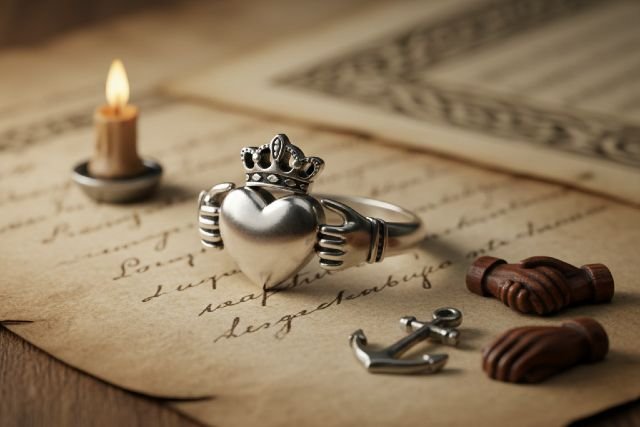
If you’ve ever wondered about the claddagh ring meaning, you’re in good company. This iconic Irish ring — two hands holding a heart topped with a crown — has become a global shorthand for love, loyalty, and friendship, and it’s one of the few jewelry designs that comes with a “language” of how to wear it.
- What does the Claddagh ring mean?
- The true origin story: Claddagh, Galway, and a ring that traveled
- The Claddagh wasn’t born in a vacuum: it’s related to older “hands” rings
- How to wear a Claddagh ring
- Claddagh ring meaning in modern relationships: what it communicates today
- Why the Claddagh ring became an Irish identity symbol worldwide
- Buying a Claddagh ring: how to choose one that matches the meaning
- Caring for a Claddagh ring so it lasts
- FAQ: featured-snippet style answers about Claddagh ring meaning
- Conclusion: the Claddagh ring meaning is a story you can wear
But the real story is even better than the postcard version. The Claddagh isn’t just romantic symbolism; it’s rooted in Galway’s history, shaped by European ring traditions, and wrapped in legends about loss, devotion, and homecoming. Let’s unpack what the ring truly means, where it came from, and how to wear it in a way that matches your intent.
What does the Claddagh ring mean?
At its core, the Claddagh ring has three elements, each with a specific message:
| Claddagh element | Meaning | What it signals in real life |
|---|---|---|
| Heart | Love | Romance, affection, emotional commitment |
| Hands | Friendship | Trust, partnership, supportive bond |
| Crown | Loyalty | Faithfulness, devotion, enduring promise |
This symbolic triad is consistently described in reputable historical and museum sources.
What makes the Claddagh special is that it works on multiple levels. It can be a friendship ring, a romantic ring, an engagement ring, or a wedding ring — often depending on how you wear it (we’ll get to that).
The true origin story: Claddagh, Galway, and a ring that traveled
The design is strongly associated with Claddagh, a historic fishing community just outside Galway City. Modern scholarship and museum writing places the earliest examples of this ring style around 1700, with the design often credited to a Galway goldsmith named Richard Joyce—though the broader tradition is intertwined with other makers and older European motifs.
Legend vs. documented history (and why both matter)
You’ll hear two versions of the origin story:
1) The documented craft history:
Surviving early rings and historical accounts connect the Claddagh style to Galway goldsmithing around the late 17th and early 18th centuries. Sources like the National Museum of Ireland discuss early examples dating to about 1700 and the common attribution to Richard Joyce.
2) The Richard Joyce legend (the romantic classic):
The best-known tale says Joyce was captured by pirates, enslaved, learned metalwork abroad, and forged a ring for the woman he planned to marry back in Galway—then returned home and presented it to her. This story is widely repeated in Irish cultural storytelling and museum commentary, and recent Irish media continues to explore how folklore and fact blend in the ring’s popularity.
Here’s the nuance that makes the “true story” satisfying: even when details are debated, the Claddagh’s meaning still tracks with the values the story celebrates — steadfast love, loyalty through separation, and friendship that endures distance.
The Claddagh wasn’t born in a vacuum: it’s related to older “hands” rings
One reason the Claddagh feels timeless is that it belongs to a broader European family of rings featuring clasped hands — often linked to vows and commitment. Scholars commonly connect it to fede rings (from the idea of hands joined in faith/loyalty), which were used in Europe for betrothal and marriage symbolism long before the Claddagh name became famous.
So the Claddagh is both uniquely Irish and part of a wider jewelry language. Galway didn’t invent the idea of “hands as a promise,” but Galway created the most recognizable version of it—by adding the heart and the crown into one clean symbol.
How to wear a Claddagh ring
This is where the Claddagh becomes more than jewelry — it becomes a social signal. Traditional wearing customs vary by community, but a commonly cited interpretation uses hand + heart direction to indicate relationship status.
The most common Claddagh ring wearing meanings
| Where you wear it | Heart points… | Common meaning |
|---|---|---|
| Right hand | Outward (toward fingertips) | Single / open to love |
| Right hand | Inward (toward wrist) | In a relationship |
| Left ring finger | Outward (toward fingertips) | Engaged |
| Left ring finger | Inward (toward wrist) | Married |
A quick real-world scenario: if someone receives a Claddagh as a gift while dating, they may start on the right hand with the heart pointing inward. If they later use it as a wedding ring, it moves to the left hand with the heart pointing inward.
Actionable tip: If you’re giving a Claddagh as a gift and you want to avoid “accidental messaging,” include a short note like: “Wear it on your right hand until you decide what it should mean for you.”
Claddagh ring meaning in modern relationships: what it communicates today
Even if someone doesn’t follow the traditional wear rules, the symbolism is still immediately understood:
- Friendship gift: “You’re important to me. I’ve got your back.”
- Long-distance relationship: “My heart is with you, even when I’m not.”
- Engagement alternative: “We want something meaningful, not generic.”
- Family heirloom: “Our love and loyalty runs through generations.”
This flexibility is why the Claddagh thrives globally. It can be intimate without being overly formal—and serious without being flashy.
Why the Claddagh ring became an Irish identity symbol worldwide
There’s a cultural reason this ring resonates far beyond Galway: Irish identity is global.
Ireland’s own government has described the Irish diaspora as around 70 million people worldwide who are Irish-born or of Irish descent (and many more with strong affinity). The U.S. Census Bureau has also highlighted how large Irish ancestry is in the United States.
That matters because jewelry often becomes a portable identity marker — something you can wear when you’re far from home or honoring family roots. The Claddagh does that job beautifully: it’s instantly recognizable, emotionally warm, and tied to a specific place with a rich story.
Buying a Claddagh ring: how to choose one that matches the meaning
If you want the symbolism to feel “true,” don’t just buy the first ring you see. Focus on what the ring is meant to represent in your life.
1) Choose the metal based on purpose, not trend
- Gold often feels traditional and heirloom-ready (many historic examples are gold).
- Silver can be a great everyday choice and is often more accessible.
- Platinum is ideal if you want a forever ring with high durability (common in modern wedding jewelry).
2) Decide whether to add gemstones
A plain Claddagh is timeless. Gemstones can personalize it, but they shift the vibe from “classic symbol” to “statement piece.” If the ring is meant to be worn daily as a wedding band, simpler is often more comfortable.
3) Look for maker credibility (especially if it’s “Irish-made”)
If authenticity matters, look for transparent maker info: where it’s made, metal purity marks, return policy, and sizing support. Galway museums and Irish cultural institutions emphasize the ring’s strong local roots; reputable sellers should reflect that seriousness.
Caring for a Claddagh ring so it lasts
A ring that represents loyalty should survive real life.
- Take it off for gym workouts, heavy lifting, and harsh cleaning chemicals.
- Clean gently with mild soap and warm water; use a soft brush around the crown and hands where grime collects.
- If it has stones, avoid ultrasonic cleaners unless a jeweler confirms it’s safe for that specific setting.
Small habit, big payoff: the Claddagh’s design has crevices, and keeping it clean preserves the crisp look of the hands and crown.
FAQ: featured-snippet style answers about Claddagh ring meaning
What is the meaning of a Claddagh ring?
The Claddagh ring symbolizes love (heart), friendship (hands), and loyalty (crown), and it’s historically associated with Galway, Ireland.
Is a Claddagh ring a promise ring?
It can be. Because the design represents loyalty and commitment, many people use it as a promise ring — especially in long-distance relationships or as a “pre-engagement” symbol.
Can you use a Claddagh ring as an engagement ring?
Yes. The Claddagh is often used for engagement, especially among people who want something meaningful and culturally rooted. Traditional wearing customs commonly interpret a Claddagh on the left ring finger with the heart pointing outward as engagement.
Which direction should the heart face?
A commonly cited custom is:
- Heart pointing outward (toward fingertips) = single or engaged (depending on hand)
- Heart pointing inward (toward wrist) = in a relationship or married (depending on hand)
Is the Claddagh ring actually Irish?
Yes—its name and popular tradition originate in the Claddagh area near Galway, and Irish museums document early examples around 1700 with strong Galway connections.
Conclusion: the Claddagh ring meaning is a story you can wear
The claddagh ring meaning isn’t just a neat definition — it’s a wearable message. The heart speaks for love, the hands speak for friendship, and the crown speaks for loyalty, all tied to Galway’s history and a legend powerful enough to travel the world.
If you’re buying one for yourself, let the ring reflect the promise you want to live. If you’re gifting one, attach the story — because the Claddagh doesn’t just say “I care.” It says why.