


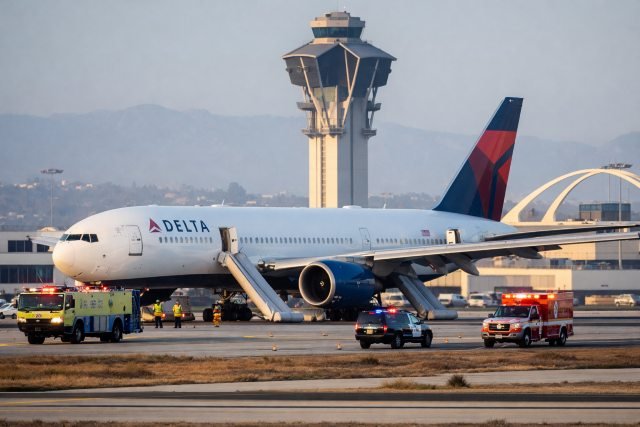
When Delta flight DL275 diverted LAX, the incident immediately raised the kind of questions every traveler asks when a long-haul aircraft changes course unexpectedly: Was this a safety scare — or simply a precautionary landing made out of an abundance of caution?
- What Happened When Delta flight DL275 diverted LAX?
- Safety Scare or Precautionary Landing? The Difference Matters
- Why LAX? Why Los Angeles Is a Common Diversion Airport
- Common Reasons Flights Like DL275 Get Diverted
- What Happens Inside the Cockpit During a Diversion Decision?
- Was There an “Emergency Landing” If Delta flight DL275 diverted LAX?
- What Passengers Experienced: What Usually Happens After a Diversion
- How Rare Are Diversions Like DL275?
- Why “Out of an Abundance of Caution” Is the Phrase You Should Like Hearing
- What To Do If Your Flight Is Diverted (Actionable Passenger Tips)
- FAQs
- Safety Scare vs. Precaution: The Real Verdict on Delta flight DL275 diverted LAX
- Conclusion: What This Incident Teaches Travelers
In aviation, diversions often look dramatic to passengers tracking the flight map, but many are planned, safety-first decisions rather than emergency “near misses.” The key is understanding what a diversion actually means, how airlines make these calls, and why Los Angeles International Airport (LAX) is one of the most common diversion hubs in the United States.
What Happened When Delta flight DL275 diverted LAX?
The most reliable public confirmation often comes from flight tracking data, which shows that the aircraft operating as DL275 changed course and landed at Los Angeles International Airport (LAX) rather than completing its original planned route. Flight tracking platforms such as FlightAware list schedules, departure/arrival records, and historical route information for DL275.
As for the specific cause, public-facing airline statements about diversions are frequently brief — sometimes describing the event as a “mechanical indication,” a “technical issue,” or a diversion made “out of an abundance of caution,” without further detail. That limited disclosure is common in aviation events where an internal inspection is still underway, or the issue was minor but operationally significant.
The important point: a diversion does not automatically mean the aircraft was in immediate danger. Many diversions are made because continuing would be inadvisable, even if it is still technically possible.
Safety Scare or Precautionary Landing? The Difference Matters
The phrase “safety scare” tends to imply panic, imminent danger, or a loss of control. A precautionary landing, however, is an aviation term of art.
According to FAA training references, a precautionary landing is defined as:
A premeditated landing, when further flight is possible but inadvisable.
This definition is crucial. It means the aircraft may still be flying normally, but the crew is making a conservative decision because of something like:
- a developing mechanical condition
- a warning indication
- weather or route complications
- medical concerns
- operational or fuel planning issues
FAA materials emphasize that precautionary landings are often less hazardous than waiting, because pilots have time to plan the landing, coordinate with the airline, and select the best airport.
So if Delta flight DL275 diverted LAX due to a technical indication, the diversion may actually be evidence that the safety system worked exactly as intended.
Why LAX? Why Los Angeles Is a Common Diversion Airport
When a long-haul flight diverts, the crew isn’t just picking a random airport. They’re choosing a location that can support:
- a wide-body aircraft landing and parking
- potential maintenance checks
- emergency services if needed
- passenger handling and rebooking
- runway length and available gates
LAX is one of the best-equipped airports in North America for that role. Aviation safety guidance describes diversion broadly as landing at a different aerodrome than planned because conditions require it — and LAX frequently meets the criteria of “most suitable.”
For trans-Pacific or long international routes especially, LAX offers:
- multiple long runways
- strong emergency response capability
- major Delta operational capacity
- maintenance availability
- high volumes of connecting flights for reaccommodation
This is why many wide-body flights, even if not originally scheduled for Los Angeles, will choose LAX when something changes mid-flight.
Common Reasons Flights Like DL275 Get Diverted
Even without full public disclosure, aviation history shows that diversions typically fall into a few predictable categories. Here are the most common:
1) Mechanical or System Indication (Most Likely in Many Diversions)
Modern aircraft are packed with sensors that detect irregularities early. Sometimes the issue is minor — but it triggers a procedure that says, land at a major airport and have maintenance inspect the aircraft.
This can include:
- anti-ice system indications
- hydraulic pressure alerts
- avionics faults
- fuel imbalance alerts
- cabin pressurization indicators
Even if the airplane is technically safe to continue, the airline may decide it’s better to land sooner.
A recent example of a separate Delta long-haul diversion was reported when a Delta A350 diverted to Tokyo due to mechanical issues. It illustrates how airlines frequently reroute proactively — before a small issue becomes a larger one.
2) Medical Emergency
Passenger medical events are another leading cause of diversions. If a serious medical situation occurs onboard, crews coordinate with medical advisory services and air traffic control to land at the nearest suitable airport.
3) Smoke, Odor, or Cabin Alerts
Smoke or odor reports are treated extremely seriously because they can indicate electrical or mechanical issues. Delta and other major airlines routinely divert in these scenarios as a precaution. For example, Delta has previously diverted flights after smoke was detected onboard, emphasizing safety-first procedures.
4) Weather or Airport Disruptions
Sometimes the destination is no longer viable due to severe weather, runway closures, or air traffic constraints.
5) Operational Factors (Fuel, Crew Duty, Airspace Restrictions)
Less dramatic but very real: reroutes can happen due to airspace restrictions, fuel planning needs, or required crew duty compliance.
What Happens Inside the Cockpit During a Diversion Decision?
Passengers often imagine a tense debate. In reality, the process is structured and checklist-driven.
When a cockpit receives an alert (or a developing situation emerges), the crew typically:
- Runs the applicable checklist
- Contacts airline operational control / maintenance control
- Coordinates with air traffic control
- Evaluates nearest suitable airports
- Plans for approach, landing, and ground handling
Aviation safety references define diversion as a pilot decision to land at a different aerodrome than intended, often driven by factors beyond the pilot’s control — like weather, technical concerns, or operational limitations.
In many cases, the aircraft lands normally, taxis to the gate, and passengers disembark safely.
Was There an “Emergency Landing” If Delta flight DL275 diverted LAX?
This is one of the most misunderstood phrases online.
A flight may receive:
- priority handling (to land sooner)
- emergency services on standby (a standard precaution)
- a gate escort or inspection
…but still not qualify as a full emergency landing.
Even if fire vehicles are visible, it may be standard airport procedure. Airports often deploy emergency crews whenever there’s a report of a technical issue — because being ready costs little compared to being unprepared.
FAA references make a key distinction: precautionary actions are taken when flight is still possible but continuing is inadvisable.
So the presence of a diversion doesn’t automatically mean danger — it often means prevention.
What Passengers Experienced: What Usually Happens After a Diversion
Diversions often create confusion because passengers are stuck between two realities:
- The flight landed safely
- The trip is now disrupted
Typically, passengers may face:
- waiting onboard briefly while a gate is assigned
- disembarking into a terminal that wasn’t planned
- rebooking onto a later flight
- delays due to maintenance inspections
- in some cases, overnight accommodations
Airlines will usually provide rebooking options, and depending on the cause and region, passengers may be entitled to compensation, refunds, or amenities (though U.S. rules are more limited than EU/UK regimes).
How Rare Are Diversions Like DL275?
Flight diversions are not everyday events for any one passenger — but across all flights globally, they happen more often than people think.
Aviation sources note that diversions are a recognized operational category and are typically classified based on cause (weather, technical, medical, operational).
The key takeaway: the aviation system is designed with redundancy and procedures so that when anomalies occur, landing early is an option.
Why “Out of an Abundance of Caution” Is the Phrase You Should Like Hearing
If there’s one phrase that should reassure passengers, it’s this one.
It usually means:
- the issue was detected early
- the crew took proactive action
- the aircraft remained controllable and safe
- the airline prioritized risk reduction
This aligns closely with FAA guidance that precautionary landings are safer than allowing uncertain conditions to develop into forced situations.
It may be inconvenient — but in aviation, inconvenience is often the cost of caution.
What To Do If Your Flight Is Diverted (Actionable Passenger Tips)
If you’re ever on a flight like Delta flight DL275 diverted LAX, your next steps can protect your time, money, and stress levels:
Step 1: Keep Your Boarding Pass and Booking Reference
You may need it for rebooking, refunds, or travel insurance claims.
Step 2: Use the Airline App Immediately
Most airlines push automatic rebooking options via their apps before passengers even reach the gate.
Step 3: Confirm Your Bags Situation
Sometimes checked bags stay onboard until the aircraft is cleared. If the diversion becomes an overnight event, ask whether bags will be released.
Step 4: Document Expenses
If you purchase meals, hotel rooms, or transport, keep receipts. Even if the airline does not reimburse, your travel insurance might.
Step 5: Know Your Rights
In the U.S., compensation rules depend heavily on the cause. In the EU/UK, passenger protections are stronger.
FAQs
Why did Delta flight DL275 diverted LAX?
Public reports suggest the diversion was precautionary and linked to a technical indication, though official details may be limited while the aircraft is inspected.
Is a diverted flight considered an emergency?
Not always. Many diversions are precautionary landings where the aircraft is safe to fly but continuing is inadvisable under established procedures.
Why would a plane divert to LAX specifically?
LAX is a major hub with long runways, strong emergency response capability, and maintenance infrastructure — making it one of the most suitable diversion airports in the U.S.
Do passengers get compensation for a diversion?
It depends. In the U.S., compensation is limited unless the airline chooses to provide it, but passengers may receive rebooking, meals, or hotel accommodations depending on cause and delay length.
Is it safe to fly after a diversion?
Yes — airlines typically return the aircraft to service only after inspections and required maintenance actions are completed. Precautionary landings are designed to improve safety, not compromise it.
Safety Scare vs. Precaution: The Real Verdict on Delta flight DL275 diverted LAX
So — was it a safety scare or precautionary landing?
Based on how aviation systems work and how precautionary landings are defined, the most likely interpretation is that this was a safety-first operational decision, not a chaotic emergency.
A diversion is often the aviation equivalent of pulling over when your dashboard light turns on. The car still runs — but ignoring the signal can lead to worse outcomes. Airlines and pilots are trained to avoid that outcome entirely.
FAA references reinforce this idea clearly: when continuing is possible but inadvisable, a precautionary landing is the safer choice.
Conclusion: The fact that Delta flight DL275 diverted LAX and landed safely should be seen less as a sign of danger — and more as proof that aviation safety culture is working.
Conclusion: What This Incident Teaches Travelers
If you take only one lesson from the Delta flight DL275 diverted LAX incident, let it be this:
Most diversions are not failures. They are safety systems functioning correctly.
They are the result of trained professionals doing what aviation is built to do: detect risk early, reduce uncertainty, and land in the safest environment available.
For passengers, diversions can still be frustrating. But understanding the “why” behind them transforms anxiety into perspective — and helps you respond calmly and strategically if it ever happens to you.