


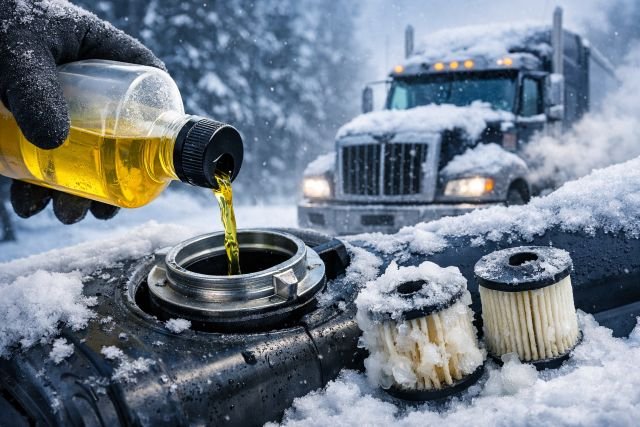
A diesel fuel additive can be the difference between a clean cold start and a “crank-no-start” morning that turns into a dead battery, clogged filters, and lost time. When temperatures drop, diesel’s natural paraffin wax begins to crystallize. Those tiny wax crystals can build up on the fuel filter and restrict flow long before the fuel becomes a solid “gel.” The result is classic winter trouble: hard starts, surging, stalling, and the dreaded “it ran yesterday, but today it won’t.”
- Why diesel gels in cold weather (and why filters fail first)
- How a diesel fuel additive prevents gelling
- H2: Choosing the right diesel fuel additive for cold weather
- Additives vs. kerosene blending: what actually works (and what it costs)
- When to add anti-gel (timing matters more than people think)
- Real-world winter scenarios (what to do, and why it works)
- Actionable tips that make anti-gel work better
- FAQ
- Conclusion: Stop gelling, protect filters, and start easier
The good news: you can prevent most cold-weather diesel issues with the right strategy — starting with a winter-grade fuel plan and pairing it with the correct diesel fuel additive (anti-gel + water control) before the cold hits.
Why diesel gels in cold weather (and why filters fail first)
Diesel contains paraffin wax. In warm conditions, it stays dissolved. As fuel temperature falls, wax comes out of solution and forms crystals — this is the beginning of “gelling.” Industry guides describe the cloud point as the temperature where wax crystals first appear and the fuel turns hazy, and the cold filter plugging point (CFPP) as the point where filters begin to plug and engines start to starve for fuel.
A key detail many drivers miss: the engine often quits because the filter plugs, not because the tank “freezes.” The wax crystals coat the filter media and fuel flow drops rapidly.
The 3 cold-flow terms that actually matter
- Cloud point: Wax crystals start forming (fuel looks cloudy).
- CFPP: Fuel won’t reliably pass through a standard filter (operability failure zone).
- Pour point: Fuel stops flowing like a liquid (worst-case “gelled” condition).
Some references note that typical cloud point temperatures vary widely by fuel and season, and can be much higher than you’d expect in some cases. That’s why “it’s only slightly below freezing” can still cause problems — especially if your fuel isn’t winterized or you’re running biodiesel blends.
How a diesel fuel additive prevents gelling
Most cold-weather anti-gel formulas are built around cold-flow improvers. They don’t remove wax; they change the size and shape of wax crystals so they’re less likely to clump and plug the filter. This mechanism is commonly described in winter fuel guidance and product data sheets.
A quality winter additive package often also targets:
- Fuel-filter icing: Water in diesel can freeze on filter surfaces and block flow.
- Water demulsification or dispersal (varies by formula): Helps manage moisture so it doesn’t become ice or a microbial growth point.
- Lubricity support: Helpful because modern ULSD can be less forgiving than older high-sulfur diesel (and kerosene blending can reduce lubricity if not corrected).
- Cetane improvement: Can help cold starts by shortening ignition delay (some winterizers include cetane boost).
“How much protection can I realistically expect?”
Real-world performance depends on your base fuel, how it was winter-blended, and how early you treat it. Still, reputable industry guidance and manufacturer info commonly cite meaningful improvements in operability. For example, one winter additive overview notes 15–20°F of cold-flow operability improvement for a high-quality additive. And a major additive manufacturer states treated fuels may achieve CFPP substantially below cloud point, often 15–20°F below in typical results.
Use those numbers as a ballpark, not a guarantee — because fuel quality, storage conditions, and blend ratios matter.
H2: Choosing the right diesel fuel additive for cold weather
Not every bottle marketed as “diesel treatment” is a true anti-gel. For winter reliability, you’re usually looking for an additive that clearly states it:
- prevents fuel gelling / improves CFPP, and
- prevents fuel-filter icing / manages water.
Many winter products position themselves exactly this way, emphasizing wax and filter icing as the two main failure modes in cold weather.
If you run biodiesel blends, be extra picky
Biodiesel (FAME) generally has worse cold-flow properties than petroleum diesel, and cold weather operability is a known concern — especially at higher blends. Research also highlights that low-temperature crystallization and filter clogging are major operability issues for biodiesel-containing fuels.
Practical takeaway: if you run B5–B20 (common in many regions), choose a winter additive explicitly rated for biodiesel blends and be more conservative with your temperature margin.
Additives vs. kerosene blending: what actually works (and what it costs)
Two common winter approaches are:
- Treating diesel with a winter additive
- Blending #1 diesel/kerosene into #2 diesel
Kerosene (or #1 diesel) naturally has much lower wax content, so blending can improve cold performance. Some cold weather operability guidance notes kerosene blending is an option, but it can require significant blend levels and may be more expensive to reach the same results as engineered cold-flow improvers.
Industry commentary also points out an important tradeoff: blending kerosene can dilute energy content (BTUs) and may reduce lubricity unless corrected — while a purpose-built additive avoids BTU dilution and may help maintain lubricity.
Best practice for most drivers and fleets: use winterized fuel from a reputable supplier and add a proven winter anti-gel additive for extra protection when your operating temps regularly approach (or fall below) your fuel’s safe operability range.
When to add anti-gel (timing matters more than people think)
Here’s the mistake that strands a lot of diesel owners: adding anti-gel after the fuel has already waxed.
Cold-flow improvers work best when mixed into fuel before wax crystals grow and agglomerate. Once your filter is already plugged with wax or ice, the fix is usually heat and filter service—not “more additive.”
A simple rule that works in real life:
- Treat early: Add your winter additive before the cold snap, and ideally at fill-up so it mixes well.
- Treat consistently: If temps stay low, dose every time you refuel to keep protection consistent.
Some manufacturer guidance also recommends heavier treatment in extreme cold or when using biodiesel blends.
Real-world winter scenarios (what to do, and why it works)
Scenario 1: Overnight low hits, truck won’t start in the morning
Most likely causes:
- Filter is restricted by wax crystals (cloud point/CFPP issue)
- Filter is iced from water contamination
What works fastest:
- Move vehicle into warmth or use safe external heat (shop heat is best).
- Replace or warm the fuel filter so fuel can pass again (filters often need service once plugged).
- Once restored, switch to a winter strategy: winterized fuel + diesel fuel additive at each fill.
Scenario 2: Equipment runs fine, then dies under load
This often happens when a partially restricted filter can’t supply enough fuel at higher demand. Wax-coated filters reduce flow quickly once temperatures drop into the danger zone.
Fix:
- Filter service + warming, then prevention (additive + winter blend).
Scenario 3: You store diesel in a bulk tank
Bulk storage adds two risks: water accumulation and inconsistent mixing. Cold-weather diesel testing guidance emphasizes moisture as a major factor because it can freeze and also create conditions for microbial growth.
Prevention:
- Keep tanks as full as practical to reduce condensation.
- Drain water regularly (or use a water management plan).
- Treat the tank before sustained cold weather, and circulate if possible for mixing.
Actionable tips that make anti-gel work better
You don’t need a complicated routine — just a smart one:
- Know your “real” fuel temperature. Wind chill doesn’t change fuel temp directly, but long exposure to low ambient temps will cool the tank, lines, and filter housing.
- Protect the filter first. The filter is where winter failures show up earliest. Cloud point and wax crystals directly impact filter restriction.
- Use winterized diesel when available. Many suppliers seasonally adjust blends for cold climates (often by blending #1/#2 or adding cold-flow improvers).
- Treat at fill-up, not after trouble starts. Anti-gel is a preventative tool.
- If you’re already gelled, don’t “dose your way out.” Warmth + filter service is usually the real fix; then use additive to prevent the next failure.
FAQ
What is the best diesel fuel additive for cold weather?
The best cold-weather diesel additive is one that improves cold-flow operability (anti-gel/CFPP improvement) and prevents fuel-filter icing by addressing water-related freezing. Many winter products explicitly target wax gelling and filter icing as the main failure modes.
When should I add diesel anti-gel?
Add it before temperatures reach your fuel’s trouble range, ideally at fill-up so it mixes thoroughly. Anti-gel works best as prevention because it modifies wax crystal formation; it’s less effective once filters are already plugged.
Can a diesel fuel additive un-gel diesel?
Usually, not by itself. Once fuel flow is blocked (commonly at the filter), the practical fix is warming the vehicle/fuel system and servicing the filter, then switching to preventative treatment. Cold operability failures are closely tied to wax crystals restricting filters.
Does biodiesel gel more easily than regular diesel?
Often, yes. Biodiesel blends can have less favorable cold-flow behavior and can crystallize in ways that increase filter-clogging risk. This is widely noted in extension and laboratory research discussing cold weather operability challenges.
Is kerosene better than an additive in winter?
Kerosene blending can help because it contains less paraffin, but it can be costly and may require significant blending to match the results of modern cold-flow improvers. Additives can improve operability without diluting BTU content and may help protect lubricity.
Conclusion: Stop gelling, protect filters, and start easier
If winter diesel problems have ever cost you a morning (or a job), the fix is straightforward: treat cold weather as a fuel-management challenge, not just a “starting problem.” Wax crystals begin forming at the cloud point and can quickly restrict filters, which is why engines often fail from fuel starvation at the filter before the tank fuel looks fully gelled.
A quality diesel fuel additive — used early, mixed well, and paired with winterized fuel—helps keep wax crystals filter-friendly and reduces fuel-filter icing risk from water contamination. Add in sensible storage habits and consistent dosing during cold periods, and you’ll turn winter from a gamble into routine operation.