

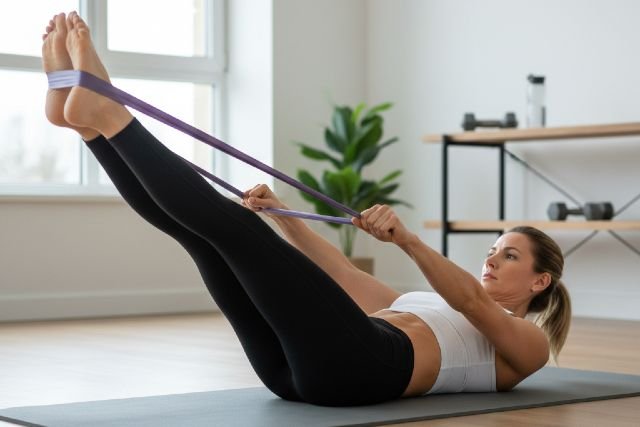
If you’ve been looking for a workout that feels friendly on your joints but still delivers serious core results, exercise bands pilates is one of the smartest combinations you can try. Pilates already emphasizes control, alignment, and deep “core” engagement; adding resistance bands turns many classic moves into strength-building, posture-improving work without needing heavy equipment.
- What is exercise bands Pilates?
- Why resistance bands + Pilates is a powerful low-impact pairing
- Core strength, defined (and why “Pilates core” feels different)
- The benefits you can expect from exercise bands Pilates
- Exercise bands Pilates setup: what you need (and what most people get wrong)
- Exercise bands Pilates routine (30–40 minutes) for a stronger core
- Progression plan: how to keep getting stronger (without “going harder” blindly)
- Common mistakes in exercise bands Pilates (and quick fixes)
- Who is exercise bands Pilates best for?
- How often should you do exercise bands Pilates?
- Mini case scenario: why bands help people who “can’t feel their core”
- FAQs
- Conclusion: Why exercise bands Pilates belongs in your weekly routine
Better yet, this approach fits real life. You can do it in a small space, scale the intensity up or down, and progress for months just by changing band tension, tempo, and range of motion. And because it’s low-impact, it’s a great option for people who want to avoid the pounding of high-impact cardio or aren’t ready for heavy lifting yet.
What is exercise bands Pilates?
Exercise bands Pilates is simply Pilates training that uses resistance bands (loop bands or long therapy-style bands) to add progressive resistance to traditional Pilates movements. Pilates already challenges your core by asking you to stabilize your spine and pelvis while your arms and legs move; bands amplify that challenge by adding tension that your body must control.
That extra tension does two important things:
- It increases muscular demand without high impact.
- It improves body awareness because the band “pull” instantly tells you when your alignment drifts.
This makes it ideal for building a stronger core in a way that feels smooth and controlled rather than harsh or jarring.
Why resistance bands + Pilates is a powerful low-impact pairing
Low-impact doesn’t mean low-effort. It means you minimize joint pounding while still creating enough muscular stimulus to adapt. Resistance bands are particularly useful here because they offer variable resistance — tension changes through the movement — so you can make a move harder without adding load that compresses joints the way heavy weights sometimes can.
The American College of Sports Medicine (ACSM) has long recognized elastic resistance as a practical strength-training option across populations (including older adults), especially because it’s portable and adaptable.
And from the Pilates side, a growing body of research supports Pilates-based training for improving core-related outcomes and function in people with persistent low back pain—one reason many clinicians recommend Pilates-style approaches as part of rehab and prevention plans.
Core strength, defined (and why “Pilates core” feels different)
When most people say “core,” they picture visible abs. Pilates trains something broader: the system that stabilizes your trunk so your limbs can move efficiently.
A practical definition:
Core strength is your ability to control your spine and pelvis under movement and load—without compensating through your lower back, neck, or hips.
Pilates cues like “ribs down,” “neutral pelvis,” and “lengthen through the crown of the head” aren’t just aesthetic — they’re ways of keeping the spine stable while you create force.
Bands intensify that stability demand because they’re constantly trying to pull you out of position.
The benefits you can expect from exercise bands Pilates
Stronger deep core and better posture
Band tension challenges your trunk to resist rotation, extension, and unwanted shifting. Over time, many people notice they sit taller, stand more evenly, and feel less “collapsed” in the midsection during daily life.
Joint-friendly strength training
Because it’s low-impact, it’s a popular choice for people with sensitive knees, hips, or shoulders — especially when moves are modified appropriately.
A practical way to meet strength guidelines
Global guidelines encourage adults to include muscle-strengthening activity as part of weekly movement habits.
Exercise bands Pilates can count toward that “strength” bucket, depending on intensity and progression.
Core-focused support for back comfort (for many people)
Evidence suggests Pilates-style exercise can reduce pain and improve function in chronic low back pain populations. A large network meta-analysis published in 2022 evaluated exercise types for chronic low back pain and included Pilates among the studied approaches.
More recent synthesis work continues to evaluate Pilates and core training approaches comparatively.
(Important note: pain is complex and individual; if you have symptoms, get clinical guidance.)
Exercise bands Pilates setup: what you need (and what most people get wrong)
You don’t need a studio reformer. You do need the right band and smart setup.
Picking the right band
A simple starting kit:
- A long resistance band (with or without handles) for presses, rows, and assisted mobility
- A mini loop band for glute activation and lateral work
Most beginners choose bands that are too heavy. In Pilates, quality beats brute force. If the band makes you lose rib/pelvis control, it’s too strong for that exercise.
Anchor safety
If you anchor a long band (door anchor, heavy furniture), you need zero wobble. A slipping anchor turns a controlled workout into a surprise event.
The Pilates “golden rule” with bands
Tension should sharpen your form, not erase it.
If you can’t keep slow control, reduce tension or shorten the range of motion.
Exercise bands Pilates routine (30–40 minutes) for a stronger core
Below is a full routine you can run 2–4 days per week. It’s designed for mobile readability, and it includes progressions so you don’t plateau.
Warm-up (5–7 minutes)
1) Breathing + rib control (no band)
Inhale into the sides/back of your ribcage. Exhale like you’re fogging a mirror, gently drawing the ribcage down without tucking aggressively.
2) Pelvic clocks (no band)
Small pelvis tilts — think “micro-movement” to find neutral.
3) Cat-cow to neutral (no band)
Move through flexion/extension, then finish in a neutral spine.
Main set A: Anti-extension core + banded control (12–15 minutes)
A1) Banded Dead Bug (long band anchored overhead or held in hands)
Goal: keep your ribs and pelvis steady while legs move.
Common mistake: ribs flare and low back arches.
A2) Banded Pilates Hundred (long band in hands, light tension)
Keep the neck long and shoulders heavy. The band adds demand to the upper trunk and challenges rib position.
A3) Banded Roll-Down to Hinge (long band under feet, held in hands)
Slow roll-down with control; then hinge and return.
This trains spinal articulation plus hamstring/hip control.
Do 2–3 rounds. Rest briefly between rounds.
Main set B: Anti-rotation + obliques (10–12 minutes)
B1) Pallof Press (long band anchored to the side)
Press band straight out from chest without letting your torso twist.
This is one of the simplest “featured snippet” moves to explain because it’s pure anti-rotation.
B2) Side plank with band row (band anchored in front; modify on knees)
Row slowly while holding the plank.
If your shoulder hates it, do side plank holds without the row and add rows standing.
B3) Standing band chop (high-to-low or low-to-high)
Focus on rotating through the upper back while keeping pelvis controlled.
Do 2 rounds.
Main set C: Glutes + pelvic stability (8–10 minutes)
C1) Mini band glute bridge
Band above knees. Push knees gently out while lifting hips.
This builds posterior chain support, which often reduces “all-core, no-hips” compensation.
C2) Mini band lateral steps (small controlled steps)
Keep ribs stacked over pelvis. Don’t sway.
C3) Mini band clam (side-lying, slow tempo)
Don’t roll backward; keep hips stacked.
Do 2 rounds.
Cooldown (3–5 minutes)
- Hip flexor stretch (gentle, no forcing)
- Thread-the-needle thoracic rotation
- Supine breathing to reset ribs and neck
Progression plan: how to keep getting stronger (without “going harder” blindly)
Most people progress Pilates the wrong way: they rush reps, add harder bands, and lose the method.
Instead, use this simple progression ladder:
- Control first: slower tempo (3 seconds out, 3 seconds back)
- Range next: slightly bigger movement while staying stable
- Volume next: add 1–2 reps per set
- Tension last: move up a band level only when form stays crisp
The result is sustainable core strength — not just fatigue.
Common mistakes in exercise bands Pilates (and quick fixes)
Mistake 1: Rib flare + low back arch
Fix: Exhale first, feel ribs soften down, then move your legs/arms.
Mistake 2: Band tension that forces “cheating”
Fix: Lighter band, shorter range, or anchor closer so tension is manageable.
Mistake 3: Neck and shoulders doing the work
Fix: In ab-focused moves, keep the chin slightly tucked as if holding a peach under it, and keep shoulders away from ears.
Mistake 4: Turning Pilates into random band exercises
Fix: Keep Pilates principles: alignment, breath, control, precision, flow.
Who is exercise bands Pilates best for?
This style works particularly well for:
- Beginners who want a structured, low-impact start
- Desk workers chasing posture, glute activation, and core control
- People who dislike gyms but want real strength stimulus
- Active people who want injury-resilient trunk stability as a complement to sports
If you’re dealing with pain, especially back, hip, or shoulder pain, Pilates-based exercise is commonly used in rehab contexts and has research support in chronic low back pain outcomes.
That said, individual assessment matters — don’t “push through” sharp or radiating symptoms.
How often should you do exercise bands Pilates?
A realistic schedule that works for most people:
- 2–3 days/week for strength-focused progress
- Add walking, cycling, or other cardio as desired to meet weekly activity targets described by global guidelines.
If you’re short on time, even 20 minutes of focused bands + Pilates can be enough to feel changes in posture and trunk control within a few weeks, especially if you’re consistent.
Mini case scenario: why bands help people who “can’t feel their core”
Imagine someone who does crunches but still feels unstable during planks and gets lower-back tightness during ab work.
With bands:
- A Pallof press immediately exposes torso rotation.
- A banded dead bug reveals rib flare.
- A mini band bridge shows whether glutes stabilize the pelvis.
Because the band provides constant feedback, the person learns what “stable” feels like faster — then strength follows.
FAQs
Is exercise bands Pilates good for beginners?
Yes. Start with light tension and slower tempo. Pilates teaches control and alignment; bands add gentle resistance that you can scale up as you improve.
How long does it take to see core results?
Many people feel better posture and control within 2–4 weeks with consistent practice (2–3 sessions weekly). Visible changes usually take longer and depend on nutrition, sleep, and overall activity.
Can exercise bands Pilates replace weight training?
It can build meaningful strength and stability, especially for beginners and intermediates. If your goal is maximal strength or hypertrophy, you may eventually want heavier loading — but bands + Pilates is an excellent foundation and complement. ACSM notes elastic resistance as a valid strengthening method when used effectively.
Is it safe for low back pain?
Pilates-based exercise is frequently used for chronic low back pain and has supportive evidence for improving pain and function in many people.
Still, pain is individual — work with a clinician if symptoms are severe, worsening, or radiating.
What band strength should I use?
Choose the lightest band that lets you maintain rib/pelvis control through the full set. If you lose alignment, reduce tension.
Conclusion: Why exercise bands Pilates belongs in your weekly routine
Exercise bands pilates is one of the most effective ways to build a stronger, more functional core without beating up your joints. Pilates gives you the control, alignment, and deep trunk engagement; bands provide progressive resistance and instant feedback — so you get stronger with better mechanics, not just more sweat.
If you want a low-impact routine you can do at home, scale over time, and actually feel in daily movement, start with the 30–40 minute plan above twice a week. Master control first, then progress tension. Your core — and your posture — will thank you.