


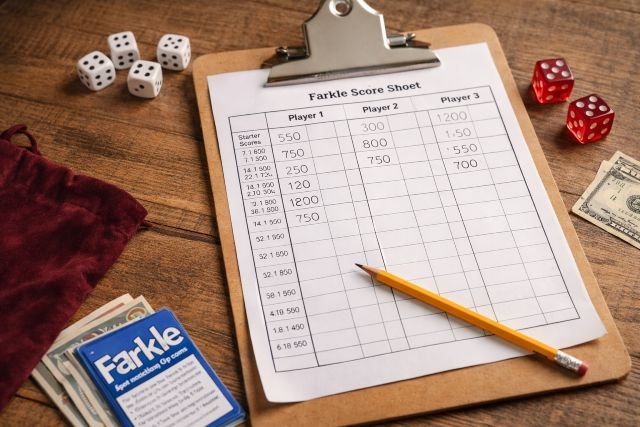
If you’ve ever played Farkle with a scrap of paper and ended up arguing over totals, you already know why a farkle score sheet matters. In a game where points can swing wildly from one roll to the next, clean scorekeeping isn’t “extra” — it’s what keeps the energy fun instead of frustrating. A good sheet helps you record points quickly, see who’s leading at a glance, and reduce those “Wait… did we count that straight?” moments.
- What Is a Farkle Score Sheet?
- Why Scorekeeping Gets Confusing in Farkle
- Farkle Score Sheet Layout That Actually Works
- Use a Farkle Score Sheet Step-by-Step (Fast, No Drama)
- Printable vs Digital Farkle Score Sheets
- Actionable Tips to Prevent Scoring Mistakes
- Example Scenario: How a Good Sheet Saves a Game Night
- Featured Snippet-Ready: What to Include on a Farkle Score Sheet
- FAQs About Farkle Score Sheets
- Conclusion: A Farkle Score Sheet Makes the Game Smoother
Farkle is a push-your-luck dice game with many “house-rule” variations, which is exactly why scorekeeping gets messy: one group scores three pairs, another doesn’t; some require an “entry score” to get on the board; others play to 10,000 with slightly different combo values. Even sources that teach the classic game acknowledge common variations and alternate scoring approaches.
This guide breaks down what a great Farkle score sheet includes, how to use it without slowing the game down, and how to choose between printable and digital formats — plus a few practical tips to avoid scoring errors.
What Is a Farkle Score Sheet?
A farkle score sheet is a structured page (printable or digital) designed to record each player’s points round by round. Most versions include:
- Player names across the top
- A column (or row) for each round/turn
- A running total for each player
- A quick scoring reference so no one has to pause the game to Google “three of a kind values”
Many printable sheets even include scoring combinations at the bottom so you can confirm points instantly during play.
The goal is simple: track every round clearly, consistently, and fast.
Why Scorekeeping Gets Confusing in Farkle
Farkle’s tension comes from decisions—bank points or roll again. But confusion usually comes from three places:
1) Variations in rules and scoring
Because Farkle has folk origins and many variations, not everyone scores the same combos the same way. Some variants change what counts as a scoring roll and even affect probabilities.
A well-designed score sheet solves this by including a small “rules used tonight” area (or checkboxes) so everyone agrees before the first roll.
2) Mental math under pressure
When someone hits “hot dice” (scores with all dice and gets to roll again), the table gets excited—and math gets sloppy. A sheet with clear per-turn lines reduces errors because you’re not trying to reconstruct totals after the fact.
3) The pace of the game
Farkle is quick by nature. If recording points takes too long, players stop writing details and just jot rough totals… and that’s where disputes start. A sheet built for speed (simple grid + running total) keeps the flow.
Farkle Score Sheet Layout That Actually Works
Here’s what to look for (or include if you’re making your own).
Player section (top of page)
Keep this simple: 2–8 players is common on printable sheets. Some popular printables are designed to fit multiple sheets per page so you can print and play immediately.
Turn-by-turn rows (the heart of the sheet)
Each row should allow:
- Turn score (banked points)
- Optional notes (like “hot dice” or “farkle”)
- Updated running total
That “running total” is the real secret. If you only track per-turn scores, totals become a calculator job at the end—and mistakes compound.
Rules/variants tracker (small but powerful)
Because scoring variants are common, a small tracker prevents mid-game debates. Some Farkle resources explicitly highlight optional variants and even provide sheets with variant trackers.
Scoring reference (bottom of page)
A quick reference speeds everything up. Even if your group knows most scoring by memory, a reference helps newer players and prevents “confidently wrong” scoring.
Here’s a simple reference-style table you can keep on your sheet (adjust to your house rules):
| Combination (common rules) | Typical score note |
|---|---|
| Single 1 | High-value single (commonly used) |
| Single 5 | Lower-value single (commonly used) |
| Three of a kind | Base pattern many variants build on |
| Straight (1–6) | Often a big bonus in many rule sets |
| Three pairs | Variant-dependent (some score it, some don’t) |
Because variations differ, the safest approach is to print your scoring reference according to the rule set your group uses, then keep it consistent for the whole game.
Use a Farkle Score Sheet Step-by-Step (Fast, No Drama)
- Write player names once.
If you rotate scorekeepers, keep the sheet in the center of the table. - Agree on rules before the first roll.
Decide: entry score (if any), whether three pairs score, and what counts as a special combo. - Record only banked points, not “in-progress” points.
When a player decides to stop and bank, write that turn’s banked total. - Update the running total immediately.
This prevents endgame recalculations and reduces disputes. - Mark a Farkle clearly.
A simple “F” in the notes column helps everyone track the story of the game without confusion.
Printable vs Digital Farkle Score Sheets
Printable score sheets (best for game nights)
Printables are easy, distraction-free, and friendly for groups. Many sites offer free PDF score sheets designed for multiple players and clean layout.
A practical bonus: writing by hand can improve focus and retention compared to typing in some contexts, according to research on longhand note-taking. While that research is academic (students learning), the principle maps nicely to casual scorekeeping: writing tends to keep you more “locked in” than switching apps or notifications mid-game.
Best for: families, parties, mixed ages, low-friction play.
Digital score sheets (best for travel or remote play)
Digital sheets (phone notes, spreadsheets, scoring apps) are convenient if you’re playing on the go. But they can slow the pace if only one person has the sheet, and they can invite distraction.
Best for: travel, quick two-player games, or long campaigns where you want a saved history.
Actionable Tips to Prevent Scoring Mistakes
Keep one “official scorer” per game
Rotating can work, but it increases the chance someone skips the running total. If you do rotate, rotate only between rounds and have the next scorer confirm the totals before play continues.
Make “house rules” visible on the sheet
A tiny header like “Three pairs: YES / NO” prevents 90% of scoring arguments.
Use a “turn number” column
This is surprisingly helpful. If someone questions a score, you can trace it to Turn 7 instead of “that roll like… 20 minutes ago.”
Leave space for “hot dice” notation
When someone uses all dice to score and continues, people often mis-add. A note like “HD” helps you double-check the math quickly.
Example Scenario: How a Good Sheet Saves a Game Night
Imagine four players: Ayesha, Bilal, Daniyal, and Sana.
Mid-game, Daniyal rolls a huge sequence, keeps pushing, and eventually Farkles. Everyone remembers the excitement, but nobody remembers whether he had banked earlier in the turn or was still accumulating. With a casual scrap-paper approach, this turns into a debate.
With a proper farkle score sheet, it’s clear:
- Turn score line is empty (nothing banked)
- Notes show “F” for Farkle
- Running total doesn’t change
No argument, no bad vibes — just laughter and the next roll.
Featured Snippet-Ready: What to Include on a Farkle Score Sheet
A Farkle score sheet should include player names, a turn-by-turn scoring grid, a running total column, a Farkle marker (for zero-point turns), and a scoring reference for your chosen rules. For groups that play variations, add a small “rules tracker” so everyone scores the same combos the same way.
FAQs About Farkle Score Sheets
What is the best format for a Farkle score sheet?
The best format is a simple grid with a running total column. Running totals prevent end-of-game math errors and make it easy to see the leader instantly.
How many players can a Farkle score sheet support?
Many printables support 6–8 players on one sheet, and some PDFs print two sheets per page for convenience.
Do I need a scoring reference on the sheet?
If your group plays with any variations — or you have new players — yes. Farkle often includes optional scoring variants, and a reference keeps the game moving.
What does “Farkle” mean on the score sheet?
A “Farkle” indicates a turn where the player rolls and gets no scoring dice, typically losing the unbanked points for that turn under common rules.
Is there a “right” way to score Farkle?
There are common rule sets, but Farkle is widely played with house variations. The key is agreeing on rules before starting and using a sheet that reflects those rules.
Conclusion: A Farkle Score Sheet Makes the Game Smoother
A well-designed farkle score sheet does more than track points — it protects the fun. It keeps scoring consistent across house rules, reduces mental math mistakes, and makes it obvious what happened each turn. If your group plays often, pick a printable sheet with a running total and a scoring reference, and you’ll immediately notice fewer disputes and faster gameplay. And if you’re building pages around Farkle content, connect this guide to your rules and strategy pages to create a helpful, search-friendly hub.