

If your engine is smoking like a chimney, fouling plugs, or idling rough, the fastest place to look is oil for two stroke — not just the brand, but the type, the mix ratio, and whether the engine is burning it cleanly. Two-strokes don’t keep oil in a crankcase like four-strokes. The lubricant is mixed with fuel (or injected), travels through the engine to lubricate parts, and then burns, which means oil choice and quantity show up immediately as smoke, carbon, and plug deposits.
- What oil for two stroke really does, and why it can cause smoke and fouling
- Why your two-stroke smokes too much
- Why fouled plugs and rough idle usually happen together
- Choosing the right oil for two stroke engines, without overthinking it
- The mix ratio is your biggest lever for smoke versus reliability
- How to fix excess smoke, fouled plugs, and rough idle in a practical sequence
- Featured snippet answer: What is oil for two stroke?
- Common questions people search, answered clearly
- Why this topic matters beyond performance
- Conclusion: oil for two stroke is the foundation of a clean-running engine
The good news is that most “excess smoke, fouled plugs, rough idle” complaints are fixable without opening the engine. When you treat oil spec, mix accuracy, and carb tuning as one system, two-strokes usually clean up quickly and become far more predictable.
What oil for two stroke really does, and why it can cause smoke and fouling
Oil for two stroke engines has an unusually difficult job. It must lubricate bearings, piston skirts, rings, and cylinder walls under high load, but it also has to burn with minimal deposits. That deposit piece is not a marketing detail; it’s the whole game. Standards for two-stroke oils exist specifically because residue control matters just as much as wear protection.
A helpful example is the NMMA TC-W3 certification used widely for marine two-stroke oils. TC-W3 is performance-based and includes bench tests for properties like miscibility and rust protection, plus engine tests intended to prevent ring sticking and carbon buildup. If the oil burns dirty or separates poorly, you don’t just get smoke; you can get ring sticking, poor sealing, and chronic plug fouling that keeps returning.
For motorcycles and many air-cooled applications, the JASO M345 system classifies two-stroke oil performance into FB, FC, and FD based on test methods that include lubricity, detergency, smoke, and exhaust system blocking behavior. In plain terms, these standards exist because “two-stroke oil” is not one universal thing. The wrong oil type can behave like a problem even when you measure perfectly.
Why your two-stroke smokes too much
A little smoke on cold start can be normal. Thick, constant smoke that hangs in the air, leaves wet residue, or gets worse at idle usually points to one of a few patterns.
The first is mix ratio error. Too much oil can worsen combustion quality, leave more unburned residue, and accelerate carbon deposits that foul plugs. People often assume extra oil automatically equals extra safety, but in many engines it’s the opposite: it can make the engine run dirtier, load up faster at low rpm, and lose stability at idle.
The second is oil type mismatch. If an outboard calls for TC-W3, that’s not a “nice to have.” TC-W3 is built around marine engine needs and certification requirements for deposit control and ring sticking prevention. If you use a different category oil because it “sounds higher performance,” you can end up with more smoke or deposits because the formulation and intended duty cycle differ.
The third is rich fueling or restricted airflow. A stuck choke, clogged air filter, incorrect jetting, or maladjusted idle mixture can create incomplete combustion. When the engine doesn’t burn the fuel cleanly, it also doesn’t burn the oil cleanly, so smoke and carbon rise together.
The fourth is residue already stored in the exhaust. If the engine has been run oil-heavy for a while, the muffler, expansion chamber, spark arrestor, or exhaust port area may be saturated with oily deposits. Even after you fix the mix, that old residue can keep smoking until it burns off or is cleaned.
Why fouled plugs and rough idle usually happen together
Rough idle and plug fouling are basically best friends in a two-stroke. At idle, the engine is cooler, airflow is lower, and combustion quality is naturally worse than at mid-throttle. That’s exactly when oil has the hardest time burning cleanly. Deposits can build on the plug insulator and electrode, causing misfires. Once it misfires, even more unburned fuel and oil go out the exhaust, which increases smoke and adds more carbon, which worsens misfires.
This is why deposit-control standards matter. JASO’s classification system explicitly evaluates detergency, smoke, and exhaust system blocking in addition to lubricity. In other words, “running clean” is part of what a good two-stroke oil is supposed to do.
Choosing the right oil for two stroke engines, without overthinking it
Start with your owner’s manual and follow its required oil category. If you don’t have the manual, choose based on engine type and the manufacturer’s common specification.
If you have a marine two-stroke outboard that requires TC-W3, use an oil that clearly states TC-W3 certification. TC-W3 is a qualification program that includes tests aimed at preventing carbon buildup and ring sticking, and it’s designed around the needs of marine two-stroke engines.
If you have a motorcycle, scooter, or many air-cooled power tools, look for oils that meet the relevant JASO M345 performance level (FB, FC, or FD) when that’s what the manufacturer references. The JASO document describes classification levels based on test results across lubricity, detergency, smoke, and exhaust system blocking. In practical everyday use, oils that meet higher performance levels in the correct standard family often burn cleaner and help reduce plug fouling, assuming you still match the engine’s required spec.
One important caution is to avoid “mixing standards” casually. TC-W3 oils are designed around marine requirements; JASO categories focus on different test profiles common to motorcycle-type usage. The safest path is simple: follow the engine manufacturer’s required category, then buy a reputable oil that clearly states it meets that category.
The mix ratio is your biggest lever for smoke versus reliability
If there’s one place two-stroke owners go wrong, it’s treating the mix ratio like a suggestion. Engines are designed around a target ratio such as 50:1, 40:1, or 32:1, and carburetion, temperatures, and deposit behavior are built around that baseline.
When you add “a little extra oil,” you can create a combustion and deposit problem that looks like a tuning problem. If your goal is to reduce smoke and prevent fouled plugs, the most effective move is usually returning to the manufacturer ratio and measuring accurately every time.
A real-world scenario shows how this happens. A scooter or small bike that idles in traffic is especially sensitive because it spends a lot of time at low rpm. If the owner runs oil-heavy thinking it adds protection, the engine often starts loading up at stoplights. Smoke increases, plug tips turn black, and idle becomes unstable. When the mix is corrected and the plug is replaced, idle behavior frequently improves within a tank because the engine stops accumulating wet deposits at the worst operating condition.
How to fix excess smoke, fouled plugs, and rough idle in a practical sequence
Begin by treating the current fuel as suspect. If you don’t know exactly what oil was used and how it was measured, drain or run it down and remix with fresh fuel using the correct oil category and ratio. For a marine engine, that often means verified TC-W3 oil; for other engines, it means whatever the manual specifies, often referencing JASO categories for motorcycle-type applications.
Next, measure precisely rather than eyeballing. Consistency matters more than anything because two-strokes amplify small errors. A dedicated measuring bottle or graduated container is worth it because it eliminates the single most common cause of smoke and fouling: accidental over-oiling.
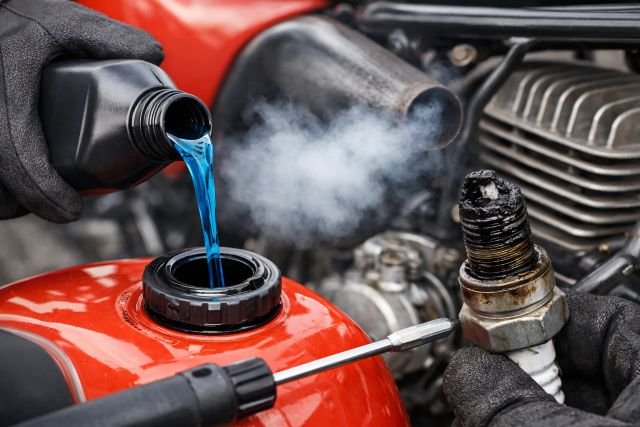
Then replace the spark plug rather than trying to “burn it clean.” Once a plug is heavily carboned or oil-wet, it may continue misfiring even after you correct the root cause, and those misfires keep the engine in a dirty cycle. A fresh plug gives you a clean baseline for diagnosis.
After that, check the simple airflow and enrichment issues that mimic “bad oil.” Make sure the choke is fully off after warm-up, confirm the air filter is clean and not saturated, and ensure the idle mixture and idle speed are set correctly. A rich idle circuit will often cause the worst smoke and plug fouling because the engine is coolest at idle and deposits accumulate fastest there.
If smoke remains heavy after the above changes, consider the exhaust system’s role. Many two-stroke mufflers or spark arrestors can collect residue and restrict flow. A restricted exhaust increases reversion and worsens combustion quality, which can increase smoke even when your mix is correct. Cleaning a spark arrestor screen, if your machine has one and the manufacturer permits service, can make an immediate difference.
Finally, if you have corrected oil category, ratio, measurement method, plug condition, and basic fueling, yet the engine still smokes excessively and idles rough, start considering mechanical issues. Crank seals, reed valve problems, and other sealing faults can cause abnormal mixture behavior that looks like an oil issue. At that point, continuing to “tune around it” can make things worse, so it’s smarter to diagnose leaks or compression problems.
Featured snippet answer: What is oil for two stroke?
Oil for two stroke is a lubricant formulated to mix or inject with gasoline in a two-stroke engine, lubricate internal components as it passes through, and then burn with the fuel, so it must balance wear protection with low-smoke, low-deposit combustion.
Common questions people search, answered clearly
Why is my two-stroke smoking even with the correct ratio?
It can happen if the oil category doesn’t match the engine’s requirement, if the engine is running rich on fuel due to choke or carb settings, or if the exhaust is saturated with old deposits. Certification and classification systems emphasize deposit control and smoke behavior because these outcomes are strongly tied to oil formulation and combustion conditions.
Will using more oil reduce engine wear?
Not necessarily, and it can create the opposite of what you want by increasing incomplete combustion and deposits that foul plugs and destabilize idle. In many engines, the manufacturer ratio is already the engineered “safe” point when combined with the correct oil type.
Should I use TC-W3 oil in a motorcycle or chainsaw?
Only if the manufacturer specifically allows it. TC-W3 is a marine-focused certification with requirements aimed at deposit control, miscibility, and ring sticking prevention in marine duty cycles. Motorcycles and many air-cooled tools often follow standards such as JASO M345 levels evaluated for smoke, detergency, and exhaust blocking in their own test framework.
How do I know if my plug is fouled from oil or from rich fueling?
Oil-heavy fouling often looks wet and shiny, while rich fueling often leaves dry, fluffy carbon, but real engines frequently show a mix. The more reliable clue is behavior: if the engine loads up at idle, smokes heavily at low rpm, and improves at higher rpm, you are usually dealing with low-speed combustion quality, which can be driven by over-oiling, rich idle mixture, or both.
Why this topic matters beyond performance
Two-stroke exhaust is a mix of burned and unburned fuel and oil, which is part of why small spark-ignition engines have been regulated heavily for emissions. The U.S. EPA has adopted standards for small engines and has specific rules for handheld applications such as trimmers, blowers, and chainsaws. While you’re not going to “tune your way into compliance,” choosing the correct oil category, keeping the ratio correct, and maintaining proper fueling can reduce the visible smoke and the deposit buildup that makes engines run worse over time.
Conclusion: oil for two stroke is the foundation of a clean-running engine
Excess smoke, fouled spark plugs, and rough idle are usually not mysteries in a two-stroke; they’re signals that the engine is not burning its lubricant-fuel system cleanly. The fix almost always starts with oil for two stroke selection and accuracy: match the oil category to what the manufacturer requires, measure the ratio precisely, replace a fouled plug to reset your baseline, and then correct idle fueling and airflow so the engine can burn the mixture cleanly. Standards like NMMA TC-W3 and classifications like JASO M345 exist because deposit control, smoke, and exhaust blocking are central to real-world two-stroke reliability.
If you tell me what machine you have, whether it’s pre-mix or oil-injection, and what ratio and oil you’re currently using, I can rewrite the troubleshooting section to match your exact setup and typical operating conditions.