

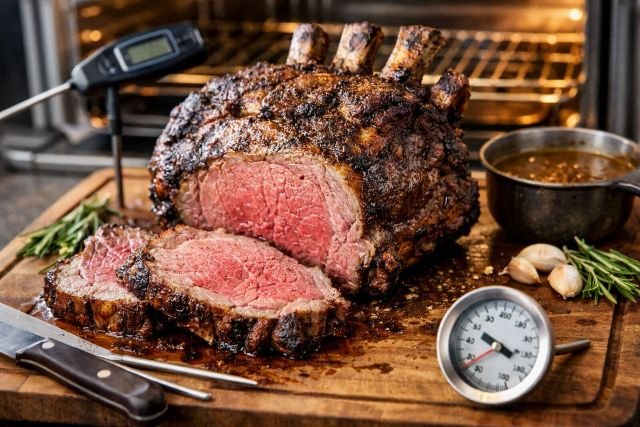
If you’re cooking rib of beef for a holiday, a Sunday roast, or a “just because” dinner, the oven can absolutely deliver steakhouse results — if you treat time as a rough guide and temperature as the real boss. The goal is simple: a deep, browned crust outside and a tender, evenly pink interior that stays juicy when sliced.
- What is rib of beef?
- Rib of beef oven temperature: the two best approaches
- Rib of beef cooking times: a reality check before you start
- Rib of beef oven times at 325°F
- Best internal temperatures for rib of beef
- Resting tips: how long should rib of beef rest?
- Step-by-step: classic rib of beef roast method
- Step-by-step: reverse sear rib of beef
- Should you bring rib of beef to room temperature first?
- Carving rib of beef without losing the juices
- Common rib of beef problems
- Food safety: the non-negotiables
- FAQs
- Conclusion: the simplest way to nail rib of beef every time
In this guide, you’ll get practical oven temps, realistic time ranges, and the resting strategy that prevents dry slices. We’ll also cover the two most reliable methods (classic roast vs. reverse sear), what internal temperatures actually mean, and why “resting” isn’t optional if you want that glossy, juicy cut.
What is rib of beef?
Rib of beef is a roast cut from the rib primal — the same neighborhood that gives you ribeye steaks. You’ll also see it labeled as standing rib roast or prime rib (and “prime” can be a style of roast, not necessarily USDA Prime grade). Bone-in versions tend to cook a bit more forgivingly and look dramatic on the table; boneless versions are easier to carve and sometimes cook a touch faster.
If you’re aiming for that “special occasion roast” experience — tender, rich, and buttery — rib of beef is the cut designed for it.
Rib of beef oven temperature: the two best approaches
There are two oven strategies that consistently work. Pick the one that matches your confidence level and your schedule.
Classic method: high-heat start, then roast at 325°F
This is the traditional approach: blast the outside to jump-start browning, then finish at a moderate oven temperature.
A widely used baseline is 325°F (163°C) after browning, with doneness determined by internal temperature. FoodSafety.gov even provides rib roast timing guidance at 325°F based on weight.
This method is great when you want something straightforward and you’re okay with a slightly wider gradient from edge to center (still delicious, just not as “edge-to-edge” even as reverse sear).
Reverse sear: low-and-slow first, then a final high-heat blast
Reverse sear is the method many modern recipe developers recommend for prime rib because it tends to cook more evenly and gives you more control near the finish line. Serious Eats, for example, highlights the low-and-slow roast followed by a high-heat finish for a juicy, evenly cooked prime rib.
This is my go-to recommendation if you’re nervous about overcooking: it’s more predictable, especially with a thermometer.
Rib of beef cooking times: a reality check before you start
Here’s the truth most recipes don’t emphasize enough: minutes-per-pound is only a starting point.
Two rib roasts with the same weight can cook differently depending on:
- shape (short and thick vs. long and narrow)
- bone-in vs. boneless
- starting temperature (fridge-cold vs. slightly warmed)
- oven accuracy and airflow (convection runs faster)
- how often you open the door
So, use time estimates to plan the day — but use a thermometer to decide when it’s done.
Rib of beef oven times at 325°F
FoodSafety.gov provides a roasting chart for beef rib roast at 325°F (163°C), including minutes-per-pound. It also states the minimum internal temperature is 145°F (63°C) with at least a 3-minute rest.
Timing guidance at 325°F (163°C)
| Rib of beef cut | Weight range | Oven temp | Time estimate |
|---|---|---|---|
| Rib roast, bone-in | 4–6 lb | 325°F | 23–25 min/lb |
| Rib roast, boneless | 4–6 lb | 325°F | 28–33 min/lb |
These numbers help you plan — especially for guests — but don’t treat them like a countdown timer. Start checking internal temperature early (at least 45–60 minutes before you “think” it’ll be done).
Best internal temperatures for rib of beef
If you remember one thing: you don’t cook rib of beef to the final temperature in the oven. You pull it early because of carryover cooking, then let it finish while resting.
Doneness targets (center temperature)
- Rare: pull at 120–125°F (49–52°C), finish ~125–130°F (52–54°C)
- Medium-rare: pull at 125–130°F (52–54°C), finish ~130–135°F (54–57°C)
- Medium: pull at 135–140°F (57–60°C), finish ~140–145°F (60–63°C)
For food-safety guidance on whole cuts of beef, U.S. agencies commonly cite 145°F (63°C) with a 3-minute rest as the safe minimum benchmark.
Practical note: Many people prefer prime rib at medium-rare. If you’re cooking for a mixed crowd, aim for medium-rare in the center and serve end slices (more done) to those who want it.
Resting tips: how long should rib of beef rest?
Resting is where good rib of beef becomes great rib of beef.
Why resting works
When the roast is piping hot, juices are more mobile. Slice immediately and those juices spill onto the board instead of staying in the meat. Resting also allows temperature to even out as heat travels inward—this is why the center rises a few degrees after you pull it (carryover cooking).
How long to rest (real-world guidance)
- Minimum: 20 minutes (small roasts)
- Ideal for most rib of beef roasts: 30–45 minutes
- Very large roasts: up to 60 minutes can still be great
Loosely tent with foil. Don’t wrap it tight — tight wrapping traps steam and softens your crust.
Step-by-step: classic rib of beef roast method
This is the “traditional” approach: sear first, then finish at 325°F.
1) Season early for better flavor
Salt is the upgrade that makes rib of beef taste like a steakhouse roast. If you can, salt it the night before and leave it uncovered in the fridge. This dries the surface slightly and improves browning.
2) Preheat and set up the pan
Place the roast on a rack in a roasting pan. Bone-in roasts can sit “rib-side down” like a built-in rack.
3) Brown, then roast at 325°F
Start hot for browning, then drop to 325°F (163°C) to finish. Timing guidance at 325°F is available from FoodSafety.gov.
4) Use a thermometer (this matters more than anything)
A probe thermometer you can leave in while it roasts is ideal. Insert into the thickest part, avoiding bone.
5) Pull early, then rest 30–45 minutes
Pull at your target “pull temperature,” rest, then carve.
Step-by-step: reverse sear rib of beef
If you want a more even interior and less guesswork, reverse sear is the move. Serious Eats is a well-known proponent of low-and-slow cooking for prime rib with a final high-heat blast.
1) Low-and-slow roast first
Roast at a low temperature (commonly around 200–275°F, depending on your preferred method) until the roast is close to your target pull temperature.
2) Rest, then finish hot
After the low roast, rest the meat, then blast at high heat to brown the exterior without pushing the center too far past target.
This approach shines because the roast climbs toward doneness gradually, giving you more control.
Should you bring rib of beef to room temperature first?
You’ll hear advice like “leave it out for 2–3 hours.” The benefit is often overstated.
Serious Eats tested tempering (bringing meat toward room temp) and found the core temperature rise was modest even after hours, with minimal impact on cooking time or final results — while also adding food-safety downsides if left too long.
A practical compromise: take it out while the oven preheats and you prep — no need to push it for hours.
Carving rib of beef without losing the juices
Carving is where people accidentally turn a perfect roast into a messy one.
Let it rest, then:
- Bone-in: slice along the bones to remove the rack in one piece (save for gnawing or serving separately), then slice the boneless portion into thick or thin slices.
- Boneless: slice across the grain into your preferred thickness.
Use a long slicing knife and smooth strokes. Sawing crushes the crust and squeezes juices out.
Common rib of beef problems
“My roast is overcooked.”
This usually comes from cooking to the final temperature in the oven, then resting (which pushes it even higher). Next time, pull earlier and trust carryover cooking.
“It’s browned outside but raw inside.”
Your oven temp was likely too high for too long, or the roast was very thick. Lower-and-slower methods (or reverse sear) solve this.
“The crust got soft.”
Tenting too tightly traps steam. Tent loosely, and consider a quick high-heat refresh right before serving (only if needed).
Food safety: the non-negotiables
Foodborne illness is more common than most people think — CDC estimates 48 million people in the U.S. get sick from foodborne illness each year.
For whole cuts of beef, U.S. guidance commonly points to 145°F (63°C) with a 3-minute rest as a safe minimum benchmark.
If you’re serving anyone pregnant, elderly, immunocompromised, or very young, consider cooking closer to that benchmark and discuss preferences openly.
FAQs
What oven temperature is best for rib of beef?
For a classic roast, 325°F (163°C) is a reliable finishing temperature, and it’s the baseline used in FoodSafety.gov timing guidance. For the most even doneness, use a low-temperature roast (reverse sear) and finish with a short high-heat blast.
How long do you cook rib of beef per pound?
At 325°F, FoodSafety.gov suggests 23–25 minutes per pound for a 4–6 lb bone-in rib roast and 28–33 minutes per pound for a 4–6 lb boneless rib roast. Always confirm with a thermometer because shape and oven performance change the result.
How long should rib of beef rest before carving?
Rest 30–45 minutes for most rib of beef roasts. Resting helps the temperature stabilize and keeps juices in the meat when sliced.
What internal temperature should rib of beef be for medium-rare?
For medium-rare, pull rib of beef around 125–130°F (52–54°C) and expect it to finish around 130–135°F (54–57°C) after resting.
What is the safe minimum internal temperature for beef roasts?
U.S. guidance commonly lists 145°F (63°C) with a 3-minute rest for whole cuts of beef.
Conclusion: the simplest way to nail rib of beef every time
If you want consistently great rib of beef, don’t chase the clock — chase the temperature. Use time-per-pound only to plan your meal, then let a thermometer tell you when to pull the roast. Choose classic roasting at 325°F for simplicity (using reputable timing guidance as a starting point) or use reverse sear for the most even, edge-to-edge doneness.
Finally, treat resting as part of cooking, not an afterthought. That 30–45 minute rest is where carryover finishes the center and your slices stay juicy on the plate — not on the cutting board.