

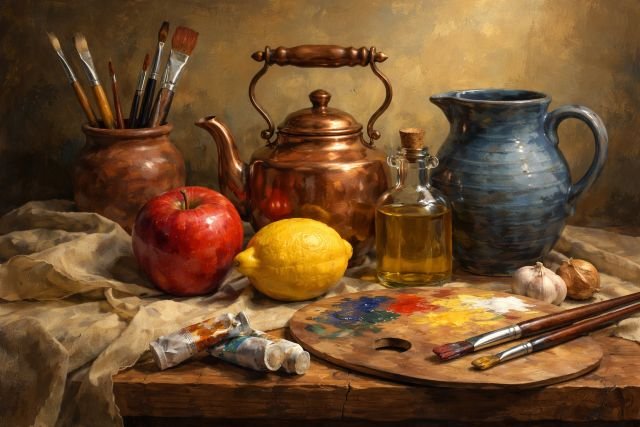
If you want to improve quickly, still life painting is one of the most efficient training grounds you can set up at home. Unlike landscapes or portraits, a still life doesn’t move, you control the lighting, and you can repeat the same setup until your eye and hand “click” on values, edges, and color. That repeatability is exactly what skill researchers call deliberate practice — focused repetition with feedback — which is strongly linked to performance gains across many domains.
- What counts as “fast improvement” in still life painting?
- Still life painting setup that makes every object easier
- Best objects for still life painting (in the order that levels you up)
- The “fast improvement” object ladder (table)
- Next-level objects that upgrade your realism
- High-impact “material study” objects (where most painters level up)
- The best object combinations (small setups that teach big skills)
- How to practice still life painting for faster gains
- Common questions
- Conclusion: Choose objects that teach, not objects that impress
Even better: observational art training has measurable cognitive and perceptual benefits. For example, research on observational drawing training has found changes associated with learning and brain function over time, supporting why “from life” practice can accelerate improvement.
What counts as “fast improvement” in still life painting?
Fast improvement usually means you’re building transferable fundamentals — the kind that immediately makes all your paintings better:
- Values (light and shadow organization)
- Proportions (drawing accuracy)
- Edges (soft vs. hard transitions)
- Color relationships (temperature, saturation, harmony)
- Material rendering (glass, metal, fabric)
Observational drawing/painting is closely tied to perception skills; studies commonly find relationships between perceptual ability and observational drawing skill.
So the best “objects” are the ones that force you to see clearly — without overwhelming you.
Still life painting setup that makes every object easier
Before choosing objects, make the setup work for you:
- Use one strong light source (a desk lamp is perfect).
- Keep the background simple (mid-gray or neutral cloth).
- Limit your palette early (2–4 colors + white is plenty).
- Paint larger shapes first; details last.
Museum and art-education resources regularly emphasize still life practice for learning observation, space, and texture.
Best objects for still life painting (in the order that levels you up)
1) White sphere (or a matte ball): the fastest value teacher
A white, matte sphere teaches you more about light in one sitting than most “pretty” setups teach in a week.
You’ll practice:
- The highlight, halftone, core shadow, reflected light, and cast shadow
- Soft edge handling
- Clean value grouping (light family vs shadow family)
Pro tip: Put the sphere on a plain surface and paint only 5 values at first. If it reads like a sphere, you’re winning.
2) Cube or box: proportions, perspective, and planes
Boxes are “honest.” If your perspective is off, the viewer feels it instantly.
You’ll practice:
- Measuring angles and relationships
- Plane changes (top vs side values)
- Hard edges vs slightly softened corners
Fast-improvement move: Paint a box in two values first — one for light planes, one for shadow planes — then refine.
3) Cylinder (mug, can, candle): turning form + ellipses
Cylinders teach you two critical things: ellipses and gradations.
You’ll practice:
- Ellipse symmetry and alignment
- Gradual transitions on curved form
- Rim thickness and perspective cues
Pick a matte cylinder first (paper cup). Save shiny metal cans for later.
The “fast improvement” object ladder (table)
| Object | Best skill trained | Why it improves you fast | Common mistake |
|---|---|---|---|
| White sphere | Values + edges | Clear light pattern, minimal detail | Overblending everything |
| Box/cube | Proportion + planes | Easy to measure, obvious planes | Inconsistent perspective |
| Matte cylinder | Ellipses + turning | Forces accurate curves | Ellipses too pointy/flat |
| Egg | Subtle value control | Tiny shifts teach sensitivity | Adding outlines |
| Apple/pear | Form + color | Simple shape, natural gradations | Too many midtones |
| Glass jar | Transparency + edges | Teaches value compression | Painting “lines” instead of shapes |
| Metal spoon | Reflections | Sharp value jumps train accuracy | Over-smoothing highlights |
| Drapery | Soft edges + rhythm | Great for composition and flow | Painting wrinkles individually |
Next-level objects that upgrade your realism
4) Egg (matte): subtle shifts = pro-level control
An egg is harder than a sphere because its curvature changes continuously.
You’ll practice:
- Gentle, controlled value transitions
- Edge hierarchy (where to sharpen vs soften)
- Small highlight placement
Fast plan: Do 3 eggs in 3 sessions. Keep the setup identical. You’ll see improvement immediately.
5) Simple fruit (apple, pear, lemon): form + color without chaos
Fruit is popular for a reason: it’s organic, forgiving, and teaches color temperature.
You’ll practice:
- Warm vs cool shifts in light and shadow
- Surface texture (waxy apple vs porous orange peel)
- Cast shadow color notes
Best pick for speed: A lemon (simple shape + strong light logic + easy color mixing).
6) Ceramic cup or bowl: edge control and believable thickness
Ceramics sit between matte and glossy: they have soft reflections but don’t become mirror chaos.
You’ll practice:
- Thickness of rims
- Subtle reflected light
- Controlled highlights (not pure white everywhere)
High-impact “material study” objects (where most painters level up)
7) Glass bottle or jar: transparency and value compression
Glass teaches you a crucial realism concept: transparent objects often have less value range than you think, but sharper edge moments.
You’ll practice:
- Painting what you see, not what you know a bottle “looks like”
- Hard, selective edges
- Distortion through glass
Shortcut: Start with tinted glass (green bottle). It’s easier to read than perfectly clear glass.
8) Metal spoon (or simple chrome object): reflections that train accuracy
Metal is the “truth serum” of painting. It forces you to get values right.
You’ll practice:
- High contrast control
- Sharp highlight shapes
- Reflected environment mapping (simplified)
If you want a grounded guide to how light behaves across different surfaces, realist painting resources stress studying light sources, reflected light, and surface behavior.
9) Fabric/drapery: composition, rhythm, and soft edges
Drapery teaches you to see big folds first, not wrinkles.
You’ll practice:
- Large value masses
- Soft edge transitions
- Compositional flow (folds guide the eye)
Fast improvement rule: Paint the shadow mass as one shape before separating folds.
The best object combinations (small setups that teach big skills)
Here are three compact setups that deliver maximum learning per hour:
- Sphere + box + cylinder
Best for: fundamentals, drawing, values, edges. - Fruit + ceramic bowl + cloth
Best for: color harmony, soft edges, composition. - Glass bottle + metal spoon + dark cloth
Best for: material realism, reflections, contrast control.
How to practice still life painting for faster gains
Use deliberate practice, not random repetition
Skill improvement accelerates when practice is targeted and feedback-driven (deliberate practice).
Try this structure:
- Session 1: 20–40 min value study (grayscale or limited palette)
- Session 2: same setup, focus on edges + drawing accuracy
- Session 3: color pass (still simplified—don’t chase details)
Limit complexity on purpose
If you’re improving fast, your paintings may look “simple” for a while — and that’s correct. Your eye is learning to organize.
Repeat the same setup
Repetition isn’t boring — it’s how your brain calibrates.
Research on observational drawing/painting highlights the importance of studying how people draw from observation and how training affects performance and perception.
Common questions
What is still life painting?
Still life painting is the practice of painting inanimate objects arranged in a controlled setup, usually from direct observation, to study light, form, color, and composition.
What are the easiest objects to paint for beginners?
The easiest objects are a matte sphere, a box, and a simple cylinder, because they clearly show how light behaves on basic forms and they’re easy to measure.
What objects improve shading the fastest?
A white sphere and an egg improve shading fastest because they force you to control smooth value transitions and understand core shadow vs cast shadow.
What should I paint to learn reflections?
Start with a ceramic mug (soft reflections), then move to a metal spoon (sharp reflections), and finally try glass + metal together once you can control contrast.
How many objects should be in a still life?
For fast improvement, use 1–3 objects. More objects usually adds composition complexity before fundamentals are stable.
Conclusion: Choose objects that teach, not objects that impress
If you want fast improvement, treat still life painting like a skill gym: pick objects that isolate one challenge at a time. Start with a sphere, box, and cylinder to master values, planes, and ellipses. Then level up with fruit for color, glass for transparency, metal for reflections, and drapery for edges and composition. Repeat setups on purpose, practice deliberately, and you’ll notice your accuracy and realism jump — not just in still lifes, but in everything you paint.