

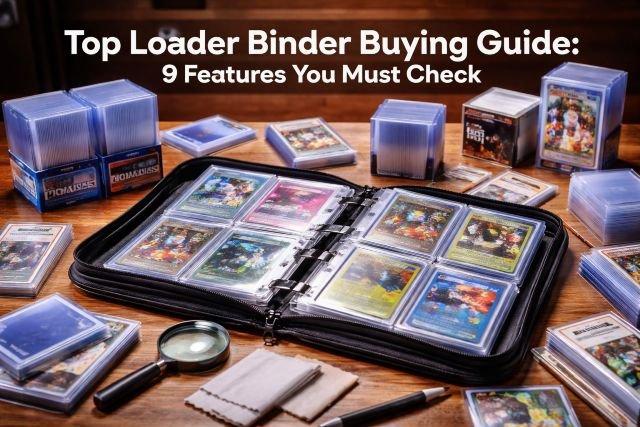
If you’ve ever pulled a favorite card out of storage and noticed a fresh corner ding, a surface scuff, or that faint “binder wave,” you already know why a top loader binder has become a go-to upgrade for modern collectors. In plain terms: it’s a binder designed to hold cards inside rigid top loaders (and usually a penny sleeve too), so you get binder-style organization without giving up hard-case protection.
- What is a top loader binder?
- Who should buy a top loader binder?
- Top Loader Binder: 9 features you must check before buying
- Bonus: features that separate “good” from “great”
- How to store a top loader binder for maximum protection
- Common questions (FAQ) for featured snippets
- Conclusion: choosing the right top loader binder
But not all toploader binders are built the same. Some “fit” top loaders the way a tight shoe fits — technically yes, practically annoying. Others use questionable plastics, weak seams, or rings that can press into pages. This guide walks you through 9 must-check features so you can buy once, protect better, and keep your collection looking sharp long-term.
What is a top loader binder?
A top loader binder is a trading card binder that uses specially sized pockets to store standard rigid top loaders (typically 3″ x 4″ holders). Instead of sliding a bare card into a flexible binder page, you sleeve the card (usually with a penny sleeve), place it into a top loader, and then store that top loader in the binder pocket.
Why it matters: rigid holders reduce bending, corner pressure, and surface contact — three of the most common ways cards get damaged during handling and storage.
Who should buy a top loader binder?
Top loader binders make the most sense if you’re any of the following:
- Value-focused collectors who want binder organization without “raw card risk.”
- Set builders who want to flip through pages safely at a card show or trade night.
- Players who carry higher-end staples and want better travel protection.
- Parents building collections with kids (top loaders add a huge safety buffer).
If you mostly store bulk, a standard binder or storage box may be enough. But if you care about condition consistency (especially edges/corners), a toploader binder is a practical sweet spot between a card box and a display case.
Top Loader Binder: 9 features you must check before buying
1) Pocket size and real-world fit (3″ x 4″ isn’t the whole story)
This is the #1 failure point: pockets that are technically sized for top loaders, but too tight (causing scuffs) or too loose (causing slide-out).
What to verify:
- The binder explicitly states it’s designed for standard toploaders and how many it holds.
- Pocket depth allows the top loader to sit fully inside without sticking out.
- The pocket opening doesn’t scrape the top loader edges during insertion.
A reliable product page should clearly describe pocket count and “toploader” compatibility, not just “trading card binder.” For example, Ultra PRO’s listing describes archival-safe pages with side-loading pockets intended to keep top loaders in place.
Practical tip: if you use thicker holders (premium or “thick” top loaders), check reviews for “fits thick top loaders” specifically.
2) Archival-safe, PVC-free page material (this is non-negotiable)
If you’re storing anything long-term, page plastic matters as much as pocket sizing. Preservation guidance for paper-based collections commonly recommends stable plastics like polyester (PET), polypropylene, or polyethylene, and warns against PVC/vinyl due to plasticizers and degradation risks.
What to look for in specs:
- “PVC-free,” “archival safe,” “acid-free,” “no plasticizers”
- Materials listed as polypropylene or polyester/PET
What to avoid:
- Vague “premium plastic” with no material disclosure
- “Vinyl” pages (often PVC)
If a brand won’t state materials clearly, treat it as a red flag — especially for high-value cards.
3) Side-loading pockets + a real retention system
Most toploader binders use side-loading pockets because gravity is not your friend in a heavy, rigid holder. Side loading reduces accidental slide-outs while flipping pages, especially if you’re moving quickly at a show.
But side-loading alone isn’t enough. A “retention system” can include:
- Tight, well-stitched pocket seams
- A flap design (less common with toploaders)
- A zipper closure that prevents pages from gapping
Many premium models pair side-loading pockets with a zipper closure to keep the whole binder compressed and dust-resistant.
Quick check: gently shake a closed binder (with a few empty toploaders inside) and see if anything creeps upward. You want “stays put,” not “slides around.”
4) Zipper quality (because the binder is only as secure as its closure)
If you travel with your binder, the zipper is a protection feature, not just a convenience. A zipper helps:
- Keep dust and debris out
- Prevent pages from separating in a bag
- Reduce the chance of a top loader slipping partway out of a pocket
What to look for:
- Smooth zipper track (no snags at corners)
- Covered zipper seam (reduces scratching the cover)
- Solid pull tab you can grab quickly
A zipper is especially valuable if you store the binder vertically on a shelf (spine-out), where gravity is constantly testing pocket retention.
5) Ringless design vs ring binder (ring marks are real)
Many collectors prefer ringless (fixed-page) binders for one simple reason: rings can create pressure points that bend pages, especially when stored full or misaligned. With top loaders adding bulk and weight, ring pressure becomes an even bigger risk.
A ringless binder typically offers:
- More uniform page support
- Less “page curl” near the spine
- Fewer pressure dents on pockets
If you do choose rings, make sure they’re:
- D-ring (generally lays flatter than O-ring)
- Wide-spine and not overstuffed
- Paired with pages designed to prevent ring contact
6) Page construction: stitched vs heat-sealed, plus seam strength
Top loaders are heavier than raw cards, so page durability matters more than in standard binders.
Common page builds:
- Heat-sealed/welded pockets: can be strong, but cheaper welds split over time
- Stitched reinforcement: often improves long-term durability, especially at pocket edges
What to test (even in a store):
- Pull lightly at the pocket corner seams — do they feel rigid and uniform?
- Flip pages quickly — do seams look stressed or wrinkled?
- Check for glue-like residue or uneven sealing
If pages feel “crinkly” or thin, assume long-term failure is more likely under the weight of rigid holders.
7) Cover rigidity and padding (your first line of impact protection)
A good toploader binder cover should do two jobs:
- protect from compression and impacts (bags, shelves, travel)
- keep the binder square so pages don’t torque and stress seams
Look for:
- Semi-rigid or rigid boards in the cover
- Padded or reinforced front/back
- A spine that doesn’t collapse when lifted one-handed
This matters most if you bring binders to shows or store them in stacked piles.
Scenario that exposes weak covers: you place the binder in a backpack with a laptop. A soft cover flexes; rigid top loaders become the “hard edges” that press into pages; seams weaken over time.
8) Capacity that matches your collection style (don’t overstuff)
Capacity looks great on a product listing, but overstuffing is the silent killer of binders — especially with rigid holders.
When evaluating capacity:
- Prefer a binder that is comfortable at 70–85% full
- Check if the zipper closes without bulging
- Ensure pages lie flat when filled (no “arched” pages)
For example, some 4-pocket toploader binders are designed around a specific capacity (e.g., 80 toploaders), which can help avoid the temptation to cram “just a few more.”
Practical rule: if you’re building a full set, consider buying two binders early rather than forcing one binder to do it all.
9) Clarity, texture, and “viewability” (yes, it affects how often you handle cards)
Collectors handle cards more when they can’t see them clearly. More handling = more risk.
What to look for:
- Clear, non-hazy pages that show surfaces well
- Pockets that don’t create heavy glare (some textures reduce reflections)
- Enough spacing so the top loader doesn’t press into the pocket face
If your pages distort the card view, you’ll constantly remove cards “just to check,” which defeats the point of protective storage.
Bonus: features that separate “good” from “great”
These aren’t part of the core nine, but they’re meaningful upgrades:
- Spine label slot (easy set identification)
- Dust-resistant edge finishing
- Lay-flat binding (pages stay open without forcing)
How to store a top loader binder for maximum protection
Even the best binder can’t fight bad storage conditions. Museums and archives focus on stability because temperature and humidity swings accelerate deterioration. National Archives guidance emphasizes that higher temperature and humidity increase deterioration rates, and that controlled environments are the most cost-effective way to prolong life.
Two practical home guidelines you can actually follow:
- Keep indoor relative humidity below 60% (EPA notes mold risk rises with humidity; ideally 30–50% RH).
- Smithsonian’s preservation guidance lists 30–50% RH as a recommended range for paper-based collections.
Also: limit light exposure. Light damage is cumulative, and conservation guidance often frames exposure as “light level × time.”
For most collectors, the takeaway is simple: don’t store binders in direct sunlight, and avoid leaving them open on display for long periods.
Common questions (FAQ) for featured snippets
What is a top loader binder used for?
A top loader binder is used to store trading cards inside rigid top loaders while keeping them organized in binder pages, reducing bending and handling damage compared to storing raw cards in standard binder pockets.
Do top loader binders prevent card damage?
They can significantly reduce common damage like corner dings, surface scuffs, and bending — especially when cards are sleeved and kept in stable, PVC-free materials. The binder still needs quality pockets, strong seams, and good storage conditions to be effective.
Should I choose a zipper top loader binder?
If you travel with your cards or store binders vertically, a zipper binder is usually the safer choice because it helps keep pages compressed and reduces the chance of top loaders shifting.
Are ring binders safe for top loaders?
They can be, but ring pressure and overstuffing can cause page warping or pressure marks. Many collectors prefer ringless designs for heavier setups like top loaders.
What materials are best for binder pages?
Archival guidance commonly recommends stable plastics like polyester (PET), polypropylene, or polyethylene, and warns against PVC/vinyl for long-term storage.
Conclusion: choosing the right top loader binder
A top loader binder is one of the most practical upgrades you can make if you care about condition, organization, and safe handling. Focus on the fundamentals: true toploader fit, PVC-free archival materials, side-loading pockets, strong seams, a quality zipper, and sane capacity. Then back it up with smart storage — stable humidity and minimal light exposure go a long way toward keeping cardboard (and inks/finishes) looking the way you bought them.
If you want, tell me what you collect (Pokémon, sports, MTG, One Piece, etc.), whether you use standard or thick top loaders, and your target capacity — and I’ll recommend an ideal binder “spec” (and what to avoid) based on that setup.